Vĩnh Long unlocks billion dollar potential for coconut exports
Vĩnh Long unlocks billion dollar potential for coconut exports
Vĩnh Long Province is rapidly positioning itself as Việt Nam’s most promising hub for coconut export growth, capitalising on outstanding natural conditions and an expanding processing industry to move towards a billion dollar breakthrough.
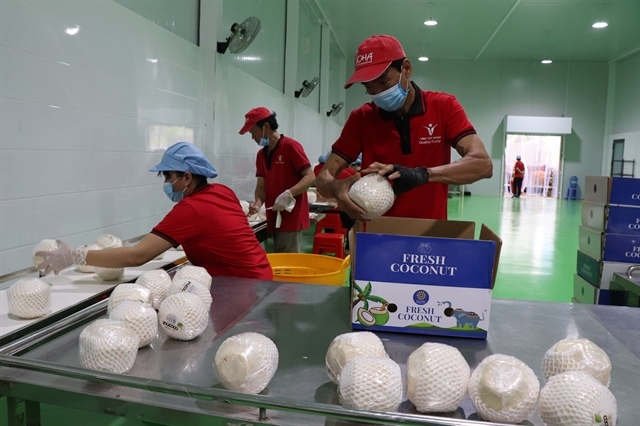
Workers package fresh coconuts for export at a processing facility in Vĩnh Long Province. VNA/VNS Photo |
As plant-based products surge worldwide, a coconut powerhouse is taking shape in Việt Nam’s Mekong Delta. Anchored by Vĩnh Long’s vast groves and deep-processing drive, the country’s coconut industry is eyeing a new billion-dollar frontier.
In 2025, the province’s coconut export value is expected to exceed US$500 million, underscoring its status as the nation’s leading “Coconut Capital”.
With nearly 120,000 hectares of coconut – equivalent to about 65 per cent of national coconut cultivation – the enlarged province of Vĩnh Long (which now also includes the former provinces of Trà Vinh and Bến Tre) commands a raw-material base unmatched by most global coconut producing regions.
Although Việt Nam accounts for only around two per cent of global coconut-growing area, its value-added ratio is almost three times the world average, thanks to product diversification and deep processing. This advantage is particularly evident in Vĩnh Long.
According to Châu Hữu Trị, director of the Agricultural Extension Centre under the provincial Department of Agriculture and Environment (DAE), coconuts grown between the Tiền and Hậu rivers absorb nutrient-rich alluvium, producing fruits with abundant sweet water and thick flesh – attributes highly sought after by international buyers.
Yet structural challenges persist. Most farmers cultivate only around 0.4 hectare on average, leaving production fragmented and limiting investments in improved varieties and farming techniques.
Although the province hosts 183 coconut-processing enterprises, linkages between the State, scientists, businesses and farmers remain relatively loose, leaving the value chain exposed to fluctuations.
Organic production – vital for markets such as the US, European Union and Northeast Asia – also faces bottlenecks due to inconsistent national frameworks on certification, traceability and pest control.
Processing power
Despite these constraints, Vĩnh Long’s long-term export potential remains exceptionally strong. Việt Nam already masters about 90 per cent of its coconut-processing technologies, enabling nearly every part of the coconut tree to be transformed into high-value products, according to Trị.
As global demand rises for plant-based beverages, natural ingredients and sustainable materials, opportunities for the province to strengthen its role in global value chains continue to expand.
A key contributor to this momentum is Trà Bắc Joint Stock Company (Trabaco), one of the province’s largest deep-processing firms. Exporting to more than 30 countries, the company produces activated carbon, desiccated coconut, frozen coconut milk and a range of coir-based products.
CEO Huỳnh Khắc Nhu said investment into Vĩnh Long’s coconut sector – both domestic and foreign – was accelerating, with new projects valued between VNĐ500 billion and 1 trillion (US$20 million to 40 million).
However, raw material supply remains insufficient, forcing factories to source coconuts from neighbouring provinces, according to Nhu. Only around two per cent of local farmers own more than five hectares, making it difficult to establish uniform cultivation zones that meet international standards.
Nhu suggested prioritising the rehabilitation of mixed coconut gardens, expanding industrial-grade varieties, improving traceability systems and modernising harvesting and transport chains.
With an economic lifespan of more than 60 years, coconut trees can support long-term value chains if production is organised methodically.
Market imbalance
This view is echoed by Phạm Hồng Dương, deputy general director of Betrimex Import Export Joint Stock Company, who noted that Việt Nam produces roughly 1.7 billion coconuts annually, ranking sixth globally and standing as the world’s leading exporter of canned coconut water.
The industry earned $1.05 billion in 2024, but with more advanced deep processing, this figure could rise to $1.8 billion each year.
Yet farmers often sell fresh aromatic coconuts for about VNĐ30,000 ($1.20) per dozen, while factories pay up to VNĐ15,000 ($0.60) for a single industrial-grade fruit.
This imbalance is a direct result of insufficient industrial varieties suitable for deep processing.
Vĩnh Long currently has more than 30,000ha of internationally certified organic coconut, but safeguarding this advantage requires strict biological pest management.
Dương warned that even one month of pest outbreak could reduce output for an entire year, stressing the need to prioritise sustainable biological crop protection.
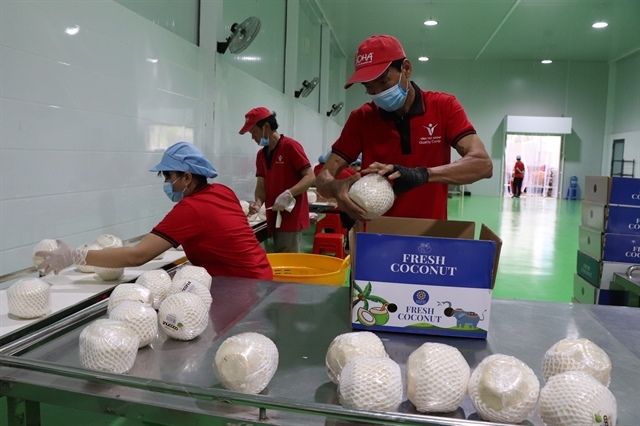
Workers package fresh coconuts for export at a processing facility in Vĩnh Long Province. VNA/VNS Photo |
Building resilience
According to Văn Hữu Huệ, deputy director of the DAE, Vĩnh Long is pursuing a comprehensive strategy to strengthen climate-adaptive cultivation, enhance deep-processing capacity and tighten value-chain cohesion.
The province is expanding internationally certified organic zones, selecting drought- and salt-tolerant varieties, adopting water-saving irrigation systems and promoting low-emission farming techniques.
Biological control agents such as parasitic wasps and earwigs are being encouraged to protect coconut farms against pests.
Beyond agriculture, Vĩnh Long also aims to link coconut production with tourism, promote local craft villages and develop OCOP products — especially those made from the province’s well-known sáp coconut variety.
On the processing side, Việt Nam still lags behind the Philippines and Indonesia in advanced technologies, particularly in preserving drinking coconuts.
To meet rising quality standards in major markets, the province plans to introduce new incentives to attract investment into modern deep-processing technologies that fully use coconut water, flesh, husk, shell, and trunk.
Digital transformation – including blockchain-based traceability and automated quality monitoring - will be prioritised.
To strengthen the value chain, Vĩnh Long will support the establishment of modern agricultural cooperatives, intensify international trade promotion and build a strong global presence for the “Vĩnh Long Coconut” brand. International cooperation will also be expanded to access high-end technologies and premium markets.
In support of long-term development, the agricultural sector has proposed a project to analyse soil characteristics, build a detailed coconut soil map using ArcGIS and develop a comprehensive data system for planning from 2026 to 2030, with a vision to 2050.
With outstanding natural advantages, expanding processing capacity and increasing international demand, Vĩnh Long is well positioned to accelerate Việt Nam’s ascent toward a new billion-dollar frontier in coconut exports.
- 08:43 27/12/2025