Coffee industry to meet new EUDR standards
Coffee industry to meet new EUDR standards
Under EUDR, commodities such as coffee, cocoa, rubber, timber, palm oil, soy and beef must demonstrate legal origin and no link to deforestation or forest degradation after December 31 2020.
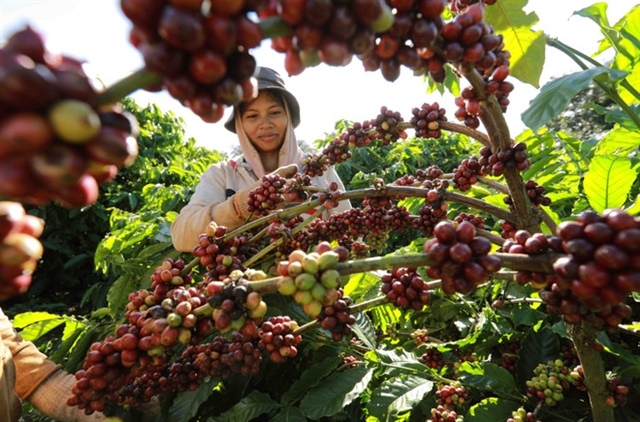
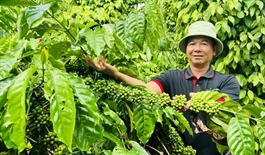
A farmer during coffee harvest season in Đắk Lắk Province. — VNA/VNS Photo Vũ Sinh |
Việt Nam's coffee industry is entering a decisive test of environmental responsibility and supply-chain transparency as the European Union Deforestation Regulation (EUDR) begins to be enforced.
The regulation, effective from mid-2023, sets strict conditions for agricultural and forestry goods entering the bloc. Industry specialists say it could become an opportunity to reorganise a strategic sector, encourage sustainable production and raise export value.
Under EUDR, commodities such as coffee, cocoa, rubber, timber, palm oil, soy and beef must demonstrate legal origin and no link to deforestation or forest degradation after December 31, 2020. Exporters must provide precise geolocation data for each production plot. For coffee, one of Việt Nam’s major earners in the EU, the regulation has become an entry ticket to a demanding but highly valuable market.
Coffee, once assessed mainly on quality, volume and price, must now be traceable from farm to cup. This requires full transparency throughout cultivation, procurement, processing and export.
Việt Nam has more than 600,000 coffee-growing households farming nearly 800,000ha, largely in the Central Highlands. The dominance of small, scattered plots and the proximity of many plantations to natural forests present major challenges for traceability yet the shift is also pushing the industry towards more modern and environmentally responsible management.
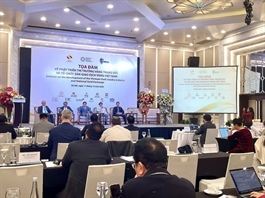
At a recent dialogue on Việt Nam–EU cooperation in EUDR preparation, Nguyễn Đỗ Anh Tuấn, Director of the Department of International Cooperation under the Ministry of Agriculture and Environment, said compliance depends on linking three core datasets: land-use maps, forest-status maps and land-user information. Together they will form a unified plantation database that supports EUDR requirements and long-term sustainable agriculture.
Several Central Highlands provinces are already piloting 'deforestation-free coffee models, assigning GPS coordinates and polygon maps to each plot and uploading them to mobile-based traceability systems. Experts from the German Agency for International Cooperation (GIZ) say scaling up this approach could make Việt Nam a regional leader in transparent agricultural supply chains.
Since late 2023, the ministry, industry associations, businesses and international partners have coordinated on standardising procedures and data requirements. Exporters must now declare polygon-mapped plantation coordinates and a traceability system covering the entire supply chain. The exporting company holds final responsibility for compliance.
Anh Tuấn described EUDR as the 'IUU of forests,' saying it shares the same objective as the EU’s illegal, unreported and unregulated fishing regulations, steering global production towards sustainability.
The country has tested low-cost data-collection methods and strengthened monitoring of areas bordering forests to prevent encroachment. Coffee has been identified as a priority sector with early investment in plantation databases, satellite-based mapping and end-to-end traceability. As a result, the EU has classified Việt Nam as a low-risk country with an inspection rate of just one per cent, far lower than competitors such as Brazil and Indonesia.
However, adaptation remains difficult. Smallholder farming dominates the industry while land-use maps are incomplete and boundaries between agricultural and forest land often overlap. Many farmers are not familiar with GPS tools, digital logs or mobile applications used in plantation management. Experts warn that without stronger sourcing systems and tighter control over raw-material zones, major exporters may struggle to meet EU requirements.
From the EU side, Cyril Loisel, First Secretary for Climate, Environment and Social Policy at the EU Delegation to Việt Nam, said the bloc is providing extensive technical support, particularly for coffee. Several projects with the Forestry Department and enterprises are building traceability platforms and improving enforcement capacity.
GIZ is implementing support programmes in Sơn La, Thái Nguyên, Đắk Lắk and Lâm Đồng, training farmers and cooperatives in geospatial mapping, digital plantation management and local EUDR planning. Oemar Idoe, head of GIZ’s agriculture, environment and climate projects, said the goal is to help Việt Nam comply while strengthening competitiveness and positioning Vietnamese coffee as a model of green supply chains in Asia.
EUDR is driving Việt Nam’s shift from volume-based exports to higher-value, environmentally responsible production. As data on forests, plantation areas and producers becomes more transparent, Vietnamese coffee will compete not only on taste but also on sustainability.
Trương Tất Đơ from the Forestry Department noted that Việt Nam halted logging in natural forests in 2014 and ended it completely in 2016. The VPA/FLEGT agreement with the EU and the Glasgow Leaders’ Declaration reinforce the country’s commitment to sustainable forest management. A national forestry data platform under development will allow public access to deforestation-risk information classified into high, medium and low levels.
For businesses, EUDR is seen as an essential filter for sustainable development. Cao Xuân Thanh, Chief of Office at the Việt Nam Timber and Forest Products Association, said the regulation is a matter of survival for the wood industry, where small-scale plantations, incomplete digital maps and difficulties verifying coordinates for imported timber remain significant obstacles.
Despite these challenges, support from EU partners, GIZ and IDH together with strong coordination among ministries and local authorities, is helping the coffee sector navigate this new green standard and consolidate its position in the global sustainable supply chain.
- 11:04 19/12/2025