ST25: 20-year journey to be hailed as world’s finest rice
ST25: 20-year journey to be hailed as world’s finest rice
What began as a long-standing ambition to restore the value of Việt Nam’s traditional fragrant rice has, after two decades of perseverance, brought the grain to the global stage.
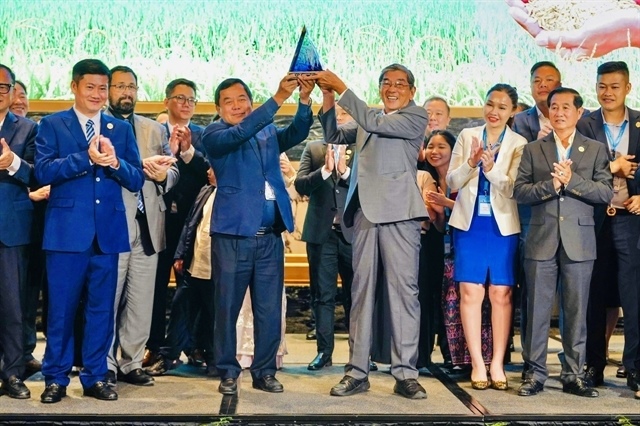
Labour Hero Hồ Quang Cua, who created the ST25 rice variety, receives a commemorative award at the 2025 World’s Best Rice contest. — VNA/VNS Photo |
What began as a long-standing ambition to restore the value of Việt Nam’s traditional fragrant rice has, after two decades of perseverance, brought the grain to the global stage.
Labour Hero Hồ Quang Cua and his colleagues spent 20 years inventing ST25, a strain that has repeatedly been acknowledged as the world’s best, marking a major scientific and agricultural milestone for the nation.
Before the widespread adoption of intensive farming and high-yield varieties, the Mekong Delta was well known for aromatic rice types such as Châu Hạng Vỏ and Trắng Tép, once closely associated with Tây Đô, the former Cần Thơ City.
However, the push to maximise productivity during the period of intensification gradually sidelined these premium varieties, replacing them with high-yield strains that prioritised output over quality.
Cua was fixated with the idea of reviving the high-quality fragrant strains since his student years.
After observing renowned rice varieties in Europe cultivated on soils similar to those of the Mekong Delta, he returned to the former Sóc Trăng Province circa 1980 and began collecting and testing aromatic strains in local conditions.
A decisive shift came in the 1990s, when he undertook detailed studies of Thai fragrant rice.
By the late 1990s analysis showed that the ST3 variety he developed possessed quality characteristics comparable to Thailand’s Khao Dawk Mali, including grain shape, translucency, natural softness, mild sweetness, and a jasmine-like aroma, and closely aligned physical, chemical and sensory indicators.
In 2001 ST3 was introduced to farmers and quickly gained recognition for its distinctive quality.
This success laid the groundwork for a far more ambitious breeding programme, as Cua and his team embarked on a challenging 20-year process that ultimately resulted in the development of ST25.
According to Cua, rice quality is determined by a complex set of criteria, ranging from geometric and physical properties to chemical composition, biological traits and sensory evaluation by consumers.
Despite extensive research aimed at improving adaptability, shortening growth duration and maintaining high yields, ST25 initially struggled to gain recognition in domestic competitions.
The breakthrough came in 2019, when it surpassed Thai rice to win first prize at the World’s Best Rice contest, drawing widespread attention in both domestic and international markets.
That same year it was recognised as a national rice variety by the Ministry of Agriculture and Rural Development, now the Ministry of Agriculture and Environment.
ST25 continued to confirm its standing by reclaiming the global top prize in 2023 and 2025.
Cua was later awarded the Hồ Chí Minh Prize for Science and Technology in recognition of his contribution.
Support from local authorities, farmers and a market increasingly focused on quality has enabled the research team to further refine the variety.
Six years after its official release, ST25 has an entrenched position in both domestic and export markets.
The variety is the result of a complex cross between ST3 and Tiến Vua rice, creating a product regarded as distinct from any other rice currently available anywhere.
ST25 demonstrates wide adaptability, allowing it to be cultivated across different ecological zones, from coastal to inland areas.
Notably, it does not deliver optimal quality when grown on overly fertile land, and performs best in coastal and brackish environments such as Sóc Trăng and the U Minh areas, particularly in rice–shrimp farming eco-systems.
The rice–shrimp model not only enhances grain quality but also helps adapt to climate change, reduce greenhouse gas emissions and improve economic efficiency compared with conventional freshwater rice cultivation.
Some 100,000 hectares of rice–shrimp land in the Mekong Delta planted with ST25 achieve average fresh paddy yields of nearly seven tonnes per hectare, making it among the highest yielding in these production systems.
ST25 is currently grown on 200,000 hectares nationwide, leaving considerable room for expansion.
With its paddy prices at around VNĐ3,000 per kilogram higher than ordinary rice, it offers significant income potential for farmers while contributing to the long-term sustainability of the rice sector.
- 13:31 25/12/2025