Rising live hog prices enhance year-end profits for enterprises
Rising live hog prices enhance year-end profits for enterprises
Live hog prices in Việt Nam are rebounding sharply as supply tightens, boosting livestock firms’ profits ahead of Tết and raising expectations of further gains in early 2026.
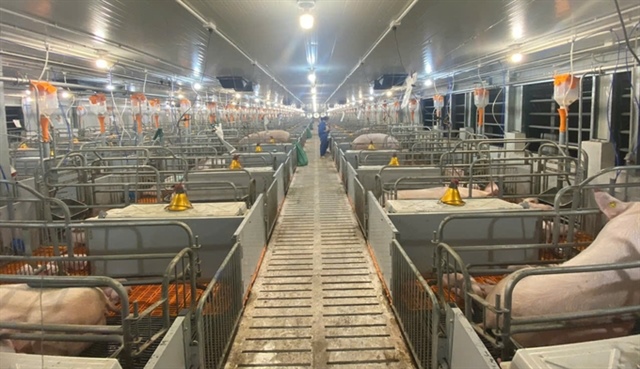
A pig farm of Vietnam Agriculture JSC (BAF). — Photo baf.vn |
As the year draws to a close, the recovery of live hog prices in Việt Nam to between VNĐ59,000 and 61,000 per kg (US$2.24-2.32) is significantly enhancing profit margins for numerous enterprises in the livestock sector.
This resurgence comes amid a backdrop of diminished supply, allowing a more substantial gap between production costs and selling prices.
Following a sharp decline in live hog prices at the end of November, primarily due to panic selling by small-scale farmers anxious about the spread of African Swine Fever (ASF), the market has seen prices rebound by more than 20 per cent from their lowest point.
Analysts from DSC Securities have noted that this trend is consistent with historical price cycles where live hog prices typically experience a rebound after significant downturns attributed to disease outbreaks.
The potential for further price increases remains optimistic, with projections suggesting prices could approach the previous peak of VNĐ65,000-75,000 per kg, a level seen in the second quarter of this year when the market was still adjusting to the effects of ASF.
This price recovery is further supported by decreasing supply forecasts. Following the substantial impact of ASF, it is expected that the number of pigs on the market will decrease significantly, coupled with a recovery time of four to six months for the breeding cycle to stabilise.
Recent floods that have affected various regions have also exacerbated supply constraints just as demand for pork surges in the lead-up to the Tết (Lunar New Year) holiday.
Companies specialising in pig farming stand to benefit greatly with their production costs remaining low amid rising selling prices.
Vietnam Agriculture JSC (BAF) is poised to gain directly from the increasing prices as it operates under a closed-loop model with large farms in Nghệ An and Tây Ninh provinces.
This setup allows BAF to control its supply chain from breeding to raising, significantly reducing the risks associated with disease impacts.
In the third quarter, BAF faced challenges due to natural disasters that inflated operational costs.
However, industry experts assert these setbacks are temporary and as live hog prices rebound toward Tết, an improvement in BAF's financial performance is anticipated.
DSC Securities predicts that the favourable price-cost dynamic will likely persist into the second quarter of 2026, given the ongoing supply reduction in the pig farming sector and potential support from partners in managing raw material costs.
Meanwhile, executives from Hoa Phat Agriculture (HPA) have reported an average production cost of around VNĐ42,000 per kg with market prices reaching VNĐ59,000-61,000.
The company's average selling price stands at approximately VNĐ63,000 per kg, according to vice chairman of the Board of Directors Nguyễn Thị Thanh Vân.
Nguyễn Việt Thắng, chairman of the Board of Directors, forecasts that the final prices may exceed initial profit targets, estimating profits of more than VNĐ1.5 trillion in the coming months.
As market conditions evolve, experts suggest that live hog prices and retail meat prices are likely to continue their upward trajectory in the upcoming weeks, driven largely by seasonal demand and the impacts of recent weather-related challenges.
With expectations of limited supply and increasing consumer demand, predictions indicate that live hog prices could surpass VNĐ60,000 per kg, potentially reaching VNĐ70,000 by the time the Tết holiday arrives, Nguyễn Văn Trọng, former deputy director of the Livestock Breeding General Department, told media.
He added that next year, the price of live pigs will depend on whether the sow herd can be maintained at 3 million.
If the sow population is sustained, the supply of breeding stock will remain stable, ensuring that the supply of pork meets market demand.
- 07:43 23/12/2025