Vietnamese cement industry sees bright outlook for Q4
Vietnamese cement industry sees bright outlook for Q4
The recovery has been supported by several factors, including the completion of maintenance work at many plants in the third quarter and stable energy costs.
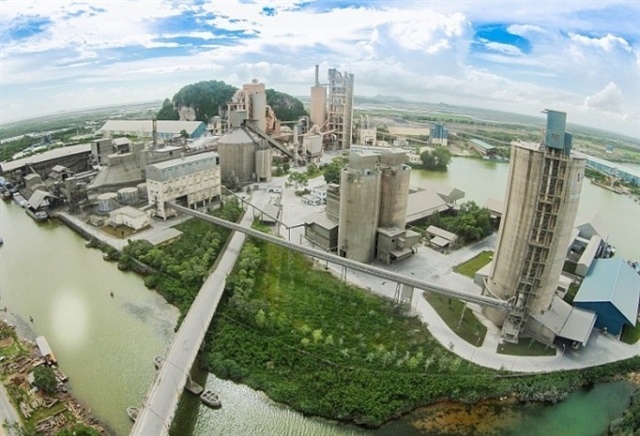
A Vicem Ha Tien production plant. — Photo vicemhatien.com.vn |
The domestic cement industry is experiencing a significant recovery as companies successfully navigate past major declines in consumption. Recent data shows a rebound in demand, driven by heightened construction activities and increased infrastructure investment nationwide.
In November, cement production saw substantial improvement, with output surpassing 10.5 million tonnes, an increase of about 8 per cent compared to October and a significant recovery from previous months.
According to the Vietnam Cement Association, the total volume produced over the first 11 months reached over 105 million tonnes, up 10 per cent year-on-year.
The recovery has been supported by several factors, including the completion of maintenance work at many plants in the third quarter and stable energy costs.
Domestic cement manufacturers have ramped up their operational ratios to meet rising demands from both local and export markets.
As the end of the year approaches, sales activities have entered a heightened phase, with November's consumption rising by 12 per cent compared to the previous month to reach 7.5 million tonnes. The domestic market continues to dominate, accounting for about 68 per cent of the overall cement consumption.
Price adjustments were also observed, particularly in the northern regions, where prices increased by an average of VNĐ100,000 per tonne in November.
Major producers such as Vicem But Son, Vicem Hai Phong and others raised their selling prices from VNĐ100,000 to VNĐ140,000 per tonne. This increase aimed to offset high input material costs and the tightening supply, ensuring steady production and product quality.
The recovery in production and consumption is significant. Although cement production capacity has remained above 100 million tonnes for years, consumption has recently experienced downturns.
Following a record-breaking year in 2021, when consumption reached 108 million tonnes, including over 45 million tonnes in exports, subsequent years saw substantial declines.
In 2022, total consumption dropped to about 93.3 million tonnes, with domestic consumption around 62.7 million tonnes and exports plummeting by 33 per cent. The decline continued in 2023, with total consumption estimated at 87.8 million tonnes.
By 2024, overall consumption rebounded slightly to 93 million tonnes, but remained below previous records.
Infrastructure boosts demand
Since November, several major transportation projects have entered the final stages or started accelerating construction, greatly increasing the demand for cement and building materials compared to earlier months.
A representative from Vicem Ha Tien noted that the construction market is heating up, with public investment projects accelerating and new residential projects underway, creating opportunities for increased cement sales.
On the export front, cement and clinker shipments are also improving. In November, exports maintained a level of 3.6 million tonnes, elevating the total exports for the year to 33.4 million tonnes, valued at approximately US$1.2 billion – an increase of 21.7 per cent in volume and 17.6 per cent in value compared to the same period last year.
With a consistent export performance of around 3.5 million tonnes monthly, the cement sector is expected to reach an annual export total of around 37 million tonnes, worth about $1.36 billion.
Despite the increasing demand for cement in the last quarter of 2025 compared to previous quarters and the same period last year, the overall industry remains in a state of surplus relative to demand, posing challenges for future prospects.
The need for balanced regulation among production, consumption and supply structure remains critical.
With the current growth trajectory in both domestic and export markets, the total consumption of cement and clinker for 2025 is likely to surpass the 100 million-tonne mark.
This is viewed as an encouraging signal, laying the groundwork for the cement industry to strengthen production capacities, expand its market and achieve a more robust recovery in the coming year.
- 07:55 26/12/2025