Cambodia’s public debt reaches over $12 billion by end of Q3
Cambodia’s public debt reaches over $12 billion by end of Q3
Kingdom’s public debt situation remains ‘manageable’, ‘sustainable’, and at ‘low risk’, reflecting the government’s strict adherence to responsible borrowing practices, says Pornmoniroth.
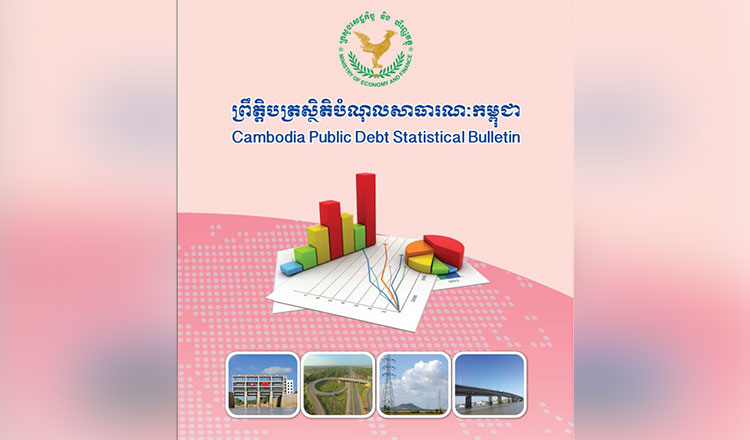
The Royal Government of Cambodia’s total public debt stock reached $12.62 billion by the end of the third quarter of 2025, according to the latest Cambodia Public Debt Statistical Bulletin released by the Ministry of Economy and Finance yesterday.
Of the total debt, $12.49 billion—equivalent to 99 percent—is public external debt, sourced 60 percent from bilateral development partners and 40 percent from multilateral partners. Public domestic debt accounts for the remaining one percent, or $133.49 million.
The composition of the overall public debt is diversified across major currencies, including 46 percent in USD, 18 percent in Special Drawing Rights (SDR), 11 percent in JPY, 10 percent in CNY, 9 percent in EUR, and 6 percent in local and other currencies.
During the third quarter, the government signed $100 million in new concessional loans, equivalent to SDR 72.86 million. From January to September 2025, total new loan commitments with development partners reached $297.77 million, or SDR 216.96 million—representing 11 percent of the SDR 2 billion borrowing ceiling permitted by law.
Of these new commitments, 17 percent were signed with bilateral partners and 83 percent with multilateral institutions. The volume of loans signed in the first three quarters marked a sharp decline of about 72 percent compared to the same period in 2024.
Despite the lower volume, all newly signed loans remained highly concessional, with an average grant element of approximately 39.9 percent. The government stated that these loans aim to finance priority public investment projects that support long-term sustainable economic growth and strengthen national productivity.
In terms of disbursement, Cambodia drew down $206.41 million from existing concessional loans during Q3 2025. Cumulatively, disbursement reached $592.14 million in the first nine months of the year, with 49 percent sourced from bilateral partners and 51 percent from multilateral partners.
Infrastructure development accounted for 87 percent of the disbursed amount, while the remaining 13 percent supported other priority sectors. Disbursement levels from January to September fell by roughly 31 percent compared to the same period last year.
Debt servicing also saw notable activity. The government paid $266.11 million in debt service during Q3 alone, bringing total payments in the first three quarters of 2025 to $563.07 million. Of this amount, $525.07 million was allocated to external public debt—including $421.22 million in principal and $103.86 million in interest and fees—while $37.98 million covered domestic public debt obligations. Debt service payments rose by about 21 percent year-on-year, reflecting the maturing debt structure and cyclical payment schedules.
The Ministry of Economy and Finance reported that the preliminary findings of the Estimated Debt Sustainability Analysis for Q3 2025 confirm that Cambodia’s public debt remains “sustainable” and at “low risk” of debt distress. Key debt indicators continue to fall comfortably below international thresholds.
The present value of total public debt-to-GDP stands at 18.8 percent—well under the 55 percent ceiling—while the present value of public and publicly guaranteed external debt-to-GDP is at 18.4 percent, compared to the 40 percent benchmark.
The report underscores the government’s continued commitment to prudent debt management amid fluctuating global financial conditions and persistent regional economic uncertainties.
Aun Pornmoniroth, Deputy Prime Minister and Minister of Economy and Finance, said in the report that Cambodia’s public debt situation remains “manageable”, “sustainable”, and at “low risk”, reflecting the government’s strict adherence to responsible borrowing practices.
He explained that maintaining this stability depends on a strong public debt management system built on a clear legal framework, detailed policies and procedures, capable institutions, skilled human resources, and modern information technology systems for analysing and monitoring debt risks.
The Minister said the Royal Government has been rigorously implementing its Public Debt Management Strategy, guided by key principles designed to ensure fiscal discipline and effective public investment. These include borrowing only within the limits of what the economy can afford, accepting loans with concessional or preferential terms, and directing borrowing strictly towards priority sectors that boost sustainable economic growth and national productivity.
He added that transparency, accountability, and efficiency remain central to how all loan funds are managed, particularly for infrastructure projects that must meet high standards and support Cambodia’s long-term development.
He also noted that shifting the national accounts to the 2014 base year has increased Cambodia’s borrowing capacity, allowing greater investment in priority sectors and reinforcing economic diversification as the Kingdom moves towards its 2030 and 2050 development goals.
Cambodia’s public debt remains under control, with borrowing largely directed towards productive investments, according to economist Darin Duch.
“The public debt is still controllable, as the debt-to-GDP ratio remains well below 40 percent, significantly lower than the international thresholds for emerging economies,” Darin told Khmer Times. “This reflects disciplined borrowing, focused primarily on loans with low interest rates and long-term maturities.”
He highlighted that Cambodia’s debt strategy prioritises infrastructure, connectivity, energy, and human capital, which supports long-term sustainability. “Borrowing for productive investment is what keeps the debt manageable over time,” he said.
Darin also noted potential external risks, including global interest rate volatility, slower growth in major economies such as the US, EU, and China, climate-related shocks affecting export revenues, and geopolitical tensions.
“Cambodia is being strategic about its borrowing, ensuring only high-impact projects move forward. This approach also shows that the country retains considerable fiscal space,” he added.
Analysts say the government’s careful approach to debt management has helped maintain investor confidence while supporting the country’s development priorities.
- 08:55 10/12/2025