

Vietnam approves securities regulatory sandbox from March 2027
Vietnam approves securities regulatory sandbox from March 2027
The amended Law on Securities will introduce a regulatory sandbox for financial innovation while reinforcing investor protection, operational safety, and transparency across the securities market.
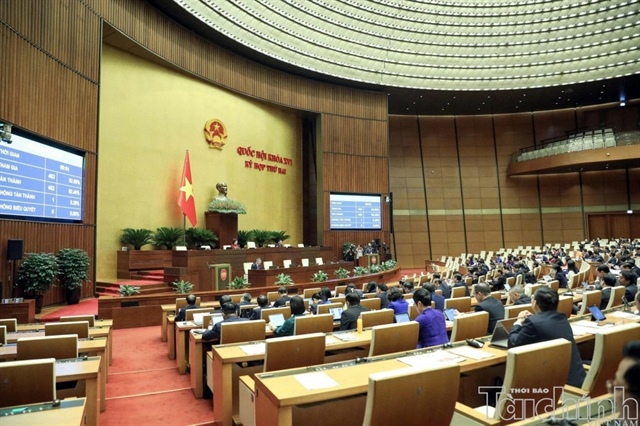
On November 13, the National Assembly voted to pass the Law Amending and Supplementing a Number of Articles of the Law on Securities.
Before the vote, Minister of Finance Ngo Van Tuan presented the government's report on the review, explanation, revision, and finalisation of the draft amended Law on Securities.
“The government has carefully studied, incorporated feedback, provided explanations, and revised the draft law to ensure its consistency with actual market operations, the relevant legal framework and the requirements for developing a safe, transparent, and sustainable securities market in the coming period,” Minister Tuan said.
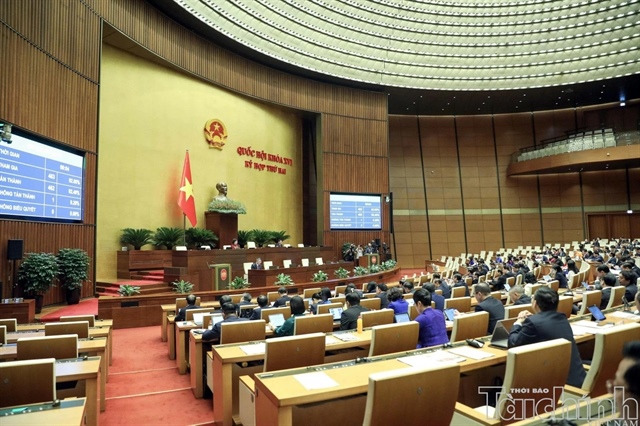
National Assembly deputies vote to pass the Law Amending and Supplementing a Number of Articles of the Law on Securities. Photo: Duc Thanh |
One of the key provisions incorporated and revised in the draft law concerns the regulatory sandbox mechanism for the securities sector.
The draft law clarifies the requirements for interim and final assessments, enabling competent authorities to consider whether testing should continue or the legal framework should be further developed before official implementation.
This will facilitate the testing of new models, products and services while safeguarding market stability and investors' rights.
The law establishes the fundamental principles and limits of the mechanism, while authorising the government to provide detailed regulations on procedures, risk-control measures, and the handling of testing results. The mechanism must ensure market safety, the protection of assets and data, and the safeguarding of investors' rights.
The government's report on the review and revision of the draft law also clarifies that the amendments are intended to specify the sector-specific regulatory requirements of the securities industry within the broader legal framework governing science, technology, and innovation, with particular emphasis on market safety, investor protection, segregation of assets, and the management of customer data.
Regarding market organisation, the government has maintained its position of assigning the prime minister the authority to decide on the organisational model of the stock exchange, ensuring flexibility and alignment with development requirements in each period.
Provisions on restructuring state capital at the stock exchange have also been revised to define their scope clearly and ensure consistency with legislation governing the management and investment of state capital in enterprises and other relevant laws.
Regarding human resources policies, the draft law clarifies the distinction between general workforce development policies for the securities industry as a whole and specific employment policies and entitlements applicable to civil servants at the State Securities Commission.
According to the government's report, industry-wide policies are directional in nature and do not directly establish specific remuneration arrangements or impose budgetary obligations relating to personnel at enterprises.
Policies applicable to civil servants must be consistent with job requirements, position-based employment arrangements, and regulations governing cadres and civil servants, salaries and the state budget.
Regarding administrative procedure reform, the government has retained its proposal to remove certain conditions and documentation requirements for registering securities depository operations.
This is intended to avoid duplicate assessments of capital adequacy requirements already supervised by banking regulatory authorities, while simplifying procedures for market participants.
Minister Tuan noted that requirements concerning technical capacity, operational safety, segregation of customer assets, and supervision of securities depository operations would remain in place.
Requirements for data reconciliation, settlement, and the transfer of customer accounts in cases where a securities depository institution is unable to continue operating will also remain applicable, ensuring the protection of investors' rights.
Regarding qualification standards for managers and securities practitioners, the draft law clearly distinguishes the professional requirements applicable to managers, legal representatives, and securities practitioners, in line with the responsibilities of their respective positions.
In cases the general director (or director) is not also the legal representative, a securities company or fund management company must have at least one legal representative who meets the corresponding professional qualification requirements. However, the law does not require every legal representative to hold a securities practising certificate.
The Law Amending and Supplementing a Number of Articles of the Law on Securities will take effect on March 1, 2027.
- 20:43 15/11/2026