

Việt Nam, Japan urged to deepen technology co-creation, build new value chains
Việt Nam, Japan urged to deepen technology co-creation, build new value chains
At the forum, representatives of Vietnamese and Japanese businesses shared their views and presented practical cooperation initiatives with determination to unlock new development opportunities for bilateral relations.
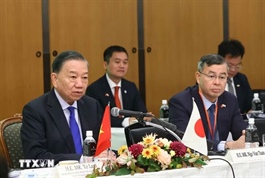
General Secretary of the Communist Party of Vietnam Central Committee and President Tô Lâm delivers remarks at the Vietnam-Japan Public-Private Forum on Economic, Science and Technology Cooperation in Tokyo on November 9. — VNA/VNS Photos Thống Nhất |
Việt Nam and Japan should step up joint research and technology development, create new industries and build future value chains, General Secretary of the Communist Party of Việt Nam Central Committee and President Tô Lâm said while attending the Vietnam-Japan Public-Private Forum on Economic, Science and Technology Cooperation in Tokyo on November 9, as part of his official visit to Japan.
General Secretary and President Lâm said the two countries should move beyond traditional cooperation in infrastructure and manufacturing towards co-creating technologies and developing new industrial sectors, calling for stronger cooperation in artificial intelligence, semiconductors, biotechnology, clean energy and smart industries.
He urged closer links in research, product development and technology commercialisation, as well as the establishment of joint research centres, laboratories and technology development programmes aligned with production needs and market demand.
The Việt Nam's top leader also urged both sides to shift from technology adoption to joint research and innovation, and from manufacturing products to jointly designing and developing products.
Speaking at the forum, Minister of Finance Ngô Văn Tuấn said that rapid changes in technology, digital transformation, the green transition and global supply chains required both countries to improve not only the scale of investment and trade but also technological content and added value.
Tuấn called on businesses from both countries to strengthen research and development cooperation, connect enterprises with research institutes and universities, and accelerate the commercialisation of research outcomes.
Companies should also deepen their participation in emerging value chains and improve technological capabilities, product quality and corporate governance while taking on greater roles in design, manufacturing and supply, he said.
Tuấn reaffirmed the Vietnamese Government's commitment to improving the investment and business environment, mobilising and allocating resources more effectively and promptly addressing businesses' concerns.
For his part, Chairman and CEO of the Japan External Trade Organisation (JETRO) Ishiguro Norihiko welcomed General Secretary and President Lâm and the Vietnamese delegation on their official visit, highlighting Việt Nam’s efforts to attract foreign investment and accelerate industrial development, with a shift from quantity to quality and greater emphasis on science and technology, innovation and human resources training.
He noted that this orientation is creating growing business opportunities for Japanese companies in Việt Nam and expressed JETRO’s desire to explore new potential and expand business cooperation in the country.
At the forum, representatives of Vietnamese and Japanese businesses shared their views and presented practical cooperation initiatives with determination to unlock new development opportunities for bilateral relations.
Addressing the forum, General Secretary and President Lâm said Việt Nam and Japan had built a strong foundation of substantive and reliable cooperation over more than half a century, with the Comprehensive Strategic Partnership opening up new opportunities for collaboration.
Japan is one of Việt Nam's leading economic partners and its largest provider of official development assistance (ODA), he noted.
Cooperation is increasingly shifting towards strategic technology sectors, with the joint semiconductor research initiatives launched by the two countries in 2026 demonstrating a move from technical cooperation towards joint research and technology development, he said.
The two countries have complementary strengths that could generate new sources of growth for both economies. Japan has advantages in technology, finance, management, quality standards and global market networks, while Việt Nam offers a dynamic workforce, a promising market, an important position in regional production networks and strong development ambitions.
Việt Nam is entering a new development phase, aiming to become a developed, high-income country by 2045. Science and technology, innovation, digital transformation and high-quality human resources have been identified as key drivers of productivity, growth quality and national competitiveness, the leader said.
He called for stronger economic links to establish new value chains that are autonomous, sustainable and resilient. He also urged Japanese businesses to expand high-quality investment in Việt Nam and strengthen partnerships with local companies in research, design, supporting industries, smart manufacturing and management.
Vietnamese businesses, meanwhile, should proactively innovate, improve technological capabilities, product quality and management standards, and gradually move into higher value-added segments of global production networks.
|
General Secretary of the Communist Party of Vietnam Central Committee and President Tô Lâm delivers remarks at the Vietnam-Japan Public-Private Forum on Economic, Science and Technology Cooperation in Tokyo on November 9. — VNA/VNS Photos Thống Nhất |
General Secretary and President Lâm also called for greater investment in high-quality human resources and knowledge-sharing ecosystems, with stronger links among government agencies, educational institutions and businesses.
He proposed expanding training programmes for engineers, technology specialists and young scientists, alongside joint research, expert exchanges and cooperation among leading educational institutions in both countries.
Public-private partnerships should become an important mechanism for translating strategic visions into practical results, he said, proposing the development of a Việt Nam-Japan technology co-creation network and the selection of priority projects with clear objectives and implementation prospects.
Việt Nam would continue to improve its institutions, develop infrastructure and enhance workforce quality while maintaining a stable, transparent and predictable business environment, he stressed.
He reaffirmed the country's commitment to protecting the legitimate rights and interests of investors and creating favourable conditions for Japanese businesses, scientists and partners to invest, cooperate and pursue long-term development in Việt Nam.
He also urged Japanese companies to view Việt Nam not merely as an investment destination, manufacturing base or consumer market, but as a partner in joint research, technological innovation, product development and expansion into regional and global markets.
Vietnamese businesses should strengthen their initiative, self-reliance and innovation capacity to become increasingly capable partners in international cooperation networks, he said.
The success of bilateral cooperation in the coming years should be measured by the technologies developed, products created, businesses growing together and generations of skilled workers trained, he emphasised.
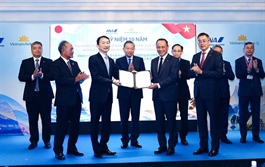
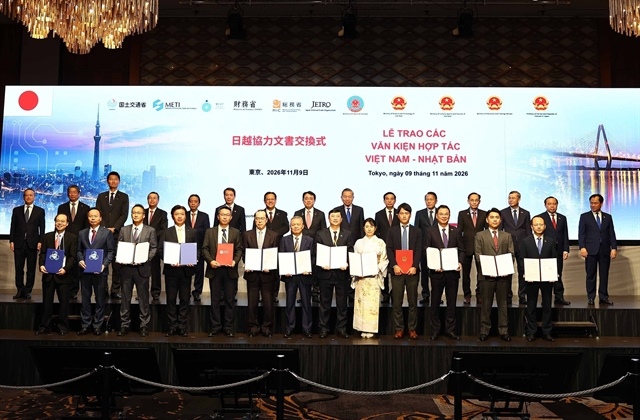
At the forum, General Secretary and President Lâm witnessed the exchange of cooperation documents between Vietnamese and Japanese businesses, ministries and agencies.
The agreements cover information technology, artificial intelligence, semiconductors, energy, renewable energy, the green transition, education and training, scientific research, healthcare, finance and banking, aviation, investment, agriculture, smart transport and logistics.
The two sides also announced the Vietnam-Japan Tourism Cooperation Year 2027-2028, aiming to further strengthen tourism links and exchanges between the two countries.
- 15:52 09/11/2026