AI communications need to look beyond discovery
AI communications need to look beyond discovery
Under Resolution 57, AI is identified as one of the strategic technologies that will play a decisive role in the country’s future development.
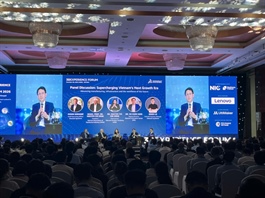
Experts discuss about applying AI in communication sector at first OAC Regional Communications Forum 2026 in HCM City. — Photo courtesy of Ivy+Partners Vietnam |
Artificial intelligence (AI) can increase the speed and volume of content production, but relying on similar tools and outputs without a clear strategy risks making communications less distinctive and weakening a brand’s ability to stand out, experts said at a recent conference in HCM City.
The comments come as AI is adopted across sectors in Việt Nam, in line with Resolution 57 on breakthroughs in science and technology, innovation and national digital transformation.
Under the resolution, AI is identified as one of the strategic technologies that will play a decisive role in the country’s future development. It is seen as a force linking data, computing capacity, digital platforms, innovation and economic sectors to create new value. Data and AI are also identified in related legal documents as important drivers of socio-economic development.
In communications, AI is helping businesses speed up research, analyse information, create content and run campaigns. AI-powered platforms are also becoming a source of information for consumers to discover and compare brands.
This makes brand visibility in AI-generated responses increasingly important. Generative engine optimisation (GEO) is emerging as a way to improve brand visibility in AI-powered search.
However, appearing in AI-generated answers does not mean a brand is accurately presented or recommended to consumers. A brand may appear in direct searches but be missing when users ask AI about specific needs or solutions. Measuring GEO effectiveness therefore requires businesses to understand how consumers search for information and make decisions.
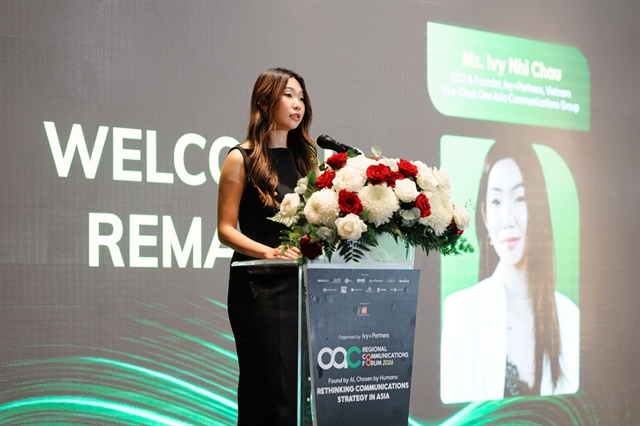
At the first OAC Regional Communications Forum 2026, held recently in HCM City, Ivy Nhi Châu, founder and CEO of Ivy+Partners Vietnam, said a brand’s reputation was shaped not only by what people encountered online, but also by its relationships with stakeholders and their real-world experiences with the business.
“For brands, the question is not simply whether AI mentions them, but whether the information AI provides accurately reflects the credibility they have built through consistent actions,” she said.
|
Experts discuss about applying AI in communication sector at first OAC Regional Communications Forum 2026 in HCM City. — Photo courtesy of Ivy+Partners Vietnam |
AI’s understanding of a brand depends on the quality of information available across different sources. Alongside official websites and other owned channels, media coverage and third-party platforms can provide information for AI systems to draw on.
Businesses need to ensure that information is clear, consistent and contextualised so it accurately reflects their operations, capabilities and competitive strengths.
“Businesses need to look at the actual value AI brings, rather than simply focusing on what the technology can do. Tools that track brand visibility across AI platforms and GEO performance can help businesses understand how their brands are being mentioned and described,” said Ong Hock Chuan, managing partner at Maverick Indonesia.
AI visibility shows how brands are represented, while reputation depends on what audiences experience and believe over time. AI's value should be measured not by the amount of content it produces, but by how well it helps build a credible, relevant and distinctive brand.
For brands operating across Asia, including Việt Nam, expanding communications requires more than translating messages or using a uniform regional strategy. Different languages, cultures, media environments and consumer behaviours mean that a message seen as clear and credible in one market may be interpreted differently in another. AI systems can reflect or overlook these differences depending on the information and context available.
During a panel discussion at the forum, Chetan Mahajan, founder and CEO of The Mavericks India, said AI could amplify both the strengths and limitations of communications professionals. Those with subject knowledge, sound judgement and the ability to ask the right questions were better equipped to use AI effectively.
By contrast, a lack of foundational knowledge or the ability to assess AI-generated results could make existing limitations more apparent.
These considerations are especially important in crisis communications. AI can help monitor information and identify shifts in public sentiment, but deciding whether to respond, when to speak and how to communicate requires experience and an understanding of legal, policy and cultural contexts.
Not every negative development calls for a public response. Businesses need to assess each situation and determine the appropriate timing and level of intervention.
- 15:16 09/11/2026