

New credit policy widens student loan access for disadvantaged families
New credit policy widens student loan access for disadvantaged families
A new government-backed credit policy aims to improve access to education by easing financial pressures on disadvantaged students and their families through more flexible lending arrangements.
From January 1, students from disadvantaged backgrounds will be eligible for policy loans of up to $320 per month to cover tuition fees, study-related expenses, and living costs.
The new policy expands the scope of support while setting out more specific provisions on loan disbursement and repayment periods, helping ease financial pressure on students and their families.
Deputy Prime Minister Nguyen Van Thang signed Decision No.50/2026/QD-TTg ,dated November 2, on credit for students, which will take effect from the start of 2027.

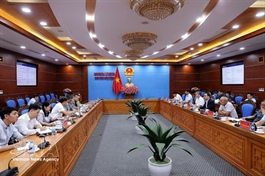
Photo: VBSP |
The policy is designed to help students from disadvantaged backgrounds cover expenses incurred while studying at higher education institutions, other institutions providing higher education programmes, and vocational education institutions within Vietnam's national education system.
Under the decision, eligible borrowers are Vietnamese students enrolled at training institutions who fall into one of the specified categories of disadvantaged circumstances.
The first category comprises students who have lost both parents, or whose parents are both unable to work, have lost their civil act capacity, or are legally declared missing. The policy also covers students who have lost either their father or mother, while the surviving parent is unable to work, has lost their civil act capacity, or is legally declared missing.
The second category includes students who are members of households classified as poor, near-poor or having a medium standard of living under the criteria prescribed by law.
In addition, the policy supports students whose families encounter financial difficulties due to accidents, illness, natural disasters, fires, or epidemics during their studies. In such cases, the circumstances must be certified annually by the People's Committee of the commune where the family resides.
Regarding lending arrangements, Vietnam Bank for Social Policies (VBSP) will provide loans through households. A household representative will be named as the borrower and will conduct transactions with the bank.
However, if a household has no remaining member aged 18 or above, or if its remaining members are unable to work, lack civil act capacity, or are legally declared missing, the student may directly apply for and take out a loan in their own name from VBSP.
To qualify for a loan, students must belong to one of the eligible groups specified in the Decision.
First-year students must provide an admission notice or certification from their training institution. From the second year onwards, students must obtain annual confirmation from their institution that they remain enrolled, serving as the basis for VBSP to disburse the loans.
The maximum loan amount is set at $320 per student per month. Based on the borrower's funding needs and the tuition fees charged by the training institution, VBSP will consider and determine the specific loan amount, which must not exceed this ceiling.
VBSP is responsible for reporting to the Ministry of Finance, which will submit proposals to the prime minister for consideration of adjustments to the maximum loan amount in line with price fluctuations and tuition fee levels.
The loans can be used to cover education-related and living expenses, including tuition fees, books, learning materials and equipment, accommodation, meals, travel, and other necessary costs incurred during study.
Regarding the loan term, the decision stipulates that the borrowing period runs from the date the borrower first receives a disbursement until the principal and interest have been fully repaid. It comprises the disbursement period, the interval between the student's completion of the course and the first repayment, and the repayment period.
During the disbursement period, borrowers are not required to repay either principal or interest. Interest accrues from the date the first loan instalment is received until the principal has been fully repaid. VBSP will disburse loans in instalments according to schedules determined by the bank or agreed upon with borrowers.
If a student is granted temporary leave of absence and permitted to preserve their academic results by the training institution, or is expelled or voluntarily withdraws from the course, the bank will suspend further loan disbursements during that period.
Another notable provision is that borrowers must begin repaying principal and interest 12 months after the student completes the course. Borrowers may also repay their loans ahead of schedule without incurring any early repayment penalty.
The specific repayment period will be determined by VBSP and must not exceed the loan disbursement period, not encompassing any period during which the student is granted temporary leave of absence and permitted to preserve their academic results, if applicable.
The loan will be divided into repayment instalments, with the amount payable in each instalment determined by VBSP on the principle of avoiding the concentration of financial obligations at a single point.
This is intended to ease borrowers' repayment burden while reducing risks in the bank's credit operations. For training programmes lasting no more than one year, the maximum repayment period will be twice the loan disbursement period.
For credit agreements signed before January 1, 2027, VBSP, borrowers, and other relevant parties will continue to comply with the commitments, rights and obligations agreed upon in the contracts. The new maximum loan limit of $320 per month will apply only to new disbursements made from the date the decision takes effect.
VBSP is responsible for notifying borrowers of the changes and providing detailed guidance on their implementation, ensuring the lawful rights and interests of borrowers are protected.
- 15:01 09/11/2026