

Insurance segment becomes pillar for bank revenue
Insurance segment becomes pillar for bank revenue
Third quarter business results of several major banks showed that their revenue growth rate from the insurance segment was much higher than that in the same period last year.

VPBank’s insurance brand, VPLife, is expected to start operations in the first quarter of 2027. VNA/VNS Photo |
The distribution and sale of insurance products at banks are experiencing a powerful surge, emerging as one of the most lucrative revenue sources for banks and providing them with a substantial and stable cash flow.
Data from the Insurance Association of Vietnam indicates that in the first nine months of 2026, the life insurance market recorded more than 1.14 million new policies, a 4.3 per cent increase compared to the same period the previous year.
Although total life insurance premium revenue declined by 4 per cent to VNĐ101.6 trillion (US$3.9 billion), revenue from new policies still hit an impressive VNĐ15.9 trillion.
The bancassurance channel accounted for nearly 45 per cent of total new business revenue, trailing closely behind the traditional agency channel with 51 per cent, while other channels accounted for only about 4 per cent. This dominant share confirms that banks have become the most effective engines for selling insurance products within the financial market.
Third quarter business results of several major banks showed that their revenue growth rate from the insurance segment was much higher than that in the same period last year.
LPBank delivered a major surprise, with its third quarter financial statements revealing that cumulative revenue from insurance agency activities for the first nine months reached approximately VNĐ5.7 trillion.
This represents a 163 per cent increase from the VNĐ2.16 trillion recorded during the same period in 2025, positioning LPBank among the top banks in terms of insurance agency revenue.
At Techcombank, revenue from insurance services for the first nine months of 2026 reached VNĐ2.15 trillion, 2.4 times the figure from the same period last year and nearly 60 per cent higher than the total result for the entire previous year. After deducting expenses, the net profit reached nearly VNĐ1.7 trillion, more than doubling year-on-year.
Driven by this momentum, the share of insurance-related income within Techcombank’s total service revenue has risen from 10 per cent to 15 per cent.
Deputy CEO of Techcombank Nguyễn Anh Tuấn said that revenue from the bancassurance channel had served as a genuine breakthrough, particularly as the bank’s insurance subsidiary launched a range of specialised products throughout the year, tailored to the needs of different customer segments.
For MB, the insurance companies within its ecosystem continued to prove their status as ‘golden geese', achieving double-digit growth in the first half of the year.
In the first eight months, MB Life brought in approximately VNĐ900 billion in new business premiums, pushing its cumulative premium revenue to nearly VNĐ3.1 trillion. In the non-life insurance segment, MIC recorded VNĐ5.06 trillion in gross written premiums over the first nine months, representing a 32 per cent growth rate.
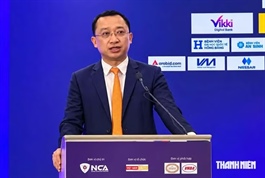
MB CEO Phạm Như Ánh said that the market had shown a clear upturn since the beginning of 2026, adding that the public's need for financial protection will remain a fundamental driver for generating sustainable revenue.
Moving beyond the collection of commissions through agencies, banks are increasingly shifting toward establishing or acquiring their own insurance subsidiaries. This strategy allows the profit generated across the entire insurance value chain to flow directly to the parent bank, rather than being shared with third parties.
For example, in August this year ACB officially launched its non-life insurance subsidiary, ACB Non-Life Insurance Co., Ltd., with a charter capital of VNĐ500 billion. The ownership structure consists of ACB Debt and Asset Management Co., Ltd. (91 per cent) and ACB Securities (9 per cent).
The company has set ambitious targets, aiming for a compound annual growth rate in premium revenue of over 50 per cent between 2026 and 2030. By 2030, it targets VNĐ2.3 trillion in gross written premiums, total assets of approximately VNĐ2 trillion, a market share exceeding 1.5 per cent and a return on equity of over 20 per cent.
Similarly, MSB has approved plans to either acquire shares in or establish new life and non-life insurance entities to drive growth for the 2027-2030 period.
LP Life Insurance Joint Stock Company, which received its licence in June, was renamed Sacom Life Insurance Joint Stock Company just over two months later.
Meanwhile, VPBank’s insurance brand VPLife is expected to begin operations in the first quarter of 2027.
This trend builds upon the success of long-established models, such as BIDV’s association with BIC and the joint venture BIDV MetLife; VietinBank’s partnership with VBI; Agribank’s involvement with ABIC; and MB’s operations through MIC and MB Life.
According to an analysis by the Vietcombank Securities Company, owning an insurance company serves as a long-term strategic move, enabling banks to leverage their existing customer databases, digital platforms and branch networks to maximise revenue.
However, experts said that for the insurance segment to truly become a stable source of income, banks must strike a balance between driving sales growth and ensuring the transparent, timely settlement of policyholder claims.
- 09:55 09/11/2026