Canada-funded GoRice project launches to cut Mekong Delta emissions
Canada-funded GoRice project launches to cut Mekong Delta emissions
Oxfam in Vietnam and its partners have launched a Canada-funded project to help rice producers in the Mekong Delta reduce greenhouse gas emissions, strengthen climate resilience, and secure fairer economic benefits across the rice value chain.
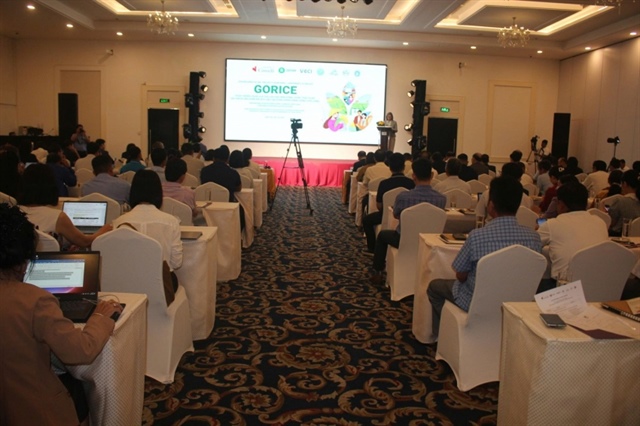
Photo: Minh Khoi |
The GoRice project – formally titled 'Enhancing Sustainable and Climate-Resilient Low-Emission Rice Value Chains' – was launched in Can Tho City on October 28. It will run towards the end of the decade and aims to directly benefit 48,200 people in Can Tho City, An Giang, and Vinh Long provinces, targeting emissions reductions of approximately 748,000 tonnes of carbon dioxide equivalent (CO₂e) and the adoption of high-quality, low-emission farming practices across 180,000 hectares of sown area.
Funded by Global Affairs Canada, the project is implemented by Oxfam in partnership with the Vietnam Chamber of Commerce and Industry (VCCI), the Institute for Agricultural Environment, and the Departments of Agriculture and Environment in Can Tho, An Giang, and Vinh Long.
Speaking at the launch, Canadian Ambassador to Vietnam Jim Nickel said the initiative would support Vietnam’s 'One Million Hectares of High-Quality, Low-Emission Rice Programme' while strengthening cooperation between the two countries on sustainable agriculture.
“By combining Canadian expertise in climate-smart agriculture, carbon accounting, monitoring, reporting and verification systems, climate finance, and agri-tech innovation with Vietnamese leadership and local knowledge, GoRice will help accelerate the transition to a competitive, low-emission rice sector,” she said.
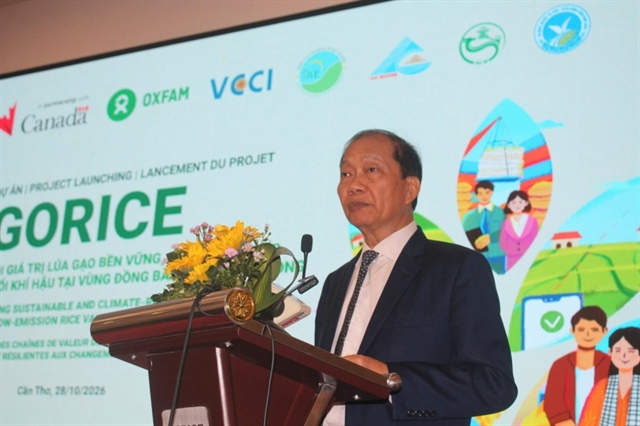
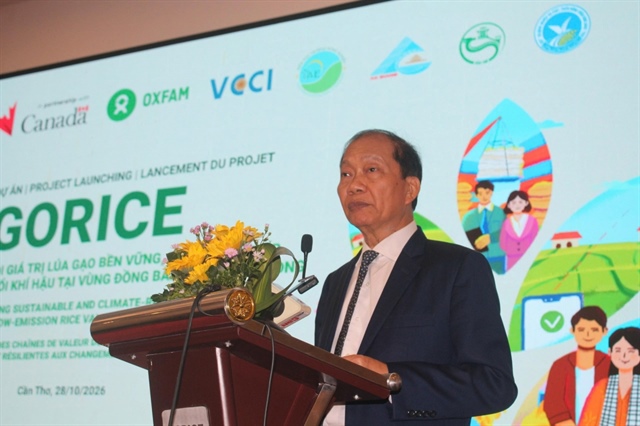
Hoang Quang Phong, vice president of VCCI. Photo: Minh Khoi |
The project also aims to mobilise private-sector investment and climate finance, creating long-term opportunities for farmers, particularly women, while advancing climate action and sustainable development across the Mekong Delta.
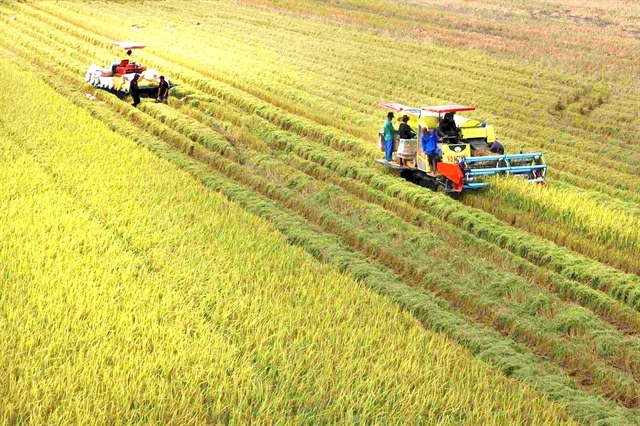
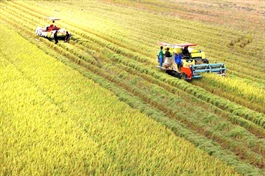
Vietnam is one of the world’s largest rice exporters, with the Mekong Delta accounting for approximately half of the country’s rice production and more than 90 per cent of its rice exports. However, rice cultivation is also the largest source of greenhouse gas (GHG) emissions in Vietnam’s agricultural sector, while climate change is placing increasing pressure on production.
Recent initiatives, particularly the 'One Million Hectares of High-Quality, Low-Emission Rice Programme', have demonstrated the potential of sustainable farming practices to reduce emissions and production costs while improving farmers’ incomes.
Nevertheless, the market for low-emission rice remains at an early stage. Many smallholder farmers continue to face barriers to accessing technical knowledge, financing, and market opportunities, limiting their ability to adopt new practices and benefit from the transition.
GoRice seeks to address these challenges by bringing farmers, cooperatives, businesses, and public-sector stakeholders together to develop high-quality, low-emission, and climate-resilient rice value chains. It also aims to ensure that women, ethnic minorities, and other vulnerable groups can participate more equally in, and benefit fairly from, the transition.
Hoang Quang Phong, vice president of VCCI, highlighted the role of businesses in connecting production with markets and financing the shift towards more sustainable farming. “Enterprises are the link in the chain that can at the same time provide upfront capital, transfer production practices, control quality and guarantee offtake,” he said.
"For businesses to maintain long-term engagement, they need reliable sourcing areas supported by data, long-term contracts rather than season-by-season purchasing, working capital, and mechanisms to share risks arising from price fluctuations," he added.
Through GoRice, VCCI will support partnerships between businesses and cooperatives, help cooperatives and producers access green finance, and work with stakeholders to develop domestic demand for low-emission rice and expand markets for high-quality, low-emission products.
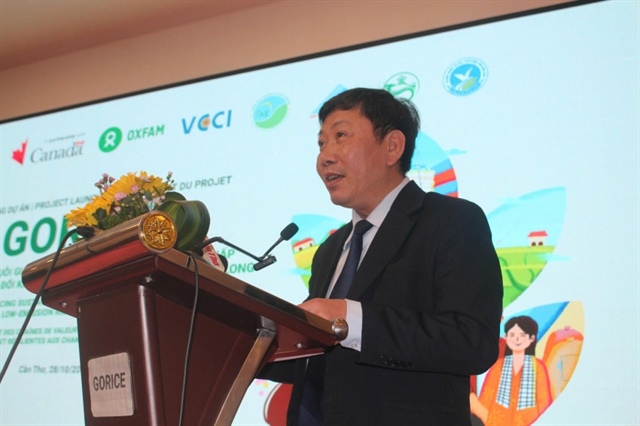
Nguyen Do Anh Tuan, International Cooperation Department at the Ministry of Agriculture and Environment. Photo: Minh Khoi |
GoRice focuses on three areas: boosting climate-smart rice production, expanding inclusive green economic opportunities, and strengthening multi-stakeholder collaboration and inclusive governance.
The initiative will provide training in low-emission farming techniques and encourage circular-economy practices to improve resource efficiency. It will also seek to expand access to green technologies, green finance, and carbon markets, helping producers participate in emerging sustainable business opportunities.
Another priority is developing a participatory framework for monitoring, reporting, and verifying GHG emissions, while contributing to the development of carbon markets. The project will also promote low-emission rice among Vietnamese consumers and support research and the sharing of good practices.
Gender equality and social inclusion will be integrated into these activities, with efforts to empower women, young people, and ethnic minorities and improve their access to economic opportunities throughout the value chain.
By 2030, the project aims to directly benefit 48,200 people, at least 50 per cent of whom will be women, and reach 100,000 consumers. It also targets the adoption of high-quality, low-emission farming practices across 180,000 ha of sown area and emissions reductions of approximately 748,000 tonnes of CO₂e.
Through these measures, GoRice aims to support a more competitive and climate-resilient rice sector in the Mekong Delta, while improving farmers’ livelihoods and strengthening the participation of domestic businesses in sustainable agricultural value chains.
- 12:18 28/10/2026