Việt Nam-EFTA agreement opens new opportunities for Norwegian salmon
Việt Nam-EFTA agreement opens new opportunities for Norwegian salmon
According to the latest survey by the NSC, 52 per cent of Vietnamese respondents expressed a preference for Norwegian salmon, although some consumers are not yet able to accurately identify the product's origin.
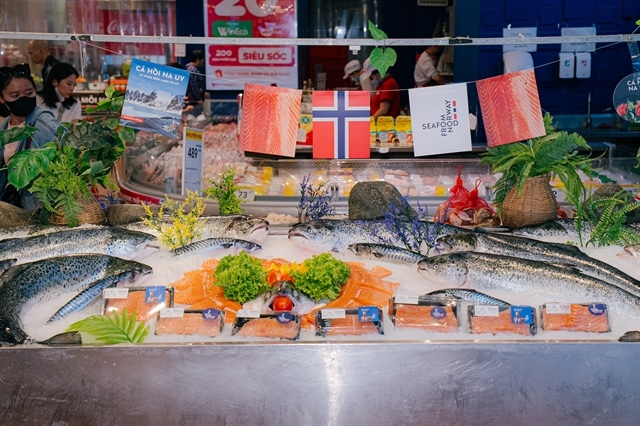
Norwegian salmon on the shelves a store in Việt Nam. — VNS Photo |
The signing of a free trade agreement between Việt Nam and the European Free Trade Association (EFTA) is expected to provide a competitive advantage for Norwegian salmon through tariff concessions and trade facilitation, thereby expanding access to Vietnamese consumers.
Việt Nam and EFTA on October 18, 2026 officially signed the deal, creating new prospects for trade. The fisheries sector, particularly Norwegian salmon, is expected to benefit from more favourable market access conditions.
According to the Norwegian Seafood Council (NSC), seafood accounts for a significant share of Norway’s total commodity exports to Việt Nam. The reduction of tariffs, simplification of customs procedures and enhanced coordination between relevant authorities are expected to enable businesses from both sides to trade more efficiently, while creating further opportunities for Norwegian salmon to expand its market share in Việt Nam.
According to information shared by Norwegian representatives, whole salmon imported from Norway is currently subject to a 10 per cent tariff, while salmon fillets face a 15 per cent tariff.
Some competing suppliers already enjoy tariff preferences through other free trade agreements. Thus, the preferences granted under the newly-signed agreement are expected to help Norwegian salmon narrow its tariff-related disadvantage, creating a more favorable competitive environment in the Vietnamese market.
State Secretary at the Norwegian Ministry of Foreign Affairs Astrid Bergmål told the press that the signed agreement will reduce tariffs, facilitate smoother trade, and make business operations more predictable. As a result, Norwegian seafood, particularly Norwegian salmon, will become more competitive in Việt Nam, and it is expected that this will ultimately bring high-quality Norwegian salmon to the tables of Vietnamese consumers.
Over the past 55 years, Norway and Việt Nam have built a strong partnership that has evolved alongside Việt Nam’s own progress. Today, trade plays an increasingly vital role in that relationship, with Norwegian salmon and other seafood having become a familiar sight in the Vietnamese market, Bergmål said.
However, tariff concessions do not necessarily mean that retail prices will immediately decrease by a corresponding amount. The final price of salmon paid by consumers also depends on exchange rates, costs related to transportation, storage, and distribution, as well as the business policies of individual companies. Nevertheless, lower import costs provide businesses with more room to optimise their operations, expand distribution networks, and develop new customer segments.
Beyond tariffs, the simplification of import procedures and enhanced coordination among relevant authorities are also expected to streamline the customs clearance process. This will assist importers and distributors in better planning their logistics, managing inventory, and minimising additional costs that might otherwise arise from delays.
According to data from the NSC, Norway is currently the largest supplier of Atlantic salmon to Việt Nam, with total imports reaching 22,407 tonnes, of which 6,828 tonnes consist of fresh salmon.
According to the latest survey by the NSC, 52 per cent of Vietnamese respondents expressed a preference for Norwegian salmon, although some consumers are not yet able to accurately identify the product's origin.
- 10:43 19/10/2026