Vietnam’s coffee industry faces value-add challenge
Vietnam’s coffee industry faces value-add challenge
Vietnam’s coffee exports are growing in volume but losing value, highlighting the industry’s challenge in moving beyond raw coffee exports towards higher-value products.
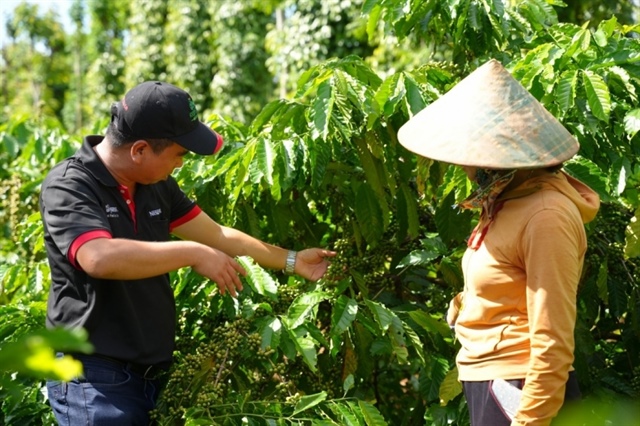
Photo: vir.com.vn |
According to the Ministry of Agriculture and Environment, Vietnam exported approximately 1.4 million tonnes of coffee, generating $6.54 billion, in the first three quarters of the year, representing a 15.4 per cent increase in volume but a 7.3 per cent decrease in value compared to the same period last year. The average export price stood at $4,537.3 per tonne, down 19.7 per cent.
Germany, Italy, and Japan remain Vietnam's largest coffee markets, accounting for 13.1 per cent, 8.2 per cent, and 7.2 per cent of market share, respectively. Notably, among the top 15 export markets, China recorded a 63.7 per cent increase in value, pointing to room for further expansion in Asian markets, particularly for higher-value coffee products.
Against this backdrop, processed coffee is emerging as a key avenue for increasing export value. Data from the Vietnam Coffee-Cocoa Association (Vicofa) indicates that Vietnam exported between 116,000 and 150,000 tonnes of processed coffee in the first nine months of the year, generating approximately $1.2 billion in turnover, a 1.7 per cent increase on-year.
However, this segment remains heavily concentrated among a few enterprises. According to Vicofa, 10 companies currently account for 85.3 per cent of processed coffee export turnover, with foreign-invested enterprises such as Nestlé Vietnam, Outspan Vietnam, Iguacu Vietnam, Sucafina Vietnam, and URC Vietnam holding a significant share.
Speaking at the Vietnam Corporate Sustainability Forum in Hanoi in early October, Binu Jacob, CEO of Nestlé Vietnam, noted that the primary scope for growth in Vietnam's coffee sector no longer lies in volume, but in the ability to add value.
Through its Nescafé Plan, Nestlé has supported farmers in the Central Highlands in adopting regenerative farming practices and replanting more than 100,000 hectares of ageing coffee trees, while achieving savings of 40-60 per cent in irrigation water and a reduction of approximately 20 per cent in chemical fertilisers and pesticides. The resulting raw materials are then processed at Nestlé factories into higher-value products, such as coffee capsules.
"The value of coffee beans lies not only in volume but also in processing capabilities, meeting standards, and creating higher-value products," Jacob said. "This serves as a foundation to further enhance the value of the coffee industry and strengthen Vietnam's position in the global value chain."
According to company data, Nestlé currently purchases approximately 20-25 per cent of Vietnam's annual coffee output, making it the country's largest coffee buyer. In addition to investing in raw material sourcing areas, Nestlé has poured nearly $580 million into its Tri An factory to process high-quality coffee, with products exported to nearly 40 markets.
Thai Nhu Hiep, vice chairman of Vicofa, notes that while Vietnam holds a significant advantage in production volume, particularly for robusta coffee, value addition remains limited because the majority of exports consist of green coffee beans.
“Currently, deep-processed coffee utilises only about 8-10 per cent of raw material supplies yet contributes 17-18 per cent of total export value,” he said. “The world recognises Vietnam as a major supplier, but we primarily sell green coffee beans, while deep processing and brand building remain limited.”
According to Hiep, to elevate its position in the value chain and boost competitiveness, the coffee industry must prioritise deep processing, brand development, and stronger inter-enterprise collaboration, moving away from fragmented operations characterised by a lack of alignment regarding information, standards, quality, and data.
Demand for processed products is driving new investment in production capacity. Trung Nguyen Legend is expanding its production capacity, with the Trung Nguyen Legend Energy Factory project involving total investment of approximately $77 million across two phases. The project has a design capacity of around 7,900 tonnes of finished products annually, with production scheduled to begin at the end of 2027.
Intimex Group also plans to expand its instant coffee plant in Binh Duong with an investment of approximately $17.3 million, aiming for a capacity of 8,000 tonnes per year.
In the foreign-invested sector, Tata Coffee, a subsidiary of India’s Tata Consumer Products, is continuing to expand its freeze-dried instant coffee plant in Binh Duong province; the facility has an initial investment of $65.5 million and an annual capacity of 5,000 tonnes.
Phuc Sinh Group, one of Vietnam’s top four domestic coffee exporters, is also ramping up investment in deep processing through its seven processing plants. Notably, the company inaugurated its newest facility in Lam Dong province this past July, featuring an investment of over $19.2 million and an annual capacity of 50,000 tonnes.
"Instead of accepting the role of a low-cost raw coffee supplier, we are proactively enhancing value through deep processing," Phan Minh Thong, chairman of Phuc Sinh Group noted.
Beyond exports, Phuc Sinh is also expanding its processing operations and developing the domestic market via its K Coffee brand. Thong stated that K Coffee is still in an investment and expansion phase and has not yet turned a profit. The company continues to develop its distribution network, with the K Coffee chain utilising raw materials sourced from Phuc Sinh’s own production areas to serve domestic customers.
Alongside the push for deep processing, enhancing quality, meeting standards, and ensuring traceability are becoming increasingly important for boosting the value of Vietnamese coffee.
Le Duc Huy, chairman of the board of directors at Simexco Dak Lak, notes that as the European market places greater emphasis on supply chain transparency, compliance with the European Union Deforestation Regulation is a crucial factor for retaining market access.
"Vietnam needs to focus on exporting green coffee that meets EU criteria, especially given that compliance levels among some other producing nations remain low. Furthermore, it is essential to develop speciality and organic coffee lines, as well as deep-processed products, to cater to the high-end European market segment," Huy said.
According to the US Department of Agriculture, global coffee production in the 2026-2027 crop year is forecast to reach 189.7 million bags, up around 6 per cent from the previous crop year. Brazil is expected to account for most of this increase, with production forecast at nearly 72 million bags. Vietnam’s output is also forecast to rise to 32.5 million bags, equivalent to growth of around 2.5 per cent.
- 10:17 23/10/2026