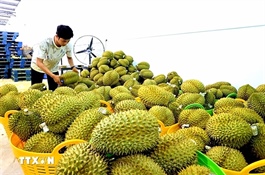
Việt Nam targets digital mapping for 70 per cent of raw material areas by 2030
Việt Nam targets digital mapping for 70 per cent of raw material areas by 2030
The scheme aims to establish raw material areas managed through unified data on acreage, producers, seasons, output, quality, growing area codes and production-consumption linkages.
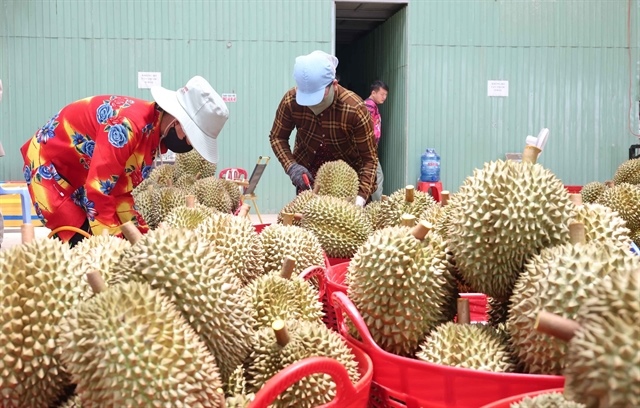
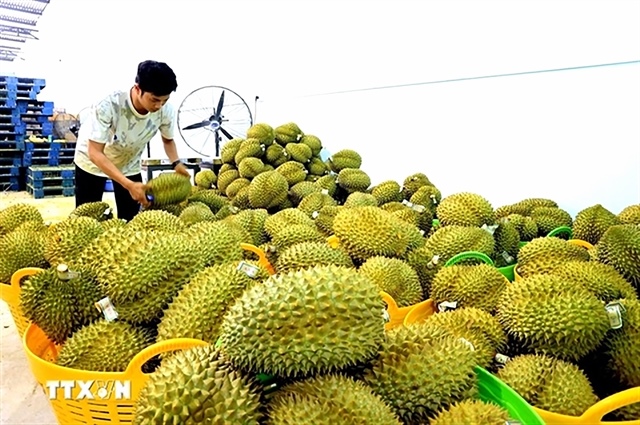
Durians are collected in Đắk Lắk Province. — VNA/VNS Photo Kha Phạm |
More than 70 per cent of supported agricultural, forestry and fishery raw material areas are expected to complete digital mapping and basic data standardisation by 2030 under a scheme for 2026-30 issued by the Ministry of Agriculture and Environment.
Digital transformation is identified as a key pillar, alongside infrastructure investment and production organisation. The scheme aims to establish raw material areas managed through unified data on acreage, producers, seasons, output, quality, growing area codes and production-consumption linkages.
At least 60 per cent of supported acreage is expected to use electronic production diaries, area-code management and traceability systems tailored to sectoral and market requirements.
The scheme stresses that digitalisation is not simply about putting production information online, but changing how raw material areas are managed. Data must be standardised, regularly updated and connected to shared platforms, avoiding fragmented systems developed independently by local authorities, businesses or cooperatives.
The system is expected to help cooperatives, businesses and management agencies improve production planning, quality control and procurement. Updated data will help balance supply and demand and organise harvesting, collection, processing and distribution, while meeting traceability and supply-chain transparency requirements. The scheme requires raw material development to be linked from the outset with data, standards and traceability.
More than 80 per cent of cooperatives and cooperative groups participating in supported areas are to receive training in governance, production planning, quality management, contracts and data management.
Around 70 per cent of supported areas must involve cooperatives in organising production and have at least one enterprise or processing, collection, distribution or consumption organisation with a valid linkage contract or cooperation agreement.
Cooperatives will organise producers and manage raw material areas, data and quality, while businesses will lead markets, set standards, invest in processing and boost sale and exports.
The scheme also seeks to improve infrastructure and value-chain linkages. The State will prioritise public infrastructure connecting raw material areas with collection, processing and storage facilities and markets.
By 2030, transport costs are targeted to fall by at least 10 per cent, collection time by 10-15 per cent and post-harvest losses by 8-10 per cent.
Material area selection will be based on market demand, processing capacity and consumption potential rather than acreage alone. Some 250-300 potential areas nationwide will be reviewed based on planning, market demand, production organisation, infrastructure, investment, digital readiness and sustainability.
The scheme targets at least 60 per cent of output being sold under contracts, while cooperative revenues and producer incomes are expected to rise by at least 10 per cent.
The targets build on a 2022-25 pilot implemented in five areas across 11 provinces. By the end of 2025, these areas covered about 169,800ha, up 20 per cent, while enterprise-linked acreage reached nearly 121,000ha, or 71.2 per cent, up from about 17,000ha.
More than 123 cooperatives were established or strengthened, bringing the total to 393, while over 5,500 managers and members received training. More than 90 linkage chains were formed.
- 12:45 10/09/2026