E10 rollout yields positive early signs on emissions
E10 rollout yields positive early signs on emissions
Vietnam's nationwide rollout of E10 biofuel petrol has shown encouraging initial results in reducing emissions, although authorities say a longer monitoring period is needed before drawing firm conclusions about its environmental benefits.
"Preliminary assessments after one month of implementation suggest E10 petrol is beginning to support the country's emissions reduction and environmental protection goals," said Dao Duy Anh, deputy director general of the Department of Innovation, Green Transition, and Industrial Promotion, at the Ministry of Industry and Trade's second-quarter press briefing on July 7.
"However, we will continue monitoring air quality over a longer period and across a broader network of locations to establish a more robust scientific basis for evaluating the impact of switching to biofuels," he added.

Dao Duy Anh, deputy director general of the Department of Innovation, Green Transition and Industrial Promotion |
According to Anh, replacing conventional petrol with E10 contributes to lowering carbon emissions because every litre of fossil fuel displaced reduces approximately 2.3 kilograms of CO2 emissions, based on combustion calculations.
The ethanol blended into E10 also increases the oxygen content of the fuel, allowing more complete combustion inside vehicle engines. This improves combustion efficiency, reduces unburned fuel and lowers emissions of certain air pollutants.
To assess E10's real-world environmental impact, the MoIT requested air quality data from the Environmental Monitoring Centre under the Ministry of Agriculture and Environment.
Initial monitoring was conducted in Hanoi and Ho Chi Minh City, with samples collected at multiple locations in late May and late June, allowing comparisons before and after the nationwide introduction of E10 on June 1. "The preliminary results indicate that several environmental indicators have shown a downward trend. However, the monitoring data differ between the two cities," Anh said.
He noted that air quality measurements are influenced by numerous factors, including traffic density, sampling time, weather conditions, wind speed and other environmental variables. As a result, the current data are insufficient to conclusively attribute any improvements solely to the use of biofuel petrol.
The ministry has therefore requested the Environmental Monitoring Centre to continue collecting data over a longer period, increase monitoring frequency and expand measurements beyond Hanoi and Ho Chi Minh City to other provinces and cities nationwide.
"Once sufficient long-term data are available, the ministry will release further findings based on assessments conducted by environmental authorities," Anh added.
Alongside environmental monitoring, the ministry has also tracked consumer feedback following the nationwide rollout. Between June 1 and June 29, Vietnam's National Competition Commission received 293 consumer inquiries and complaints through its hotline and email system, including 11 via telephone and 282 by email.
The feedback mainly focused on three issues: concerns over E10 fuel quality, limited availability at some filling stations during the initial rollout, and worries that E10 could reduce vehicle performance, with some users reporting sluggish engines or engine stalling.
According to the MoIT, all complaints have been handled in accordance with established procedures and forwarded to the relevant authorities for investigation and response.
After one month, nationwide E10 consumption reached approximately one million cubic metres, broadly matching previous consumption levels for conventional petrol. Based on information provided by fuel wholesalers and distributors, authorities have so far received no verified reports that E10 has caused engine damage or negatively affected vehicle performance.
"The early results indicate that the nationwide transition had been carefully studied and assessed before implementation and has so far achieved its initial objectives," Anh said. "Nevertheless, the ministry will continue collecting consumer feedback and expanding environmental monitoring to build a more comprehensive and objective database on E10's environmental impact."

Nguyen Thuy Hien, deputy director general of the Department for Domestic Market Management and Development |
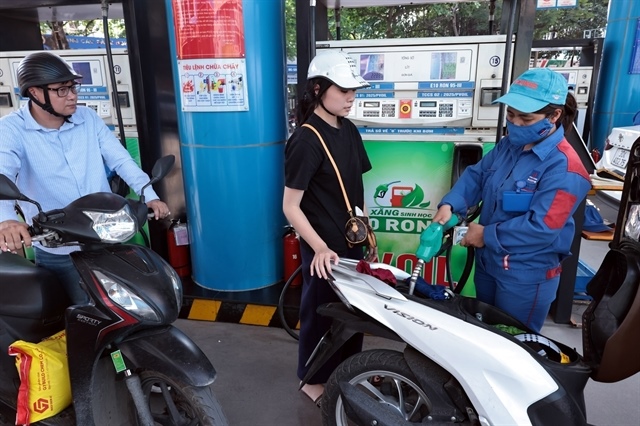
Responding to questions about why petrol prices vary between filling stations, Nguyen Thuy Hien, deputy director general of the Department for Domestic Market Management and Development, said, "Price differences mainly reflect different fuel specifications rather than inconsistent pricing."
Vietnam currently distributes several petrol grades. While E5 RON92 and E10 RON95 are the two mainstream fuels subject to government price management, some stations also sell other fuel specifications, such as E10 RON95 Grade III and Grade V, which have different technical standards and therefore different prices.
Following the government's pilot scheme making E10 RON95 a mainstream fuel for price regulation, E10 RON95 now accounts for approximately 94–95 per cent of total petrol sales nationwide, while E5 RON92 remains available at selected outlets but is no longer widely sold.
"Because demand for some fuel grades is relatively low, retailers decide which products to stock based on local market conditions. Consequently, not every filling station offers every petrol type, and prices vary depending on the product sold," said Hien.
The MoIT also confirmed it is finalising a new decree governing Vietnam's petroleum business to replace existing regulations.
"The draft has already undergone four rounds of consultation with government members," Hien said. "The latest revisions focus on simplifying administrative procedures, reducing intermediaries, and reviewing the number of petroleum trading businesses."
Following further guidance from Deputy Prime Minister Pham Gia Tuc, the ministry is incorporating additional comments from relevant ministries before submitting the draft to the government later this month.
On fuel prices, the ministry noted that recent geopolitical tensions in the Middle East had temporarily pushed global oil prices higher, affecting domestic fuel prices. However, following the latest price adjustment on July 2, domestic petrol prices have fallen below levels recorded on February 26, before the regional conflict began, while diesel prices have also returned to roughly the same level, supported in part by existing tax policies.
The ministry added that although fuel prices have eased, it is responsible only for price management of products under its jurisdiction, including petroleum, electricity, gas, coal and steel. Other ministries oversee pricing in different sectors.
To strengthen market supervision, Vietnam's market surveillance force conducted 1,202 inspections on price listing and compliance during the first half of 2026, mainly in the petroleum sector, imposing more than VND1.3 billion (about $50,000) in administrative fines for pricing violations.
- 13:47 08/07/2026