Regenerative farming helps Vietnamese coffee overcome 'green barriers': seminar
Regenerative farming helps Vietnamese coffee overcome 'green barriers': seminar
Regenerative agriculture has evolved beyond a passing trend, becoming an essential requirement across global agricultural supply chains.
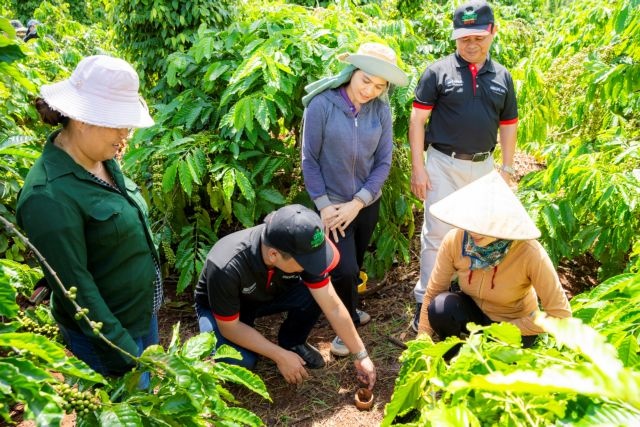
Over the past 15 years, the NESCAFÉ Plan has supported more than 23,000 farming households. — Photo courtesy of Nestlé Việt Nam |
As export markets tighten requirements on sustainability, traceability and carbon emissions, regenerative agriculture is emerging as a key strategy to help Việt Nam's coffee industry strengthen its competitiveness while delivering higher incomes for farmers.
Speaking at the recent seminar 'Regenerative agriculture: a sustainable path for Vietnamese farming' this week, Director of Control Union Việt Nam Wouter Melis Van Ravenhorst said that despite being one of the world's leading agricultural producers, Việt Nam is facing increasingly stringent 'green barriers' in major export markets.
According to Wouter, regenerative agriculture has evolved beyond a passing trend, becoming an essential requirement across global agricultural supply chains.
The farming model restores ecosystems, reduces greenhouse gas emissions and enhances the value of agricultural products, helping producers meet increasingly demanding international standards.
Country manager of the Rainforest Alliance Office in Việt Nam Nguyễn Văn Thiết said the country's coffee sector is at a pivotal moment as global buyers place greater emphasis on sustainable production.
"A regenerative farm does more than produce environmentally friendly crops. It restores ecosystems, protects biodiversity and creates a more balanced relationship between people and nature," he said.
"Soil should no longer be viewed merely as a production asset, but as a partner. Farmers should invest in improving soil health and fertility to ensure sustainable harvests for years to come."
Phạm Phú Ngọc, director of the Agricultural Development Programme and head of Nestlé Việt Nam's Central Highlands Branch, detailed the company's experience through the NESCAFÉ Plan, one of the country's pioneering initiatives supporting farmers in adopting sustainable coffee production.
Launched in 2011, the programme has gradually shifted farmers from conventional cultivation to regenerative farming practices, generating environmental, economic and social benefits.
Ngọc said the biggest challenge is not technology, but making new farming concepts practical and easy for farmers to adopt.
To simplify implementation, regenerative agriculture under the programme focuses on three core areas: soil, water and biodiversity.
Farmers are encouraged to maintain ground cover, recycle agricultural by-products into organic fertiliser and apply balanced nutrient management. These practices have reduced chemical fertiliser use by 20-40 per cent while improving soil quality and lowering production costs.
Water consumption has also fallen by 40-60 per cent through irrigation based on crop demand, helping conserve water resources while reducing electricity and fuel costs for pumping.
To enhance biodiversity, farmers are encouraged to intercrop coffee with pepper, durian and other fruit trees. The diversified farming system provides shade, improves ecosystem resilience and creates additional income streams.
Higher incomes for farmers
Ngọc said the benefits of regenerative agriculture extend beyond environmental indicators to tangible economic gains for farming households.
Programme data shows participating farmers have increased their incomes by between 30 and 150 per cent compared with conventional coffee monoculture, thanks to lower input costs and diversified revenue from intercropping.
Over the past 15 years, the NESCAFÉ Plan has supported more than 23,000 farming households, contributing to significant improvements in productivity, farming techniques and household incomes.
One example is Mai Thị Nhung, a farmer in Đắk Lắk who cultivates a two-hectare coffee farm intercropped with pepper and durian. By applying regenerative farming practices alongside digital farm management tools, her family now earns profits exceeding VNĐ1.2 billion (US$46,000) per harvest.
Hoàng Thị Thu Hương, senior project officer at Deutsche Gesellschaft für Internationale Zusammenarbeit (GIZ), said regenerative agriculture stands out because of its ability to restore natural resources while creating long-term economic value.
Under the Ministry of Agriculture and Environment's Low-Emissions Crop Production Plan through 2035, coffee has been identified as one of the crops with significant potential to reduce greenhouse gas emissions, alongside rice, sugarcane, cassava and bananas.
Hương said transitioning to regenerative agriculture would not only help the coffee industry comply with new regulations, such as the European Union Deforestation Regulation, but would also position producers to participate in future carbon credit markets, creating additional revenue opportunities while reinforcing Vietnamese coffee's position in the global sustainable agriculture landscape.
- 11:45 05/07/2026