Cash flows shift as property market repositions
Cash flows shift as property market repositions
Vietnam's real estate market is moving beyond a growth phase driven largely by expectations and entering a more sustainable cycle centred on genuine housing demand and long-term asset value.
According to Nguyen Van Dinh, chairman of Vietnam Association of Realtors (VARS), the market is no longer driven by speculative sentiment or expectations of short-term price gains, as seen in previous cycles. Instead, decisions are increasingly based on an asset's income-generating potential and the genuine housing needs of homebuyers.

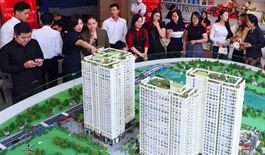
Nguyen Van Dinh, chairman of Vietnam Association of Realtors at the launch of the report "Market consolidation and value repositioning driven by real demand" held in Ho Chi Minh City on July 16 |
"This is a necessary adjustment to put the market on a more transparent, healthy, and sustainable growth path. At the same time, the shift is creating positive pressure on developers to improve product quality, strengthen project development capabilities, and better adapt to increasingly demanding customer expectations," Dinh said at the launch of the report organised by the VARS in Ho Chi Minh City on July 16.
The consolidation process is evident in transaction activity but is also becoming increasingly apparent across the real estate business community.
Data from the National Statistics Office (Ministry of Finance) shows that in the first half, the number of newly established real estate businesses rose by 23 per cent on-year, while their total registered capital surged by 71 per cent. The figures suggest that financially strong developers continue to enter the market, expand operations, and proactively prepare resources for the next growth cycle.
Considering both newly established and reactivated companies, and subtracting those that temporarily suspended operations or were dissolved, the market still recorded a net increase of around 1,200 real estate enterprises.
According to Dinh, these figures confirm that the ongoing market consolidation does not signal a downturn, but rather reflects a restructuring of the sector towards higher-quality market participants.
"Companies with strong financial capacity, sizeable land banks, clear legal status, and proven execution capabilities are continuing to expand, while those with limited resources or unable to meet the market's evolving requirements are being forced to scale back or exit. This is the natural progression of a market entering a more mature and sustainable stage of development," he said.
According to Pham Thi Mien, deputy director of the Vietnam Institute for Real Estate Market Research and Evaluation, Vietnam's housing market continued to show encouraging signs of recovery as legal obstructions were gradually resolved, project approvals accelerated, and the rollout of large-scale developments helped unlock new supply.
“However, the actual number of homes launched remained below the number of projects eligible for sale. Many developers have adopted a cautious approach, delayed new launches or extending marketing and booking periods to gauge market sentiment before bringing projects to market,” Mien said.
In the second quarter, nearly 34,000 new housing units were launched nationwide, down around 10 per cent from the previous quarter and 8 per cent on-year.
Despite the quarterly decline, Mien said, the market recorded approximately 98,000 housing units launched in the first half, up about half from the same period last year. Of these, more than 70,000 were newly launched units, representing a 40 per cent on-year increase.
“New housing supply continued to be concentrated in large-scale developments, integrated urban townships, and projects benefiting from major transport infrastructure investments,” she said.
However, Mien added that the persistent mismatch between supply and demand remains unresolved, as most newly launched products were in the high-end segment.
“Affordable commercial housing has remained virtually absent from the market. Meanwhile, landed residential products, including villas, townhouses, and residential land plots, accounted for just 25.3 per cent of total new supply, down from both the previous quarter and the same period in 2025. Most of these were villas and townhouses located within master-planned integrated townships,” she said.
According to Luu Tien, former vice director of Dat Xanh Service, genuine housing demand, together with medium- and long-term investment demand, has become the market's most important growth driver.
"This momentum is being underpinned by rapid urbanisation, economic growth, and the emergence of new development hubs. Demand is recovering in a more selective manner, focusing on locations that offer products aligned with buyers' affordability, particularly suburban areas, satellite cities, and localities where transport infrastructure has moved beyond the planning stage into actual implementation," Tien said.
Buyer preferences have also shifted markedly, with increasing interest in assets capable of generating stable cash flows, such as apartments, rental properties, or products that not only meet owner-occupier demand but also offer long-term capital appreciation and income potential.
Notably, purchasing decisions are no longer driven primarily by expectations of short-term price appreciation, as was the case in previous market cycles.
According to Tien, buyers are increasingly relying on a broader range of data before making purchasing decisions, including selling prices, credit policies, legal status, construction progress, handover quality, and rental yield potential.
"The number of prospective buyers continues to increase, but so does the tendency to conduct more thorough due diligence. Site inspections, legal verification, and assessments of an asset's income-generating potential have become top priorities, replacing the previous focus on chasing short-term price surges. This indicates that market capital is clearly shifting from a 'riding the wave' mindset to one centred on long-term value," he said.
As a result, investors are increasingly favouring assets with transparent legal status, tangible construction progress, strong income-generating potential, and stable liquidity, while speculative short-term capital continues to retreat.
- 18:03 16/07/2026