Resort developers carry out adjustments
Resort developers carry out adjustments
Despite tourism real estate seeing widespread benefits as the country grows, the market is currently facing greater challenges than at any point in recent memory.
|
|
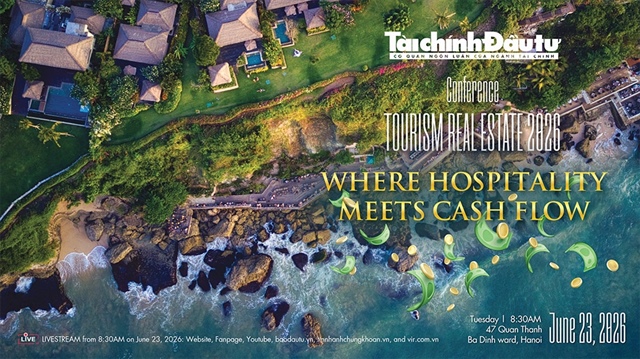
Tourism real estate seminar A comprehensive picture of efforts to unlock capital flows for Vietnam’s tourism real estate market will be presented by policymakers, industry consultants, and resort property developers at the seminar “Tourism Real Estate Market 2026: Where Hospitality Meets Cash Flow”, organised by VIR in Hanoi. The event will explore several key issues, including the strong appeal of Vietnam’s tourism industry, important new provisions in laws related to tourism real estate and their potential to remove legal impediments, market trends, and which segments are currently attracting capital flows. Participants will also discuss evolving consumer behaviour and how resort real estate developers need to adjust their strategies to sustain growth and remain competitive in the new market environment. Time: 8am-12:30pm, Tuesday, June 23 Venue: VIR headquarters, 47 Quan Thanh Street, Ba Dinh Ward, Hanoi The seminar will be livestreamed on VIR’s websites, YouTube channels, and official fanpages. |
According to the National Statistics Office, Vietnam welcomed approximately 1.78 million international visitor arrivals in May, up 16.5 per cent on-year. In the first five months of the year, total international arrivals reached around 10.6 million, an increase of 14.9 per cent on-year.
The sharp rise in both domestic and international tourist arrivals has contributed to the emergence of new destinations, the development of large-scale integrated resorts, and the creation of a highly promising market for investors.
According to a report by the Vietnam Real Estate Market Research and Evaluation Institute, the market recorded 63 resort villa projects with more than 2,500 units launched for sale in May alone, alongside 49 condotel projects offering more than 5,000 units.
From Vung Tau, Phu Quoc, Nha Trang, Van Phong, and Danang to Phan Thiet, a series of tourism and resort real estate projects spanning dozens to hundreds of hectares are being revived. Major developers such as Sun Group, Vingroup, TTC Land, and Five Star Group, as well as a number of new market entrants, are preparing to launch products in the second half of the year.
According to Phung Quang Hai, CEO of Five Star Group, the company is set to launch Five Star Odyssey in Vung Tau Ward of Ho Chi Minh City.
“It features 50 above-ground floors and four basement levels. It comprises 436 hotel rooms, over 1,000 high-end apartments, and 12 penthouses. We have already signed an agreement with an international operator to manage and operate the project,” Hai said.
Meanwhile, Sun Group is rolling out sales at Blanca City in Phuoc Thang Ward of Ho Chi Minh City. It includes townhouses, villas, and eight resort apartment towers comprising more than 2,200 units.
In the Can Gio area of Ho Chi Minh City, Vingroup is also developing and marketing Vinhomes Green Paradise. The mega-development is divided into four functional zones – The Haven Bay, The Green Bay, The Paradise, and The Grand Island. Products currently on offer include townhouses and beachfront resort villas, among others.
Eras Land Real Estate Investment is also preparing to launch 700 condotel units at Costamigo in Tan Thanh commune of Lam Dong province.
VIR this week will hold a seminar on tourism real estate (see Box). Pham Van Hoanh, editor-in-chief of VIR, said that the market was approaching a pivotal moment.
“Although the government has continuously refined the legal framework governing land, housing, and real estate business activities, while also introducing various measures to ease difficulties for enterprises, the gap between policy and practical implementation remains considerable,” he said.
According to Hoanh, the issue attracting the greatest attention from businesses, investors, and financial institutions at present is how to unlock capital flows.
“Capital costs, input expenses, and financial pressures continue to pose significant challenges for developers. At the same time, the market is demanding higher levels of transparency, stronger operational performance, and greater project management capabilities,” Hoanh said.
Meanwhile, according to Nguyen Huong, CEO of Eras Land, wellness tourism, encompassing physical and mental wellbeing, along with retreat, detox, and slow travel experiences, is expected to witness robust growth in the coming years, particularly in coastal destinations and ecological tourism areas.
“The sustainability of resort real estate hinges on striking a balance between service standards and cost control. Rather than relying entirely on international brands, flexible operating models such as franchising or controlled self-management can help projects maintain the required quality standards while enhancing long-term financial efficiency,” Huong said.
She added that product quality and consistency should be maintained throughout a venture’s lifecycle, with continuous reinvestment and the regular renewal of customer experiences.
“When developed systematically and closely linked to local identity, resort real estate can improve operational efficiency and help elevate Vietnam’s tourism industry. Conversely, a short-term mindset could leave the market vulnerable to recurring boom-and-bust cycles,” she said.
- 09:42 22/06/2026