QR codes key to safer food supply chains but transparency, supervision needed
QR codes key to safer food supply chains but transparency, supervision needed
For agricultural cooperatives, the cost of applying QR codes to every product can quickly become a financial burden.
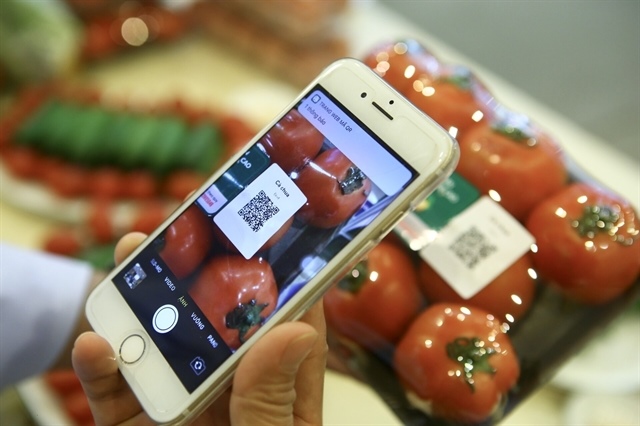
A customer scans a QR code for information about farm produce. Việt Nam is pushing ahead with plans to make electronic traceability mandatory for food products.— VNA/VNS Photo Minh Quyết |
As counterfeit food products spread more easily through online marketplaces and fragmented supply chains, Việt Nam is turning to QR codes and digital traceability systems as a new frontline defence.
But behind the promise of smarter food safety lies a more complicated reality, where rising costs, weak oversight and unreliable data threaten to undermine consumer trust.
Under proposed amendments to the Law on Food Safety drafted by the Ministry of Health, food products circulating on the market would be required to carry traceability information through QR codes, barcodes, DataMatrix or other digital tools.
The move is needed because current regulations do not clearly require electronic identification and traceability, which creates loopholes that have made it harder to combat counterfeit goods, smuggled food products and fake products, especially those sold online, according to the ministry.
The proposal also reflected a broader push toward digital governance and safer food supply chains, with QR codes increasingly promoted as a technological solution allowing consumers and regulators to trace products and enabling from-farm-to-table value chain.
Yet behind the black-and-white squares printed on packaging lies a more complicated reality.
For agricultural cooperatives, the cost of applying QR codes to every product can quickly become a financial burden.
A vegetable cooperative supplying millions of products each month must pay not only for printing labels, but also for labour, software subscriptions and data management systems required to maintain digital traceability platforms.
Phạm Ngọc Thạch, director of Sunfood Đà Lạt Agricultural Services Cooperative in Lâm Đồng Province, told vnbusiness.vn that the largest expense was not only the labels but also the annual fees charged by traceability platforms.
“Without support, many cooperatives will struggle to maintain the system in the long term,” Thạch said.
Each traceability label is estimated to cost between VNĐ200 and VNĐ500. For a cooperative selling 10,000 products a day, monthly spending on labels alone can reach VNĐ5-15 million, directly cutting into already thin profit margins.
Trust questions
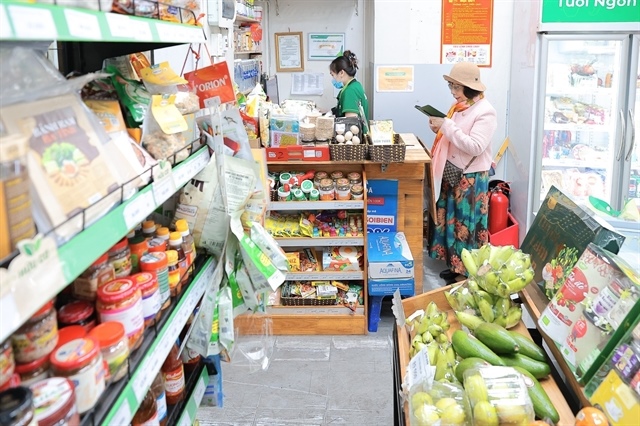
A customer scans a QR code for information about farm produce. Việt Nam is pushing ahead with plans to make electronic traceability mandatory for food products.— VNA/VNS Photo Minh Quyết |
A real problem is that QR codes only display information entered into the system by producers and cannot independently verify whether production standards were actually followed.
Nguyễn Hải Hà, a consumer in Hà Nội, questioned how buyers could know whether produce inside a package truly matched the information shown by a QR code.
“If the code says the vegetables came from a certified farm, but the actual product did not, how would consumers know?” she said.
“And who would be responsible?”
Such concerns have fuelled fears that traceability technology could be misused to legitimise poor-quality products rather than eliminate them, potentially undermining consumer trust.
Hoàng Văn Thám, director of Chúc Sơn Cooperative, said QR codes were necessary, but their effectiveness would depend on transparent data, ethical producers and strict supervision.
Experts say improving food safety requires tighter control over the roots of the supply chain rather than focusing mainly on traceability labels, including stricter oversight of fertilisers, pesticides and seeds entering the market, along with tougher enforcement against counterfeit agricultural inputs.
Nguyễn Văn Hà, head of Nghệ An’s Sub-Department of Quality Management, Processing and Market Development, said digital traceability would help improve transparency and strengthen confidence in Vietnamese agricultural products.
Still, QR technology alone cannot solve the country’s food safety challenges.
“Traceability is an inevitable trend in the digital economy,” one agricultural specialist said.
“But if the roots of the supply chain are not transparent, QR codes risk becoming little more than a clean label covering products that are not truly clean.”
Nguyễn Trung Đông from the Institute of Public Policy and Rural Development under the Ministry of Agriculture and Environment said it would be necessary to enhance management of the market for fertilisers and pesticides.
QR traceability systems should be accompanied by broader reforms across the agricultural supply chain, he added.
He called for State subsidies for traceability software and digital equipment instead of leaving cooperatives to navigate the technology market on their own.
National system
The Ministry of Public Security has proposed a national platform for product identification, authentication and traceability in an effort to prevent counterfeits and low-quality products.
Under the proposal, each product would be assigned a unique identification code (UID), allowing consumers to scan QR codes through a mobile application or national web portal to access information on origin, distribution history and product legality.
The ministry said counterfeit goods were becoming increasingly sophisticated, with fake QR labels, duplicated codes and fraudulent origin claims appearing more frequently, especially on e-commerce platforms and social media.
The proposed platform would also allow consumers to report suspected violations directly to authorities through the application.
Businesses, meanwhile, would be able to integrate the national platform with existing management systems such as ERP, POS and warehouse software, reducing compliance costs and simplifying reporting procedures.
Officials said the system could also help Vietnamese goods meet stricter transparency requirements under free trade agreements such as the EVFTA and CPTPP, improving export competitiveness.
The draft proposal is expected to be submitted to the Government in the second quarter of this year.
- 09:43 30/05/2026