HNX to operate Việt Nam's future carbon exchange
HNX to operate Việt Nam's future carbon exchange
The National Registration System for greenhouse gas emission allowances and carbon credits will be directly connected to the carbon trading platform operated by the Hanoi Stock Exchange (HNX) and the custody system managed by the Vietnam Securities Depository and Clearing Corporation (VSDC).

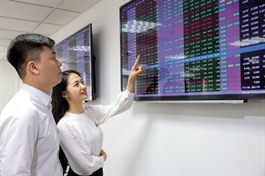
The headquarters of the Hanoi Stock Exchange in Hanoi. — VNS Photo Ly Ly Cao |
The emerging carbon market is beginning to resemble a familiar financial ecosystem, complete with trading accounts, custody services, electronic settlement and ownership transfers, as authorities move closer to launching a domestic carbon trading platform.
Under Circular 11/2026/TT-BNNMT, issued by the Ministry of Agriculture and Environment on May 27, the National Registration System for greenhouse gas emission allowances and carbon credits will be directly connected to the carbon trading platform operated by the Hanoi Stock Exchange (HNX) and the custody system managed by the Vietnam Securities Depository and Clearing Corporation (VSDC).
The arrangement places two key institutions from Việt Nam's securities market at the centre of the country's future carbon trading framework. HNX will be responsible for organising carbon trading activities, while VSDC will oversee custody, transfers and settlement.
The structure has led many observers to describe the future platform as an emissions stock exchange because of its similarities to the country's existing securities market.
According to the circular, all greenhouse gas emission allowances and carbon credits will be assigned unique identification codes and electronic serial numbers before being centrally managed within the national registration system. Transactions involving deposits, withdrawals, ownership transfers and emissions offsetting will be conducted electronically.
In practice, the system mirrors many features already familiar to stock market participants. Companies will hold dedicated carbon accounts, similar to securities accounts used for stock trading.
Emission allowances and carbon credits will be deposited and held through VSDC in a manner comparable to the centralised custody of shares. Transaction data generated during trading sessions will be reconciled between systems at the end of each trading day.
Some experts believe the approach could significantly reduce infrastructure development costs by leveraging existing technology and operational expertise from Việt Nam's securities market.
Rather than building a completely new trading platform from scratch, authorities are utilising established market infrastructure that already supports trading, settlement and asset custody functions.
The infrastructure development comes as Việt Nam prepares to pilot a domestic carbon exchange beginning in 2028, making the current phase an important step in establishing the technical foundations required for future market operations.
According to the Ministry of Agriculture and Environment, the new system will manage the entire lifecycle of emission allowances and carbon credits, from issuance through to cancellation.
The framework will also allow enterprises to carry forward unused emission allowances to future compliance periods, borrow allowances from future allocations and use carbon credits to offset emissions.
While the infrastructure model has been welcomed as a practical solution, its similarities to financial markets have also generated debate among market observers.
In Europe, emissions trading systems have at times experienced sharp carbon price increases as financial investors entered the market. Carbon credits, originally designed as environmental policy instruments, have increasingly evolved into tradable assets with speculative characteristics.
Today, a number of international investment funds view carbon as a form of green financial commodity, comparable in some respects to gold, energy products or other exchange-traded assets.
Such developments have prompted concerns that Việt Nam's carbon market could become increasingly financialised if oversight mechanisms are not sufficiently robust.
Another challenge relates to the quality and credibility of carbon credits themselves.
Unlike stocks, whose value is tied to corporate performance and ownership rights, the value of a carbon credit depends on the ability to demonstrate that a genuine and verifiable reduction in greenhouse gas emissions has occurred.
If emissions inventory data proves unreliable or verification processes remain weak, confidence in the market could be undermined.
The newly issued circular primarily addresses trading infrastructure and asset management procedures. However, a more significant challenge lies in developing a reliable Measurement, Reporting and Verification (MRV) system, which forms the foundation of any functioning carbon market.
Many Vietnamese enterprises are still unfamiliar with greenhouse gas inventory reporting requirements. Export-oriented sectors in particular continue to face difficulties in meeting increasingly stringent emissions disclosure requirements from major overseas markets, including the European Union and the US.
The pressure is expected to intensify as the Carbon Border Adjustment Mechanism (CBAM) enters its taxation phase in 2026.
The mechanism will require exporters to account for the carbon content of products entering the EU market, creating additional incentives for Vietnamese companies to participate in the carbon ecosystem and improve emissions management practices.
Market analysts noted that the involvement of HNX and VSDC signals the country's preference for a market-based approach to carbon management rather than relying solely on administrative emissions controls.
- 09:24 03/06/2026