Analysts see early signs of a new growth cycle despite market weakness
Analysts see early signs of a new growth cycle despite market weakness
The market currently exhibits many characteristics associated with a growth phase, where corporate earnings continue to expand but valuation is no longer the primary driver of stock performance.

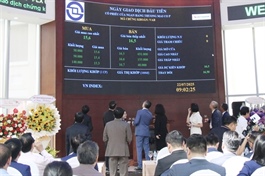
Investors watch the market's movements at a trading office of a securities firm in Hà Nội. — VNA/VNS Photo |
The stock market closed the final trading week of May on a negative note, with the benchmark VN-Index extending its losing streak to four consecutive sessions as liquidity fell to its lowest level since the beginning of the year and foreign investors continued aggressive net selling.
Although the benchmark index posted only a moderate decline, many investors incurred losses as weakness spread across a broad range of stocks, reflecting a challenging environment for stock selection and portfolio performance.
On the Hochiminh Stock Exchange (HoSE), the VN-Index finished last week at 1,863.49 points, down 0.73 per cent from the previous week.
Market liquidity remained notably weak. Average daily trading value on the southern bourse fell to approximately VNĐ20.44 trillion (US$776.8 million), a decline of 24.5 per cent from the previous week.
Matched trading volume reached 729 million shares, down more than 20 per cent and standing 26.6 per cent below the 20-week average.
The decline in liquidity underscored the cautious sentiment among investors, with cash flows becoming increasingly selective and concentrated in only a handful of sectors or stocks with distinct growth narratives.
Foreign investors continued to add pressure on the market through sustained net selling.
On the final trading day of May alone, overseas investors recorded net sales of more than VNĐ750 billion across the market.
On the HoSE, foreign investors sold a net VNĐ704 billion, equivalent to nearly 23.8 million shares. Meanwhile, net selling on the Hanoi Stock Exchange amounted to nearly VNĐ50 billion.
For the entire week, foreign investors posted net sales totalling approximately VNĐ4.92 trillion, marking a 12 consecutive session of net selling.
Despite the recent weakness, market analysts noted that the current market environment remains characterised by strong divergence rather than broad-based declines.
Many experts believe weaker liquidity has limited the market's ability to generate a sustainable upward trend, causing capital flows to focus primarily on selected industries and companies with specific catalysts.
Analysts also pointed to several medium- and long-term factors that could support the emergence of a new growth cycle for the market, including stronger credit expansion, accelerated public investment disbursement, institutional reforms and prospects for a market status upgrade.
Đỗ Hồng Vân, head of Data Analytics at Fingroup, said the market currently exhibits many characteristics associated with a growth phase, where corporate earnings continue to expand but valuation is no longer the primary driver of stock performance.
"Corporate profits are still growing, but valuations are no longer the main growth catalyst," Vân said.
According to Fingroup data, the market's forward price-to-earnings (P/E) ratio currently stands at around 12.3 times. While not considered expensive, the valuation level is no longer particularly attractive when compared with expected corporate earnings growth in 2026.
As a result, Vân noted that future market performance is likely to depend more heavily on actual earnings growth and business fundamentals rather than valuation expansion.
Nguyễn Minh Hoàng, director of research at VFS Securities, said the next upward phase of the market would likely be a continuation of the policy-driven wave that began in 2025.
According to Hoàng, the key drivers include credit growth, public investment, institutional reforms and the possibility of Việt Nam's stock market being upgraded to emerging-market status.
With a credit growth target of around 15 per cent on an outstanding loan base of approximately VNĐ19 quadrillion, the amount of capital injected into the economy could reach around VNĐ2.7 quadrillion, Hoàng said.
He added that a market upgrade could attract approximately $1.5-1.6 billion from exchange-traded funds (ETFs), while total inflows could reach US$5-6 billion when active funds are included.
Analysts at Vietnam Construction Securities (CSI) maintained a cautious view in the near term, citing persistently low liquidity and the absence of strong cash flows.
The brokerage said investors should prioritise holding existing portfolios while remaining selective in identifying sectors showing signs of strengthening trends until market conditions become more balanced.
As May came to a close, trading activity reflected a market still searching for a new catalyst, with weak liquidity, persistent foreign selling and heightened stock-specific divergence continuing to shape investor sentiment.
- 08:06 01/06/2026