Shaping Vietnam's future skyline
Shaping Vietnam's future skyline
The EuroCham Construction Sector Committee, and the Council on Vertical Urbanism on May 19 jointly held the Tall Building Forum 2026 in Ho Chi Minh City, attracting more than 200 representatives from government, architecture, engineering, urban planning, finance, and real estate.
Opening the forum, EuroCham vice-chair Jean-Jacques Bouflet emphasised that Vietnam had entered a decisive stage in its urban evolution. As Hanoi and Ho Chi Minh City continue absorbing rapid population growth, high-rise development is no longer merely a symbol of prestige, but a strategic necessity tied to land efficiency, infrastructure integration, and long-term competitiveness.
“Recent policy developments, including the implementation of the revised Law on Construction and ongoing institutional reforms, demonstrate Vietnam’s strong commitment to building a more modern, efficient, and sustainable urban environment,” Bouflet said.
He also highlighted that this year’s agenda focused specifically on Transit-Oriented Development (TOD), green high-rise design, and the pressing need for quality public housing, issues increasingly central to Vietnam’s next chapter of urbanisation.
Rethinking Vietnam’s urban future
That message resonated strongly with representatives from the Ministry of Construction (MoC), who acknowledged that Vietnam’s urbanisation model is entering a far more complex phase. While high-rise development has accelerated dramatically over the past decade, challenges surrounding infrastructure synchronisation, technical standards, waste management, energy efficiency, and climate resilience have become increasingly visible across major cities.
Le Minh Long, deputy director general of the MoC’s Department of Science, Technology, Environment and Building Materials, underscored that the ministry’s priorities now lie in narrowing the gap between academic research and implementation, while ensuring sustainability becomes a regulatory baseline rather than an optional premium feature.
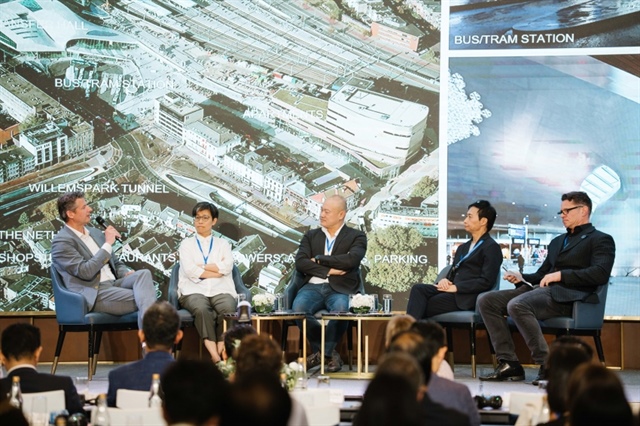
Photo: EuroCham |
“The Tall Building Forum has become an important platform for exchanging practical solutions on smart and sustainable construction,” Long said. “Urban planning and management must stay ahead of development to ensure synchronisation between high-rise projects and social infrastructure. The ministry will continue improving the legal framework to support modern, safe, and green urban growth.”
According to experts, across Asia, Europe, and the Middle East, cities are increasingly rethinking what tall buildings should achieve in the age of climate change. The emphasis is shifting away from isolated skyscrapers towards integrated “vertical communities,” where living, working, commerce, mobility, and public space coexist within walkable urban systems.
Shonn Mills, chairman of the Council on Vertical Urbanism, presented data from the past fifteen years of global tall-building development, noting that mixed-use projects integrating residential, office, retail, and social functions have become the defining trend of the decade.
“Ho Chi Minh City’s unique urban fabric and extreme density, ranking in the top 20 globally, present both a challenge and an opportunity,” Mills said. “Tall buildings are no longer simply structures; they are becoming vital components of dense, living metropolises.”
That notion of density as an opportunity, not merely a problem, became one of the forum’s defining ideas. Vietnam’s cities have historically evolved around vibrant street life, layered social interaction, and mixed commercial activity. Participants repeatedly stressed that future urban development must preserve these human dynamics even as cities grow vertically.
Marc Salemink, associate director and senior architect at UNStudio, explored the concept of “vertical communities,” arguing that the next generation of towers should function as “cities within cities,” incorporating semi-public spaces that foster interaction, identity, and belonging. Drawing from UNStudio’s transformative project in Frankfurt, which integrates contemporary architecture atop a historical structure, he demonstrated how new technologies and design innovation can coexist with cultural and historical preservation.
“Congestion is an inevitable challenge in growing cities, so we must look beyond cars to other transport modes,” Salemink said. “We must look at how people actually move through cities to build cities that truly serve people.”
Florence Chan, principal at Kohn Pedersen Fox, highlighted the transformation of Victoria Harbour in Hong Kong as an example of how commercial waterfronts can evolve into vibrant public destinations that reconnect people with the city. Reflecting on the long-term sustainability of urban projects, she argued that Vietnam’s next generation of developments must move beyond short-term construction metrics towards broader lifecycle thinking.
“We need to pivot from discussing construction costs to focusing on life-cycle costs,” Chan said. “Investing in superior materials and integrated designs today pays dividends in the longevity and performance of the building over decades.”
Her remarks reinforced a wider discussion throughout the forum on how future developments should be evaluated not only by floor area or investment speed, but also by long-term durability, environmental performance, and contribution to public life.
Next chapter of Vietnam’s skyline
Examples from Singapore drew particular attention throughout the forum. Projects such as PARKROYAL on Pickering, Oasia Downtown, Pan Pacific Orchard, and SkyVille@Dawson illustrated how greenery, natural ventilation, public terraces, and climate-responsive façades can transform high-density developments into healthier urban ecosystems. Rather than sealed glass towers disconnected from surrounding communities, these projects integrate biodiversity, passive cooling systems, and shared social spaces directly into the architecture itself.
Similarly, the One Bangkok development was highlighted as a major example of how large-scale vertical districts can integrate public transit, green public space, and pedestrian connectivity into a cohesive urban experience.
Dennis Ho, director of Strategic Development APAC at Skidmore, Owings & Merrill, stressed that future developments must prioritise “a brief for people over a brief for developers.” Reflecting on One Bangkok’s integration of major towers around central civic spaces and transit stations, he argued that the success of future cities will increasingly depend on the quality of public life created at ground level.
“People do not want to live inside isolated air-conditioned silos,” Ho said. “They want cleaner, healthier spaces that foster community and wellbeing. For the next 10 years, our focus should be on the ‘void’ between buildings, the spaces that facilitate community connectivity.”
At the event, discussions also focused on Transit-Oriented Development, which many experts described as essential to addressing congestion, pollution, and fragmented urban sprawl.
Experts noted that TOD is particularly critical for Ho Chi Minh City and Hanoi, where motorbike dependency and rapid outward expansion continue to strain infrastructure capacity. Rather than endlessly expanding city boundaries, speakers argued that Vietnam now has an opportunity to create compact, walkable, mixed-use urban clusters centred around public transit networks.
While global examples provided inspiration, discussions repeatedly returned to Vietnam’s own vulnerabilities and constraints. Rapid urbanisation, combined with climate pressures and infrastructure limitations, means that Vietnam’s cities must balance ambition with resilience far more carefully than many mature economies did during earlier development phases.
- 09:49 20/05/2026