PM calls for continued Japanese support for Cambodia’s growth
PM calls for continued Japanese support for Cambodia’s growth
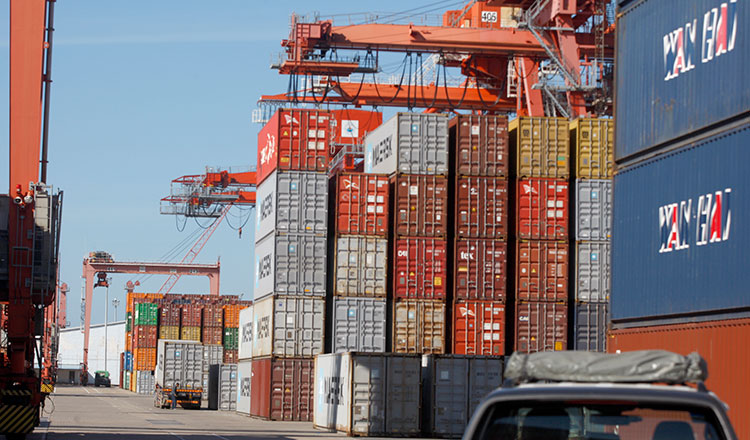
Experts say the expansion of Sihanoukville Autonomous Port could be a game-changer for the Kingdom’s economy, reducing logistics costs, attracting foreign investment, and strengthening the country’s role in global trade.
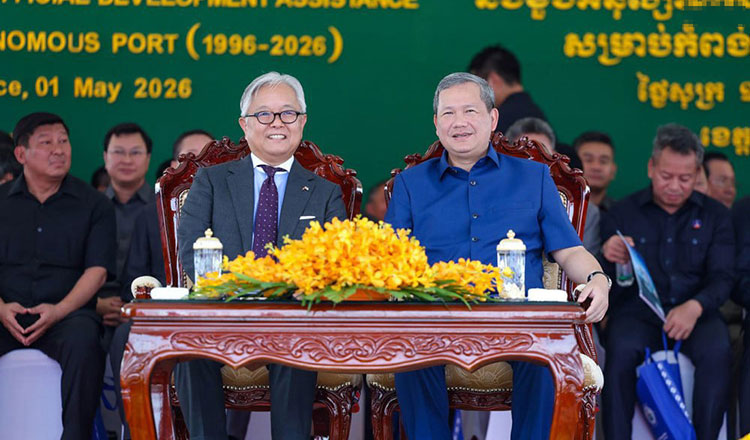
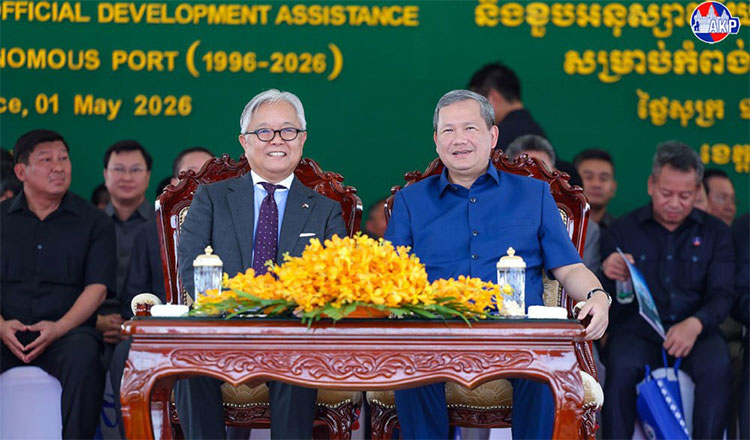
Prime Minister Hun Manet has called on Japan to deepen its support for Cambodia’s infrastructure and logistics sector, with a particular focus on expanding the capacity of Sihanoukville Autonomous Port (PAS), the country’s only deep-sea port and a cornerstone of its trade ambitions.
Speaking on Friday at a function marking the 30th anniversary of Japan’s Official Development Assistance (ODA) to PAS (1996–2026), the Prime Minister highlighted the strategic importance of continued collaboration. The event also coincided with celebrations for the 140th anniversary of International Labour Day, underscoring the role of workers and human capital in national development.
Mr Hun Manet expressed strong appreciation to the Japanese government and its development arm, the Japan International Cooperation Agency (JICA), crediting them with playing a transformative role in Cambodia’s infrastructure progress over the past three decades.
“Japan is a leading partner that has supported the development and expansion of PAS since 1996,” he said. “Today, Japan not only provides financial assistance but also supports the construction and management of the port.”
Located along Cambodia’s southwestern coast, Sihanoukville Autonomous Port serves as the country’s primary maritime gateway, handling the vast majority of its containerised cargo. As Cambodia continues to integrate into regional and global supply chains—particularly through frameworks such as the Regional Comprehensive Economic Partnership (RCEP)—the port’s efficiency and capacity have become increasingly critical.
Mr Hun Manet emphasised that infrastructure development remains a central pillar of the Royal Government’s economic strategy, linking improved logistics to trade competitiveness, foreign investment, and industrial growth. He also urged PAS authorities to accelerate modernisation efforts and strengthen connectivity with major global ports, particularly across Asia and the Indo-Pacific.
In addition to port expansion, the Prime Minister expressed hope that Japan would extend further assistance to the development of the Cambodia Logistics Centre, a planned hub adjacent to PAS designed to streamline cargo handling, warehousing, and distribution. The project is expected to enhance Cambodia’s position as a regional logistics hub and reduce trade costs.
While highlighting the benefits of modernisation and digital transformation, Mr Hun Manet stressed that infrastructure upgrades must be matched by investments in human resources. He called for a comprehensive assessment of workforce needs at PAS, including both the quantity and quality of personnel required to manage increasingly complex operations.
“Modern technology is beneficial, but without capable human resources, it cannot be effectively utilised,” he said. “Therefore, strengthening human capacity is essential.”
The Prime Minister also urged improvements in organisational structures, performance evaluation systems, and the integration of information technology into human resource management. Such reforms, he noted, would be key to improving service delivery and maintaining competitiveness in a rapidly evolving maritime sector.
Established in 1956, Sihanoukville Autonomous Port has played a pivotal role in Cambodia’s economic development for decades. However, its operations were disrupted during the period of conflict from 1975 to 1979, before gradually resuming on a limited scale. Since then, with sustained support from international partners, the port has undergone steady expansion and modernisation.
Japan’s involvement has been particularly significant, with JICA providing both financial and technical assistance since the mid-1990s. This partnership has helped transform PAS into a more efficient and internationally connected facility.
Currently, PAS is undergoing a major three-phase expansion of its new container terminal, implemented in cooperation with Japan through JICA. The project aims to significantly increase capacity and accommodate larger vessels, positioning Cambodia to better compete in regional shipping networks.
Phase 1 of the expansion includes a 350-metre-long terminal with a depth of 14.5 meters, capable of handling approximately 93 percent of vessels operating in the Asia-Pacific region. As of April 2026, construction is about two-thirds complete, with operations expected to begin in early 2027. Once operational, the port’s capacity will increase to 1.45 million twenty-foot equivalent units (TEUs) per year.
Phase 2 will extend it to 400 metres with a depth of 16.5 metres, enabling the port to accommodate larger vessels commonly used in Indo-Pacific trade routes. Construction is scheduled to begin in September 2026 and conclude in 2029, raising total capacity to 2.02 million TEUs annually.
Phase 3, currently in the bidding preparation stage, will add a 430- metre terminal with a depth of 17.5 meters. This final phase is expected to allow direct global shipping routes to Sihanoukville, reducing reliance on transhipment hubs in neighbouring countries. Construction is projected to start in early 2027 and finish by 2030, boosting total capacity to 2.64 million TEUs per year.
Experts say the expansion of Sihanoukville Autonomous Port could be a game changer for Cambodia’s economy, reducing logistics costs, attracting foreign investment, and strengthening the country’s role in global trade. However, they also note that success will depend not only on physical infrastructure but also on regulatory reforms, workforce development, and efficient management.
- 07:55 04/05/2026