Banks get new growth opportunities from digital credit for business households
Banks get new growth opportunities from digital credit for business households
Government’s new policies on streamlining and digitalising cash flow and business performance of business households and individual businesses are opening up significant opportunities for banks to boost digital lending to the customer group.
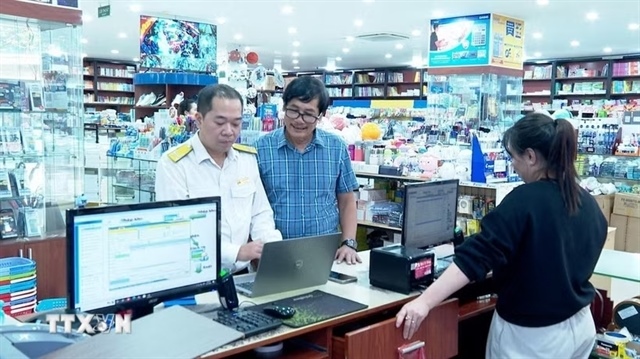
Many banks have quickly accelerated the deployment of platforms to support the digital transformation of business households. — VNA/VNS Photo |
Government policies to streamline and digitalise cash flow and business performance among business households and individual businesses are opening up significant opportunities for banks to expand digital lending to this customer group.
Since the beginning of 2026, a series of new regulations related to payment accounts and tax obligations have forced business households and individual businesses to change their operations towards greater transparency and professionalism. The prohibition of using personal accounts for business transactions, along with the requirement for transparency in cash flows, is establishing a new standard in financial management for the group.
Against this backdrop, demand for a synchronised financial solution ecosystem, from cash flow management and billing to access to credit, is rising significantly. Seizing this trend, many banks have quickly joined in, accelerating the deployment of platforms to support the digital transformation of business households.
Specifically, BIDV quickly integrated the MyShop Pro sales management solution directly into its SmartBanking application, allowing users to use both personal and business accounts simultaneously with the ability to track cash flow separately.
ABBANK collaborated with the Sales Ledger application to develop an integrated solution, enabling businesses to open accounts online, receive real-time balance change notifications and manage all sales activities on a single platform.
Meanwhile, MB introduced its MB Seller digital solution specifically for small businesses, integrating specialised accounts on its digital banking application to help separate cash flow and aggregate transactions at each stage for tax declaration purposes.
Techcombank also joined the trend with the launch of its T-Shop application, targeting retail customers, especially in the F&B sector, providing solutions ranging from payment and sales management to loan support and cash flow optimisation.

Many banks have quickly accelerated the deployment of platforms to support the digital transformation of business households. — VNA/VNS Photo |
According to industry observers, the wave of banks entering this segment is not simply about supporting digital transformation but also reflects a strategic shift towards deeper access to the small business and household business customer base, a highly potential market previously difficult to exploit due to a lack of transparent data.
Finance and banking expert Lê Hoài Ân said the trend is a significant growth opportunity for the banking sector but not in the direction of mass lending expansion. He noted that the real opportunity lies in changing the approach to a very large segment that has long lacked sufficient standardised data for assessment.
“The most important point of the new policies is not just changing the tax management method but gradually forcing the cash flow of household businesses to become more transparent. When the cash flow has a clear trace, digital credit will have a foundation for sustainable development,” Ân said.
According to Ân, in the coming time the expansion of electronic invoices, the promotion of cashless payments and the improvement of the declaration mechanism will lead to more complete data on the business activities of many individual households. This is a crucial change because for a long time banks had no shortage of demand for lending to small traders and household businesses but lacked the ability to accurately assess their financial health.
With the digitalisation of revenue, payments and tax obligations, banks can shift from manual assessment methods to data-driven credit scoring. This is the most important foundation for the further development of digital credit in the household business segment, which previously relied primarily on subjective assessments or collateral.
Ân believed that this is a suitable step in the shift towards retail lending in the banking industry. Small businesses and household businesses are gradually becoming an increasingly important customer group, not only because of their large scale but also because of their ability to create new growth opportunities for many banks. If exploited well, this segment could help banks both expand credit and improve risk diversification compared with a model that focuses too heavily on a few large corporate clients.
However, Ân noted that the expansion of the customer base also places higher requirements on banks for assessment and risk control. The growth potential in this segment is real but the winning bank will not be the one that disburses funds the fastest but rather the one that understands its customers best, builds the most realistic credit scoring model and controls fraud most effectively.
“If done correctly, this will be a very attractive market. But if credit is extended beyond control, today's short-term profits can easily become tomorrow's bad debts,” he said.
- 08:02 07/05/2026