After-sales service for home appliances emerges as lucrative market in Việt Nam
After-sales service for home appliances emerges as lucrative market in Việt Nam
Việt Nam’s home care equipment service market, including repair, maintenance and servicing, is estimated at $7.07 million in 2025, up 7.6 per cent from a year earlier. The market is forecast to expand to roughly $12.27 million by 2028.
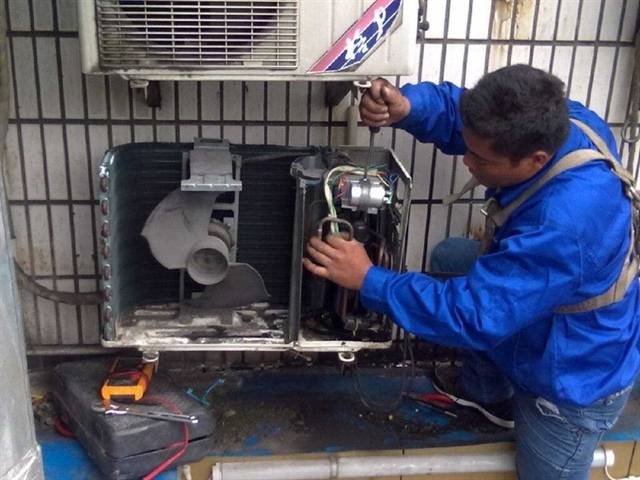
An air conditioner repair technician at work. —Photo thaolapdieuhoa.com |
Maintenance and repair services for household appliances, such as washing machines, air conditioners and refrigerators, are becoming a fast-growing and highly competitive segment in Việt Nam, attracting both independent technicians and large corporations seeking to extend product lifecycles and strengthen customer loyalty, industry insiders said.
Manufacturers recommend that major appliances undergo servicing every six to 12 months to ensure efficiency and durability. Combined with frequent breakdowns during use, this has created sustained demand for after-sales services across urban and rural households.
A simple online search for air conditioner repair yields hundreds of providers, ranging from freelance workers to organised service platforms, many competing on price and speed while promising quality.
Data from Euromonitor show that Việt Nam’s home care equipment service market, including repair, maintenance and servicing, is estimated at US$7.07 million in 2025, up 7.6 per cent from a year earlier. The market is forecast to expand to roughly $12.27 million by 2028.
The sector is further supported by growth in the housing and renovation market, which is projected to reach nearly $4 billion by 2026, driving both new appliance purchases and demand for ongoing maintenance services.
Industry participants said demand can surge sharply during seasonal peaks.
Đỗ Trọng Phú, an appliance repair technician in Hà Nội, said that during the hot season, his two-person team handles eight to 12 jobs a day, about four to five times higher than usual.
Service fees for cleaning an air conditioner typically range from VNĐ150,000 to VNĐ260,000 ($6–10) per unit, while more complex repairs involving replacement parts can cost several million đồng. Skilled technicians can earn between VNĐ1 million and VNĐ2 million per day after expenses, he added.
Buoyant repair market
An air conditioner repair technician at work. —Photo thaolapdieuhoa.com |
Alongside freelance technicians, the appliance repair market has seen growing participation from large companies and service platforms.
Retailer Điện Máy Xanh has developed a technical workforce of thousands of staff, extending its services beyond its own customers and handling millions of repair and installation orders each year.
The company posted technical service revenue of VNĐ701 billion in the first three months of 2026, up 45 per cent year-on-year and exceeding its full-year 2024 figure of VNĐ673 billion, vnbusiness.vn reported.
Manufacturers are also expanding into direct service models. Daikin is investing in customer service centres and a mobile application that allows users to book authorised technicians.
At the same time, home service platform bTaskee is expanding into appliance cleaning services, including air conditioner and washing machine cleaning, reflecting growing interest in the segment.
According to industry participants, the repair business, despite its physically demanding nature, is attracting investment due to relatively high margins. While appliance retail typically generates gross margins of around 10–15 per cent, maintenance and repair services can reach up to 40 per cent, they said.
A representative of an electronics chain in Hà Nội said that after-sales services also provide recurring revenue and help build long-term customer relationships, as satisfied customers are more likely to return for future purchases.
Unlike informal technicians, who often operate without standardised pricing or warranties, corporate service providers are increasingly using apps and published pricing structures to improve transparency and efficiency.
However, analysts said scaling the sector remains challenging due to workforce management and training requirements. Việt Nam’s appliance market includes dozens of brands and thousands of product models, requiring technicians to continuously update their skills.
They added that informal networks remain strong, as many households still rely on trusted individual technicians rather than booking services through platforms.
Despite the rapid expansion of organised players, experts said the sector still has significant untapped potential but requires large-scale workforce capacity, strong logistics systems and established customer bases to fully professionalise the market.
- 19:21 07/05/2026