Việt Nam eyes entry into $40-billion Southeast Asian CCS market: experts
Việt Nam eyes entry into $40-billion Southeast Asian CCS market: experts
Việt Nam possesses favourable conditions for storing carbon dioxide (CO2) in depleted oil and gas fields, deep saline aquifers and deep coal seams, particularly in the Red River Basin and the Cửu Long – Nam Côn Sơn basin areas. Such geological advantages are not widely available among countries in the region.
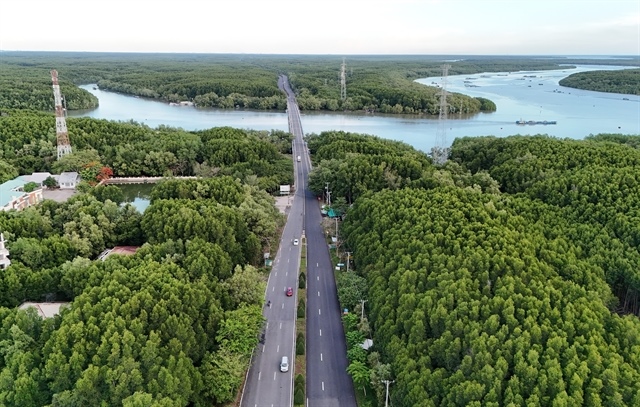
The Cần Giờ forest in HCM City. Việt Nam should work towards providing CCS services to international customers and accessing climate finance mechanisms under Article 6 of the Paris Agreement. — VNA/VNS Photo Hồng Đạt |
Việt Nam could tap into Southeast Asia’s carbon capture and storage (CCS) services market, estimated at around US$40 billion, if the sector receives appropriate investment and is developed along the right path, according to Dr. Nguyễn Văn Tư, Director of the Vietnam Petroleum Institute (VPI).
Speaking to the press about the economic potential of CCS, Tư said Việt Nam possesses favourable conditions for storing carbon dioxide (CO2) in depleted oil and gas fields, deep saline aquifers and deep coal seams, particularly in the Red River Basin and the Cửu Long – Nam Côn Sơn basin areas. Such geological advantages are not widely available among countries in the region.
For CCS projects, the use of depleted oil and gas fields, for which geological data and reservoir models are already available, could significantly reduce geological risks and investment costs, he noted.
According to Tư, VPI research shows that the full-chain cost of capturing, transporting, and storing CO2 ranges from approximately $100 USD to $350 per tonne. Meanwhile, domestic pilot carbon credit prices stand at only about VNĐ120,000-140,000 ($4.6-5.4 USD) per tonne, while Việt Nam’s mandatory carbon market is not expected to officially come into operation until 2029.
In the initial phase, he suggested prioritising CO2 injection for enhanced oil recovery, with additional oil output helping offset CCS costs. At the same time, Việt Nam should work towards providing CCS services to international customers and accessing climate finance mechanisms under Article 6 of the Paris Agreement.
He added that three key legal issues need to be clarified in guiding regulations under the amended Petroleum Law to enable the safe and sustainable deployment of CCS. These include rights to use offshore subsurface storage space, long-term liabilities of storage sites, including addressing incidents such as CO2 leakage, and the establishment of an internationally compliant measurement, reporting and verification (MRV) system to facilitate cross-border trading of carbon credits generated by CCS projects in Việt Nam.
These are complex technical and legal matters requiring thorough research and consultation of international experience, he stressed, adding that under the direction of the Vietnam National Industry – Energy Group (Petrovietnam), VPI is studying these issues and stands ready to coordinate with relevant authorities in developing appropriate criteria and proposing a small-scale commercial CCS pilot project for the 2027-2030 period.
Sharing the view, Associate Professor Dr. Lê Minh Thông from Hanoi University of Mining and Geology said State-owned enterprises should play a leading role during the initial development of CCS, given the sector’s demanding requirements in technology, engineering expertise and investment capital.
Petrovietnam, with years of research experience, offshore oil and gas expertise and a highly skilled workforce, should continue to pioneer research, testing and implementation of CCS and other new energy projects, he said.
A clear, transparent and stable legal framework would not only enable Petrovietnam to play a leading role in new energy development but also strengthen investor confidence, encouraging both domestic and foreign enterprises to invest, transfer technology and cooperate in developing large-scale CCS projects, Thông added.
- 09:55 04/09/2026