Hanoi sets timetable to allow pilot production of rare earth oxides
Hanoi sets timetable to allow pilot production of rare earth oxides
Hanoi People’s Committee has approved a pilot project to produce rare earth oxides with a purity of over 95 per cent from Vietnamese rare earth ore at a semi-industrial scale.
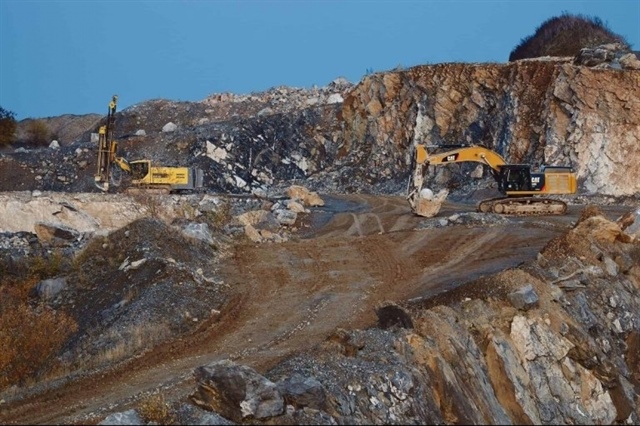
Hanoi allows pilot production of rare earth oxides in 18 months. Photo:VIR |
Truong Viet Dung, Vice Chairman of Hanoi People's Committee, on September 1, signed a decision allowing the Mining Technology and Construction Consultancy JSC to conduct a pilot project in Hanoi.
Under Decision No.4657/QD-UBND, the company will be allowed to pilot test a process for producing total rare earth oxides with a purity exceeding 95 per cent from rare earth ore sourced in Vietnam.
The pilot project will take effect within 18 months from the date the decision was signed. The entire operation is subject to strict monitoring via a camera system and 33 specific key performance indicators (KPIs) covering technical, environmental, and radiation safety aspects.
These KPIs are considered the basis for controlling, monitoring, and evaluating test results. The obtained results provide a scientific and practical basis for improving technological processes, developing technical standards and regulations, and establishing management norms for the deep processing of rare earth elements.
The processing line will have a designed capacity of 100 kg of run-of-mine ore per hour, with a maximum of 100 metric tonnes of ore to be used during the pilot.
The ore will come from the Dong Pao mine in Lai Chau province.
The technology, covered by Vietnamese Patent No.33663, involves two main stages, namely flotation to enrich the ore into concentrate and hydrometallurgical processing to produce total rare earth oxides.
The technology uses a water-recycling process during hydrometallurgical treatment and is designed to recover valuable products and by-products, including barite, fluorite and sodium hexafluorosilicate. This process is expected to improve resource use and reduce waste generation.
Thirty-five people are involved in operating the project. Personnel receive intensive training in chemical safety, radiation safety, and production line operation.
A key principle of the project is the non-commercialisation of products during the testing period. It means that the products created are used only for analysis, testing, and technological refinement; they are not to be sold, traded commercially, or given away.
The project does not involve on-site mineral extraction or long-term industrial investment at the testing site.
Hanoi Department of Science and Technology was assigned to coordinate with agencies to guide, supervise, inspect and evaluate the pilot, and handle issues arising during the process within its authority.
- 17:57 04/09/2026