SMEs struggle to access credit despite major role in economy
SMEs struggle to access credit despite major role in economy
Only about 20-25 per cent of SMEs are currently able to obtain bank loans, underscoring a structural bottleneck in the financial system.
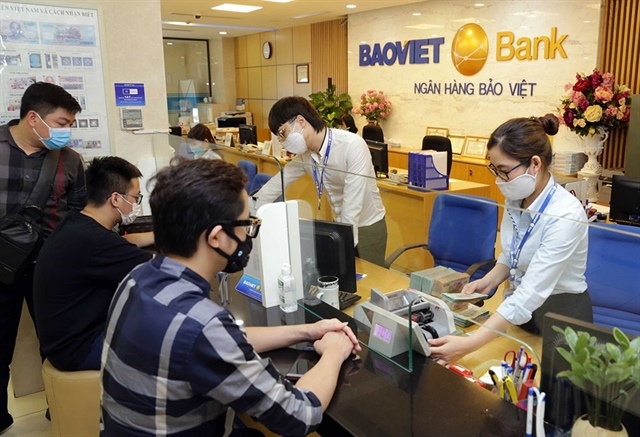
Customers conduct transactions at a BaoViet Bank office. — Photo courtesy of BaoVietBank |
Small- and medium-sized enterprises (SMEs) continue to face significant barriers in accessing credit, despite accounting for more than 80 per cent of employment and contributing nearly half of the country’s gross domestic product (GDP), experts and business representatives said at a forum on April 29.
The issue was highlighted at an online seminar on Market shifts and the adaptability of SMEs, where participants pointed to a persistent mismatch between the sector’s economic importance and its access to financial resources.
According to experts, only about 20–25 per cent of SMEs are currently able to obtain bank loans, underscoring a structural bottleneck in the financial system.
Tô Hoài Nam, Permanent Vice Chairman and Secretary General of the Vietnam Association of Small and Medium Enterprises (VINASME), said the overall health of SMEs has improved but recovery remains fragile in both business performance and competitiveness.
“SMEs play a very important role but the resources they receive are not commensurate,” Nam said, pointing to gaps in access to credit, land, production space, information and support mechanisms.
Nam identified three main factors behind the limited access to finance. The first relates to internal weaknesses, including limited capital accumulation, small scale and constrained market reach, which become more apparent during periods of economic difficulty.
The second factor is the limited effectiveness of support policies, which in some cases have not aligned with the actual needs of businesses, leading to what he described as a mismatch in implementation.
The third stems from the inherent characteristics of SMEs. While these firms are often flexible and adaptive, they tend to lag in financial management, data governance and standardisation. Administrative procedures and regulatory requirements also constitute significant barriers.
“Businesses do not lack determination but they lack access to a support ecosystem that fits their scale,” Nam said.
The disparity between SMEs’ economic contribution and their access to credit was described as a “paradox” by participants at the seminar.
Hoàng Văn Cường, Vice Chairman of the Vietnam Economic Association, said SMEs are typically more labour-intensive than capital-intensive, with many operating on thin margins due to limited capital.
Given that SMEs account for around 95 per cent of total enterprises, the average level of credit available per firm remains low, reflecting limited external financial support.
In the current context, demand for capital has increased as businesses face rising input costs, market volatility and weaker consumption, making the lack of access to financing more pronounced.
Mismatch in lending standards
Experts noted that existing credit assessment frameworks are largely designed for larger enterprises but applied uniformly across the market.
Nam said current lending standards do not adequately reflect the operational realities of SMEs. Although many firms possess assets, these often include leased factories, machinery, inventories, orders or cash flows that are not fully recognised under traditional collateral requirements.
Financial reporting is another constraint, as many SMEs maintain accounting systems primarily for tax compliance rather than for meeting broader financial management or transparency standards required by banks.
In addition, credit evaluation remains heavily reliant on static indicators while SMEs typically operate with fast-turnover cash flows and more flexible business models.
Banks also face relatively similar appraisal costs for both large and small loans, which tends to incentivise lending to larger enterprises.
Recent efforts by some banks to establish dedicated SME units were noted as a positive step but experts said broader changes are needed.
From a financial sector perspective, Cường said banks must prioritise capital adequacy and comply with strict regulatory standards, which naturally leads to cautious lending practices.
However, he pointed out that the current one-size-fits-all approach to credit assessment based on collateral, financial transparency and risk assessment disadvantages SMEs.
To address this, he suggested that banks adopt more flexible evaluation methods, including greater use of financial technology to analyse real-time data and cash flows rather than relying solely on historical records.
At the same time, SMEs need to improve governance, enhance financial transparency and adopt more structured operational practices to meet credit requirements.
“When both sides adjust, access to capital for SMEs will improve significantly,” Cường said.
- 18:49 29/04/2026