Balance critical as Việt Nam considers higher foreign ownership in aviation
Balance critical as Việt Nam considers higher foreign ownership in aviation
It is critical to strike a balance between attracting foreign investment and safeguarding national interests as Việt Nam considers raising the foreign ownership cap in the aviation sector, a move aimed at easing capital constraints while maintaining control over a strategic industry.

An aircraft of Vietnam Airlines. It is critical to strike a balance between attracting foreign investment and safeguarding national interests as Việt Nam considers raising the foreign ownership cap in the aviation sector. — VNA/VNS Photo Quang Toàn |
Việt Nam is weighing a proposal to raise the foreign ownership cap in its aviation sector, a move seen as easing capital constraints while raising concerns over control of a strategically important industry.
Under a draft decree guiding implementation of the Law on Civil Aviation, the Ministry of Construction has proposed lifting the cap on foreign ownership in domestic carriers to 49 per cent from the current 34 per cent.
The proposal is intended to help airlines expand, mobilise additional capital and access international management expertise, while remaining in line with global market-opening commitments, according to the ministry.
It said the higher ceiling would not undermine effective domestic control, ensuring Vietnamese stakeholders retain decision-making authority, particularly in exceptional circumstances.
However, concerns have emerged that expanding foreign ownership could weaken control over domestic carriers, with potential implications for sovereignty, security and national interests.
Aviation is widely regarded as a strategic infrastructure sector, closely linked to airspace management, emergency response capabilities and national connectivity. As such, limits on foreign ownership are often viewed as structural safeguards rather than temporary protectionist measures.
According to the International Civil Aviation Organization, each unit of value added by aviation can generate three to four units of value in related sectors such as tourism, logistics and trade.
Experts say the Government needs to retain control of the aviation sector given its critical role in national defence, airspace sovereignty and broader economic connectivity.
A key issue in corporate governance is the distinction between ownership and effective control. In practice, shareholders holding more than 35 per cent can exert significant influence over strategic decisions through veto rights.
Raising the cap to 49 per cent could therefore affect not only capital structure but also control rights, according to Trần Thọ Đạt, chairman of the Scientific and Training Council at the National Economics University.
At the same time, the domestic aviation industry is under pressure to secure capital and restructure. The sector requires substantial investment in fleets, technology, infrastructure and maintenance systems, and remains highly exposed to macroeconomic shocks such as the COVID-19 pandemic and geopolitical tensions.
Experts note that the current 34 per cent cap is widely seen as a barrier to attracting strategic investors, who typically seek not only financial returns but also a role in governance and strategic direction.
For capital-intensive and globally competitive industries such as aviation, the ability to attract foreign investment can help supplement financial resources, facilitate access to advanced technologies and improve corporate governance.
Int’l experiences and choices for VN
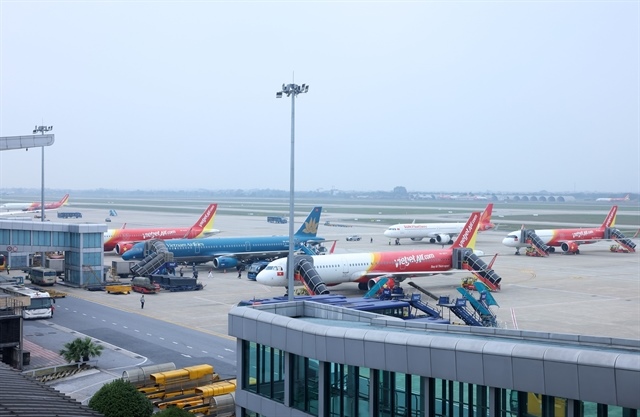
An aircraft of Vietnam Airlines. It is critical to strike a balance between attracting foreign investment and safeguarding national interests as Việt Nam considers raising the foreign ownership cap in the aviation sector. — VNA/VNS Photo Quang Toàn |
International experience shows that most countries adopt a controlled opening approach rather than full liberalisation.
In the United States, foreign ownership is capped at 25 per cent of voting rights, alongside strict requirements on effective domestic control.
In the European Union, foreign ownership may reach 49 per cent, but strategic control must remain within EU entities.
These frameworks highlight that the key issue is not nominal ownership but actual control over strategic decisions.
Raising foreign ownership has been proposed by some domestic carriers. During its restructuring in 2024, Bamboo Airways proposed increasing the foreign ownership cap to 49 per cent, arguing that the current limit discourages investors due to restricted participation in decision-making.
However, the Ministry of Planning and Investment, now the Ministry of Finance, at that time urged caution, noting Việt Nam previously allowed a 49 per cent cap before reducing it to 30 per cent in 2016 and later increasing it to 34 per cent in 2020. Any adjustment could affect domestic carriers’ market share.
The ministry also emphasised that under commitments to the World Trade Organization, Việt Nam had not committed to open its domestic air transport market, but only to allow foreign airlines to provide services through ticket offices or agents in Việt Nam.
According to Trần Thọ Đạt, the issue goes beyond technical ownership limits to how to ensure a balance between economic efficiency and national interests.
“The key challenge for Việt Nam lies not only in determining an appropriate foreign ownership threshold, but also in its ability to design an effective regulatory framework,” he said, calling for a cautious approach in which market opening is accompanied by stronger domestic corporate governance, a more robust legal framework and enhanced state oversight capacity.
He pointed out that maintaining the current 34 per cent cap would preserve a high level of control but limit access to capital and global expertise, while raising the cap to 49 per cent could unlock investment and improve competitiveness but carries risks of shifting control and conflicts of interest.
Đạt said a balanced approach should be considered, involving allowing higher foreign ownership while strengthening oversight mechanisms to ensure domestic control over strategic decisions.
Such a framework would require tighter supervision of related-party transactions, transfer pricing and technology dependencies, alongside improvements in corporate governance and regulatory capacity, he said.
“A sound policy must ensure that integration does not undermine national autonomy, but instead strengthens the internal capacity of the economy,” he said.
There are currently six domestic carriers in Việt Nam: Vietjet Air, Bamboo Airways, Vietravel Airlines, Pacific Airlines, Vietnam Airlines with its subsidiary Vasco, and Sun PhuQuoc Airways, which joined the market last year.
The domestic air transport sector in 2025 posted strong growth, reaffirming its role as a key driver of the economy.
Statistics from the Civil Aviation Authority of Việt Nam showed total market throughput is estimated at 83.5 million passengers and 1.5 million tonnes of cargo, up 10.7 per cent and 18.5 per cent year on year, respectively.
- 08:19 26/04/2026