Household businesses need more enabling policies
Household businesses need more enabling policies
The survey, conducted between February and April 2026 with more than 1,000 household businesses across 34 provinces and cities, paints a far from optimistic picture.
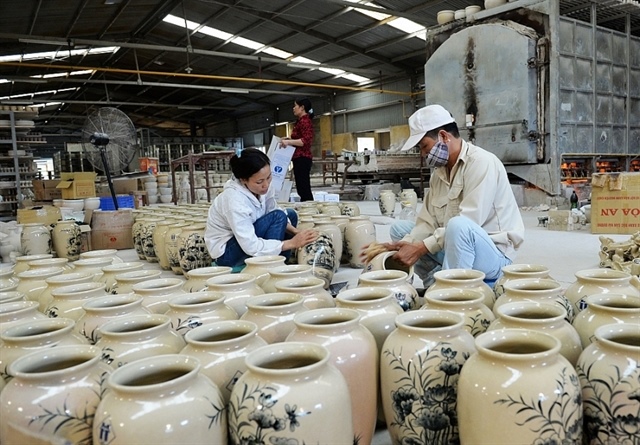
A household pottery business in Bát Tràng Village in Hà Nội produces ceramic goods. — Photo hanoimoi.vn |
Household businesses, seen as a vital pillar of the economy, are currently facing numerous challenges meaning they require more supportive policies to operate effectively, according to a survey conducted by the Vietnam Chamber of Commerce and Industry (VCCI).
A survey, released on April 23, showed that while household businesses remain numerous, they are operating on thin profit margins and adopting a largely defensive stance.
Việt Nam had approximately 6.1 million active household businesses by the end of 2025. They employ around ten million workers and contributed VNĐ32.84 trillion to the State budget.
The survey, conducted between February and April 2026 with more than 1,000 household businesses across 34 provinces and cities, paints a far from optimistic picture.
Đậu Anh Tuấn, vice secretary general and head of the Legal Department at VCCI, noted that 73.7 per cent of household businesses reported making only modest profits in 2025. More than 81 per cent experienced declining revenues, while 75 per cent saw a drop in customer numbers. Only 1.9 per cent achieved their expected profit levels.
This indicates that most businesses are operating on thin margins – sufficient to sustain operations, but insufficient to accumulate capital or withstand future shocks, Tuấn said.
According to the survey, 60.8 per cent of respondents plan to maintain their current scale over the next two years and 33 per cent intend to downsize. While 4.4 per cent are considering closure and only 1.8 per cent aim to expand.
The research team warns that without appropriate policy adjustments, the sector risks falling into a cycle of stagnation – unable to grow, formalise, or build sufficient resources to enhance competitiveness.
Notably, legal challenges have emerged as a more pressing concern than input costs or market conditions. The survey shows that 73.3 per cent of household businesses consider legal difficulties to have a major or severe impact, compared with 59.3 per cent for input-related challenges and 43.8 per cent for market issues.
Tuấn highlighted a key finding that the burden of regulatory compliance does not diminish as businesses grow. On the contrary, in many areas it increases with revenue size, potentially creating an institutional environment that inadvertently keeps household businesses reluctant to expand.
The survey shows compliance time and costs rise with revenue, from 61.5 per cent for firms earning under VNĐ500 million to 87.3 per cent for those above VNĐ3 billion.
The report also notes that only 15.6 per cent of household businesses plan to formalise within two years, while 84.4 per cent do not.
VCCI said policy awareness plays a key role, with 33 per cent of well-informed households intending to convert, compared with 13 per cent among those less informed.
Additionally, businesses integrated into supply chains, those with larger workforces, and those requiring formal contractual transactions are identified as key 'conversion nuclei'.
VCCI therefore recommends that policies encouraging formalisation should not be applied uniformly, but rather be targeted – focusing on groups with the greatest growth potential.
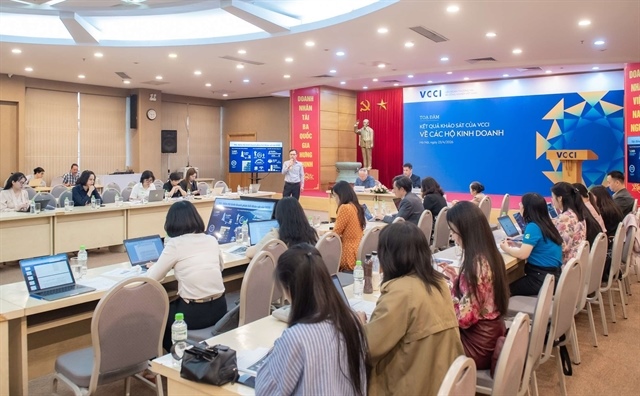
A household pottery business in Bát Tràng Village in Hà Nội produces ceramic goods. — Photo hanoimoi.vn |
Reform priorities
VCCI recommends a more practical and segmented policy approach for household businesses. The foremost priority is to reduce the complexity of regulations, ensuring they are appropriate for micro-scale operators, older business owners, and those with limited educational backgrounds.
At the same time, there is a need to develop low-cost, user-friendly compliance tools, such as simple accounting software, clear and accessible tax guidance, and direct support mechanisms at the local level.
VCCI also proposes that policies clearly identify priority groups. For exemple, small scale household businesses should receive supports in enhancing stability and resilience. While, larger ones should be prioritised for transition into enterprises.
At the pathway to the enterprises, the focus should be to reduce the real costs of conversion through initial incentives, simplified procedures, and a phased approach to regulatory obligations.
Phạm Chi Lan, a senior economist and former vice chairwoman of VCCI, emphasised that a favourable business environment is not merely one with fewer barriers, but one in which regulations are built in directions of ease of understanding, ease of implementation and predictability.
Experts stated that facilitating compliance will not only reduce pressure on household businesses, but also help preserve their inherent dynamism and flexibility – thereby contributing more effectively to sustainable economic growth.
- 10:55 28/04/2026