US 150-day temporary tariffs push local firms to rethink supply chains and strategy
US 150-day temporary tariffs push local firms to rethink supply chains and strategy
The US’s temporary import tariff policy of up to 15 per cent over a 150-day period is not only a challenge, but also a critical window for Vietnamese businesses to restructure and strengthen their resilience against future policy shifts, speakers told a seminar in HCM City on March 25.
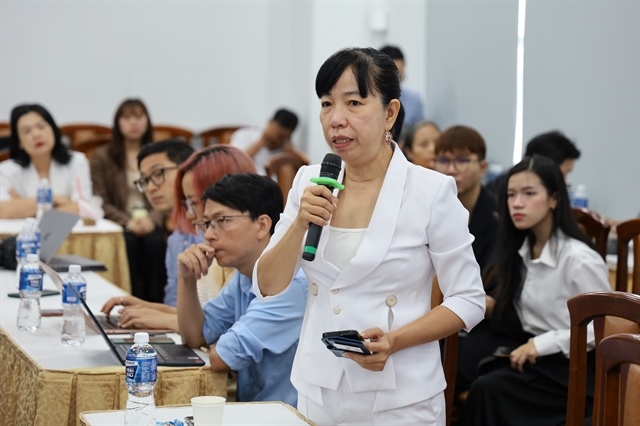
Cao Thị Phi Vân, deputy director of the Investment and Trade Promotion Centre of HCM City, speaks at the “Solutions to Respond to the US’s 150-Day Temporary Tariff Policy” seminar in HCM City yesterday. — Photo courtesy of ITPC |
The US’s temporary import tariff policy of up to 15 per cent over a 150-day period is not only a challenge, but also a critical window for Vietnamese businesses to restructure and strengthen their resilience against future policy shifts, speakers told a seminar in HCM City on Wednesday.
Organised by the Investment and Trade Promotion Centre of HCM City (ITPC) in collaboration with the Vietnam Chamber of Commerce and Industry – HCM City Regional Branch and the Institute for Vietnam Initiatives, the “Solutions to Respond to the US’s 150-Day Temporary Tariff Policy” seminar analysed changes in US trade policy, discussed response measures, and outlined long-term strategies to diversify markets and supply chains, thereby strengthening risk management capacity and supporting sustainable growth.
Speaking at the seminar, Cao Thị Phi Vân, deputy director of ITPC, said the 150-day policy is viewed as a transitional phase in US trade administration. Consequently, the risk of tariff adjustments or a shift toward more stable, high-impact instruments remains present. The temporary nature of the timeframe does not equate to policy stability.
"In the context of broad-based policy implementation, closely monitoring developments and preparing post–150-day scenarios has become particularly important, especially for industries heavily reliant on the US market and those with complex supply chain structures. Proactively analysing, forecasting, and organising early responses during this period will be key to minimising the risk of order disruptions and mitigating adverse impacts on production and export activities in the time ahead,” she said.
According to Vân, the policy presents both opportunities and challenges for Vietnamese businesses.
On the positive side, the US’s application of a uniform tariff rate of up to 15 per cent globally helps narrow the gap between Việt Nam and other ASEAN countries. Previously, tariffs on Vietnamese goods could reach around 20 per cent, higher than the regional average of approximately 19 per cent, creating a competitive disadvantage.
However, risks are expected to intensify in the medium and long term. As tariffs are applied uniformly, Việt Nam’s price competitiveness will be reduced. Industries with low margins and heavy reliance on the US market, such as textiles, footwear, furniture, and electronics, are likely to be most affected.
Shift to scenario-based response
|
Cao Thị Phi Vân, deputy director of the Investment and Trade Promotion Centre of HCM City, speaks at the “Solutions to Respond to the US’s 150-Day Temporary Tariff Policy” seminar in HCM City yesterday. — Photo courtesy of ITPC |
Experts stressed that the 150-day period is not a time for inaction, but a critical window for businesses to shift toward scenario-based management.
Companies are advised to review their supply chains, assess their dependence on the US market, and standardise documentation related to origin, customs valuation, and trade compliance. Revisiting export contracts, pricing terms, and delivery conditions is also essential to minimise risks when policies change.
Nguyễn Đức Nghĩa from the HCM City Union of Business Associations noted that this period is a key opportunity for businesses to accelerate exports, explore new markets, strengthen compliance with rules of origin, and prepare response scenarios.
According to Professor Trần Ngọc Anh of Indiana University, businesses should immediately implement a phased action plan.
From March to April, companies should review 10-digit HS codes to determine applicable tariff rates and identify exemptions, while assessing eligibility for duty drawback on qualifying shipments.
From April to June, industry associations should work with international legal experts to participate in US trade policy hearings, helping to safeguard the interests of Vietnamese businesses.
By July, businesses must be ready to adjust pricing strategies if new tariff measures are introduced.
In parallel, companies should adopt financial and technological tools to mitigate impacts. These include duty drawback mechanisms, the use of free trade zones to ease cash flow pressure, and transitioning from manual management tools to Global Trade Management platforms.
Experts also recommend adopting technologies such as blockchain to automate documentation, ensure compliance, and enhance supply chain transparency.
According to Anh, global trade is increasingly shaped by geopolitical factors rather than stable WTO rules.
In this context, businesses need to diversify export markets, leverage trade agreements such as CPTPP and EVFTA, and restructure supply chains to increase localisation.
“The survival of a business depends not on tariff levels, but on its ability to adapt,” he said.
Dr. Huỳnh Thế Du of Wisconsin Oshkosh in the US said amid growing volatility in the global trade environment, the US administration’s decision to implement a 150-day temporary tariff policy requires flexible and coordinated responses from both policymakers and the Vietnamese business community.
Authorities should establish an inter-agency coordination mechanism to monitor policy developments, provide timely updates, and support businesses in addressing challenges. Strengthening control over product origin is also essential to prevent trade fraud and protect the reputation of Vietnamese goods.
For businesses, priorities include legal reviews, contract renegotiation, supply chain risk management, and financial scenario planning. At the same time, accelerating market diversification is key to reducing reliance on a single market, he said.
- 03:28 26/03/2026