Small consumer loan threshold proposed to increase to VNĐ400 million
Small consumer loan threshold proposed to increase to VNĐ400 million
A draft circular proposes increasing the threshold to VNĐ400 million for loans issued by credit institutions and VNĐ200 million for those provided by people’s credit funds.
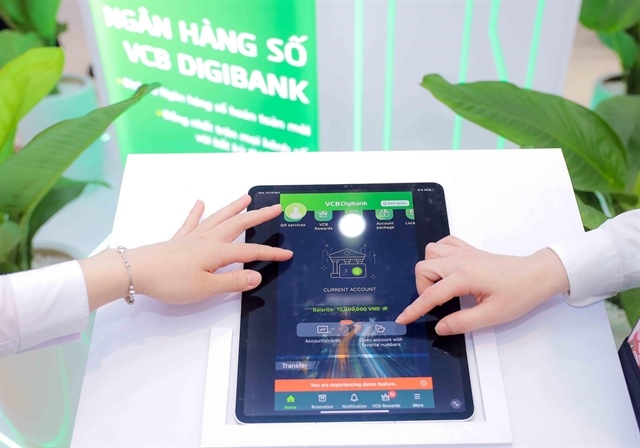
A tablet running VCB Digibank app. The State Bank of Việt Nam (SBV) has proposed raising the threshold for small-value loans to VNĐ400 million (US$15,700) from currently VNĐ100 million and removing VNĐ100 million online lending cap. — VNA/VNS Photo Trần Việt |
The State Bank of Việt Nam (SBV) has proposed raising the threshold for small-value loans to VNĐ400 million (US$15,700) from currently VNĐ100 million and removing the VNĐ100 million online lending cap to ensure greater appropriateness to the current situation.
The proposals are raised in a draft circular amending several provisions of Circular 39 on lending by credit institutions which are now open for public feedback.
Under the current regulations, small-value loans are defined as those worth VNĐ100 million or less. For such small loans, the Law on Credit Institutions allows lenders to waive requirements for customers to submit documents proving their financial capacity or detailed plans for using the borrowed funds, unlike larger loans.
Specifically, the draft proposes increasing the threshold to VNĐ400 million for loans issued by credit institutions and VNĐ200 million for those provided by people’s credit funds.
The SBV said the adjustment aimed to reflect current economic conditions, as rising living costs and spending needs had pushed borrowing demand beyond the existing VNĐ100 million limits.
A lower ceiling for people’s credit funds is to reflect differences in their operational scale, financial capacity and customer base, the SBV said, citing statistics that as of the end of March 2025 ,the average outstanding loan per customer at people’s credit funds was nearly VNĐ300 million, with loans of around VNĐ200 million accounting for about 2.9 per cent of their charter capital.
Removing online lending cap
The draft also proposes changes to regulations governing electronic lending, including removing the online lending cap which is currently set at VNĐ100 million.
The draft says that when loans are provided through electronic channels, credit institutions will bear full responsibility for associated risks and be allowed to set their own lending limits for individual customers.
As the cost of living and spending is rising, leading many customers to seek loans that frequently exceed VNĐ100 million, maintaining the VNĐ100 million limit no longer meets borrowers’ financing needs or reflects the development of financial technology (fintech), according to the SBV. “Expanding electronic lending services is therefore an inevitable trend in the banking sector’s digital transformation strategy,” the SBV stressed.
The bank stressed that removing the online lending cap could help consumers access formal credit more easily through transparent digital channels, reducing reliance on informal lending while lowering transaction costs, saving time and increasing flexibility for borrowers.
Together with removing online lending cap, the SBV proposed to tighten customer verification.
Commercial banks must establish risk management and control procedures, including measures to prevent impersonation or manipulation of customer identification data and technical solutions to confirm that borrowers have been properly identified and have agreed to loan terms.
Customer identification information, biometric data, audio and video records, phone numbers used in transactions and transaction logs would need to be stored and preserved as part of the digital lending process.
- 13:09 07/03/2026