Kim Long Motor pioneering fuel-efficient engines and green transition
Kim Long Motor pioneering fuel-efficient engines and green transition
Recent geopolitical tensions in the Middle East have continued to raise risks for the global energy market, with diesel prices rising sharply and unpredictably, placing pressure on fuel-intensive sectors such as long-distance passenger transport.
Against this backdrop, many transport companies are reassessing their vehicle investment strategies, focusing on reducing operating costs and stabilising business performance. They will invariably choose the vehicle brand that offers the best quality, most affordable price, and most fuel efficiency.
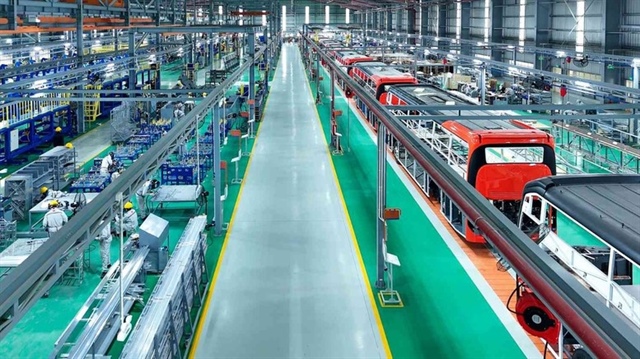
Kim Long Motor’s bus production and assembly line |
Among new options, electric buses, particularly interprovincial sleeper buses, are emerging as the best alternative.
Fuel costs: a major challenge for transport companies
Fuel accounts for a large share of operating costs for passenger transport companies. For long-distance North-South or inter-regional routes, a sleeper bus typically operates at high intensity, averaging about 800 km per day.
For diesel-powered vehicles, fuel consumption is commonly around 24 litres per 100 km. With diesel priced at roughly VND30,830 ($1.19) per litre, the fuel cost is about 28 US cents per km.
As a result, fuel expenses alone can reach nearly $231 per day for a bus travelling 800 km. In light of sustained high oil prices due to geopolitical tensions and the global energy market, fuel expenses can rise sharply, placing significant pressure on transportation companies’ business efficiency.
More companies have paid attention to new vehicle solutions with more stable and cost-efficient operating expenses.
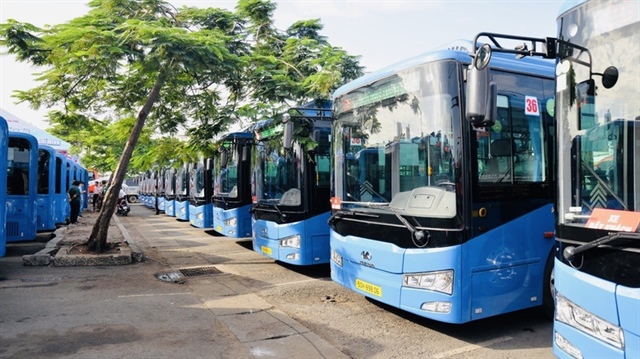
Kim Long Motor is realising its dream of bringing Vietnamese-branded cars with a localisation rate of at least 70-80 per cent to international markets. |
Electric buses and operating cost advantage
Electric sleeper bus models developed by Kim Long Motor are capturing attention. According to technical specifications, this company's 34-seat electric sleeper bus is equipped with battery pack capacity reaching 357 kWh.
The bus can travel approximately 401 km with a 90 per cent charge. Its average power consumption is as low as 0.8 kWh per km. With electricity prices around 6.23 US cents per kWh, the energy cost is as low as 4.98 US cents per km.
Electric buses could save about 23.5 US cents per km compared with diesel vehicles, which cost around 28.5 US cents per km. If a bus runs 800 km per day, the energy cost savings could reach nearly $189 daily. Over six years of operation, the total savings from avoiding diesel fuel could surpass $408,000 per vehicle.
This figure is significantly higher than the difference in initial investment costs between electric vehicles (EVs) at $204,000) per vehicle and diesel vehicles at $142,000 per vehicle. Still, it demonstrates the long-term economic advantages of EVs in long-distance transport.
Apart from energy costs, EVs also have clear advantages in maintenance. Unlike internal combustion engines with complex mechanical structures, electric motors have fewer moving parts and do not require fuel systems or exhaust treatment systems. This significantly reduces maintenance costs over the vehicle’s lifetime. According to estimates from many transportation companies, the maintenance cost is only about 5 per cent of the EV's value, while the figure for diesel-powered vehicles can be as high as 20 per cent. This difference also contributes to reducing operating costs for businesses in the long term.
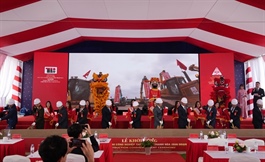
Kim Long Motor is developing next-generation electric buses and passenger vehicles to serve rising demand. The company is investing in a large-scale car manufacturing and assembly industrial park in Hue with many component factories and supporting facilities. One of the notable initiatives is the motor engine manufacturing plant by Kim Long Motor in collaboration with Yuchai Group, one of the world's largest engine manufacturers.
The Yuchai motor engine manufacturing plant in Hue has a total investment of around $260 million. With an automation rate of up to 90 per cent, the plant adopts many advanced manufacturing technologies.
In its initial phase, the plant has a capacity of more than 40,000 engines annually, serving commercial vehicles such as buses, trucks, and various industrial equipment. Mastering engine manufacturing technology marks an important step of Kim Long Motor’s journey, contributing to increasing localisation rates and strengthening the domestic car industry.
Yuchai engines: a fuel-saving solution
With the rollout of thousands of vehicles after one year, customers have widely recognized Kim Long Motor as the most fuel-efficient vehicle brand in Vietnam when compared with other vehicles in the same segment. Kim Long Motor is stepping up its production for domestic and export markets.
Kim Long Motor’s passenger buses are equipped with Yuchai S07 and Yuchai K11 engines, manufactured in Vietnam according to the technical standards of Yuchai Group.
In particular, the Yuchai K11 engine delivers up to 410 horsepower. It is designed for high-end sleeper buses, ensuring strong and stable performance on long-distance routes.
According to the company, these engines can help save approximately 4-7 litres of fuel per 100 km compared to many engines in the same segment from other manufacturers. With an operating intensity of about 800 km per day, the savings reach about 32-56 litres of fuel per day, equivalent to $37 – $65 per vehicle per day.
Over a year of operation, the total savings could reach $13,500 – $23,800, significantly improving transport companies’ business efficiency.
|
Kim Long Motor electric buses serving passengers in Ho Chi Minh City |
The shift towards environmentally friendly vehicles is accelerating worldwide. In passenger transport, many countries are encouraging the replacement of fossil-fuel vehicles with EVs to reduce emissions and improve energy efficiency.
In Vietnam, this trend is also gradually taking shape, particularly in the bus and passenger transport sectors. Domestic companies such as Kim Long Motor are investing heavily in research and production of EVs while building a complete manufacturing ecosystem – from engines and components to batteries and powertrain systems – with the goal of achieving over 90 per cent localisation in the near future at highly competitive prices for the domestic market.
Looking ahead, as battery technology continues to improve and charging infrastructure expands, EVs are expected to become an increasingly common choice for the transport industry.
For many transport companies, the shift to EVs is not only a technological upgrade but also a long-term economic decision amid increasingly volatile energy costs.
- 11:18 12/03/2026