Conference sets out science and technology path for sustainable fisheries growth
Conference sets out science and technology path for sustainable fisheries growth
The National Conference on Fisheries Science and Technology and Fisheries Surveillance has set out recommendations to help achieve the fisheries sector's growth targets and orientations for a key science and technology programme for 2026–30 in support of sustainable fisheries development, the circular economy and digital transformation.
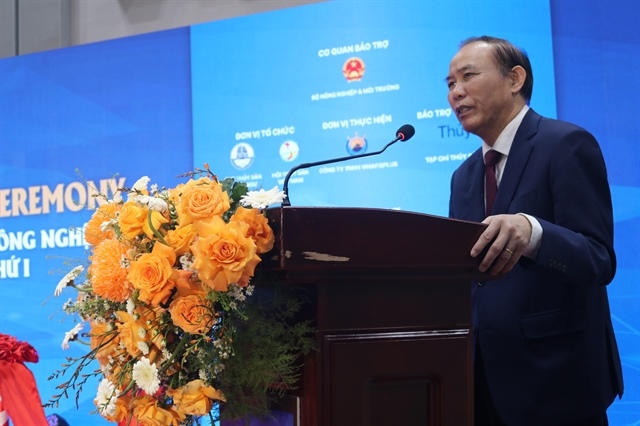
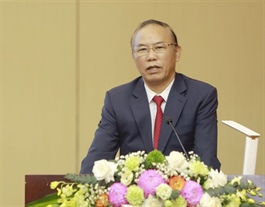
Deputy Minister of Agriculture and Environment Phùng Đức Tiến speaks at the National Conference on Fisheries Science and Technology and Fisheries Surveillance on April 28 in HCM City. — VNS Photo Hồng Linh |
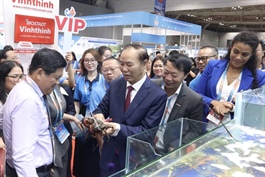
The conference was held as part of the first Vietnam International Exhibition on Fisheries Science and Technology (VinaFis Expo 2026) held on April 28-29 in HCM City, by the Ministry of Agriculture and Environment
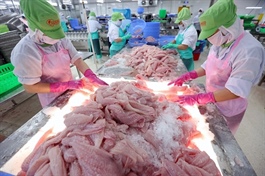
It featured numerous presentations covering the entire fisheries value chain, from capture fisheries and aquaculture, including seed stock and animal feed, to logistics, processing and distribution.
The event also served as a forum for dialogue between managers, scientists, businesses, local and international organisations, local authorities, and fishing communities.
Deputy Minister of Agriculture and Environment Phùng Đức Tiến said despite challenging conditions in 2025, the fisheries sector achieved record output of 9.5 million tonnes and exports of US$11.32 billion.
But there were also difficulties.
Experts said, for instance, that few research products had reached the market, while technology consulting, transfer and trading services remained weak.
There was also a tendency to favour imported turnkey technologies over collaboration with domestic research institutions.
Furthermore, Vietnamese fisheries faced growing pressure in global markets, as high aquatic feed consumption, heavy reliance on imported raw materials, and logistics costs of 60–70 per cent of production costs in some segments weighed on competitiveness.
Pollution caused by aquaculture remained a serious concern, with disease outbreaks and deteriorating conditions across the Mekong Delta leading to high feed conversion ratios and suppressing growth.
Despite having a monitoring system, the industry had yet to effectively apply data to production.
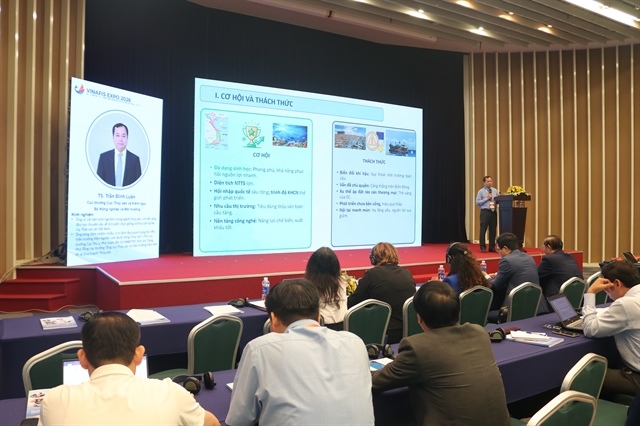
Deputy Minister of Agriculture and Environment Phùng Đức Tiến speaks at the National Conference on Fisheries Science and Technology and Fisheries Surveillance on April 28 in HCM City. — VNS Photo Hồng Linh |
Trần Đình Luân, Deputy Director of the Directorate of Fisheries and Fisheries Surveillance, cited other challenges like climate change, trade barriers, 'yellow card' warning on illegal, unreported and unregulated (IUU) fishing, tightening international norms, high compliance costs, limited infrastructure, and threats to fishery resources.
However, he said Việt Nam's fisheries sector held considerable opportunities, drawing on its advantages as a tropical coastal nation with rich biodiversity, strong resource recovery potential and diverse aquaculture ecosystems ranging from cold-water to offshore marine farming.
The Mekong Delta in particular has great potential, while the country's modern processing capacity is enabling deeper integration into global markets and meeting growing demand.
Resource conservation efforts have been stepped up through restocking, harvest controls and maritime patrols, while the sector aims to expand marine protected areas to cover 6 per cent of its natural sea area by 2030.
Restocking activities and community co-management schemes have been expanded.
Fisheries surveillance forces have been reinforced, maintaining patrols in key maritime zones to prevent violations and combat IUU fishing.
The sector's strategic direction is to shift from production-focused to economy-focused growth, and from a single-value to a multi-value approach, promoting offshore aquaculture, reducing capture fishing and ensuring supply chain transparency.
The sector is also focusing on reorganising production along value chains, applying digital technology to traceability and vessel management, developing infrastructure, reducing post-harvest losses and improving product quality, alongside strengthening resource protection, curbing illegal fishing and promoting sustainable aquaculture models.
Among these, climate-adaptive aquaculture models were given particular attention, as recirculating aquaculture systems and biofloc technology could significantly reduce water use, move towards zero discharge and lower production costs.
Experts also shared solutions for industry development, including replacing imported aquaculture breeds with high-yielding domestic strains adapted to local environmental conditions to build self-sufficiency in seed stock.
They called for the development of next-generation vaccine production technologies and research into biological and nano-based preparations, with the aim of building aquaculture models that minimise or eliminate antibiotic use.
They highlighted the importance of smart feed and nutrition technologies, including insect-based protein, AI-driven feeding management and plant-based protein products such as Empyreal 75, a maize protein concentrate, to cut feed costs and conversion ratios, boosting aquaculture productivity.
Experts said closer collaboration between scientists, the Government and businesses is essential to realise Việt Nam's ambition of becoming a world-leading deep-processing fisheries hub by 2045.
- 19:27 29/04/2026