Việt Nam's 'Đổi Mới 2.0' reforms will drive growth, though below official target: BMI
Việt Nam's 'Đổi Mới 2.0' reforms will drive growth, though below official target: BMI
Việt Nam's 'Đổi Mới 2.0' reforms will boost GDP growth to 7.2 per cent annually through 2031, but ambitious productivity targets and trade vulnerabilities pose challenges to the Government's 10 per cent goal, according to BMI.
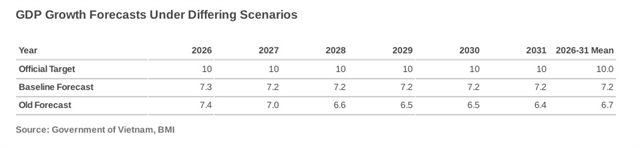 |
Việt Nam's ambitious economic reforms will boost GDP growth to an average of 7.2 per cent annually through 2031, though falling short of the Government's 10 per cent target, according to a new forecast by BMI, a unit of Fitch Solutions.
The economy expanded by 8.02 per cent in 2025, the second-highest annual growth rate over the 2011-25 period, driven by strong manufacturing output and resilient exports despite global headwinds.
BMI’s upward projection from the previous estimate of 6.7 per cent comes as General Secretary Tô Lâm's administration has approved two landmark Politburo resolutions aimed at reshaping the country's economic model.
Resolution 57-NQ/TW envisions Việt Nam becoming a top three Southeast Asian nation in digital competitiveness and artificial intelligence research, while Resolution 68-NQ/TW aims to make the private sector contribute 60 per cent of GDP by 2045, up from the current 51 per cent.
The reforms, dubbed 'Đổi Mới 2.0' by economic commentators, seek to address structural weaknesses that have emerged in Việt Nam's economy over the past 15 years, BMI said in its report released this week.
Since the 2008 global financial crisis, capital accumulation rather than productivity improvements has driven Việt Nam's growth, the report noted. This contrasts sharply with the 2001-10 period following the bilateral trade agreement with the US, when total factor productivity gains fuelled rapid expansion.
"Growth driven by capital expansion such as Việt Nam’s suffers from diminishing returns," BMI analysts wrote, projecting growth would slow to around 6.4 per cent by 2031 without the reforms.
Resolution 57 sets a target for total factor productivity to contribute 55 per cent of growth, while Resolution 68 commits the Government to legal reforms protecting property rights, improving credit access for small and medium-sized enterprises and boosting commercial research and development.
The resolution proposes making 200 per cent of R&D spending deductible from corporate income taxes.
However, BMI expressed scepticism about achieving the 10 per cent growth target, citing three key concerns.
First, the reforms may take longer than five years to take full effect, much like the original Đổi Mới launched in 1986, which only delivered strong growth in the 1990s.
Second, the productivity targets look too high. To achieve 10 per cent annual growth, total factor productivity would need to add 5.5 percentage points each year, while even after Đổi Mới, productivity growth averaged only 2.74 per cent from 1991 to 1995.
|
|
Finally, the resolutions do not fully address Việt Nam’s exposure to global economic swings. With a high trade-to-GDP ratio, the economy remains vulnerable to export shocks, as seen in 2023 when weaker exports cut growth by 3.4 percentage points.
Yet BMI said it would consider further upward revisions if the Government introduces reforms to strengthen the domestic economy and facilitate technology spillovers from foreign direct investment to local firms.
The public sector still plays a large role in Việt Nam’s economy, as State-owned banks hold much of the country’s financial assets and the public share of capital stock rose by seven percentage points between 1999 and 2025.
Despite the challenges ahead, BMI’s revised forecast is more upbeat on Việt Nam’s economic path, reflecting confidence that the new reform agenda will lift productivity and private sector dynamism over the medium term.
- 17:09 20/01/2026