Unprecedented opportunities for green financing in Việt Nam
Unprecedented opportunities for green financing in Việt Nam
Financing is crucial to meet stringent ESG standards from discerning export markets like the European Union (EU), the US and Japan. This includes costs for certifications such as GlobalGAP and organic farming, along with establishing traceability systems.
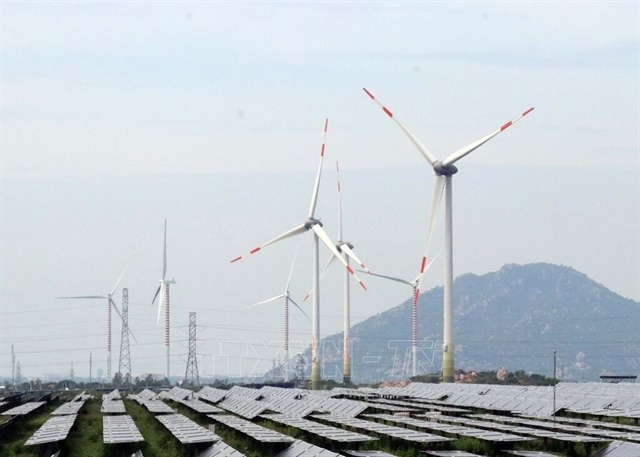
A wind farm in Khánh Hòa Province. — VNA/VNS Photo |
Given the severe impacts of climate change, the transition to a green economy is no longer a choice but a crucial requirement for sustainable development. In this context, the demand for capital to support sustainable development initiatives has never been more pressing.
At a recent workshop, Vương Văn Quý, deputy head of Credit Policy at Agribank, highlighted the significant financial needs Việt Nam faces.
According to UNESCAP, the country requires approximately US$45-55 billion annually to achieve its sustainable development goals by 2030. This staggering figure far exceeds the capabilities of the Government budget and necessitates the involvement of the entire financial system.
In particular, the agricultural sector, in which Agribank plays a pivotal role, has substantial green financing needs across three primary areas.
First, there is a demand for capital to transition from fragmented production models to large-scale operations that leverage advanced technology, smart machinery and efficient irrigation systems in critical regions like the Mekong Delta.
Financing is also crucial to meet stringent ESG standards from discerning export markets like the European Union (EU), the US and Japan. This includes costs for certifications such as GlobalGAP and organic farming, along with establishing traceability systems.
Meanwhile, significant initial investment is required for circular economy models, which encompass recycling agricultural by-products, biomass energy production and solar rooftop installations.
These fields necessitate substantial upfront capital, but are instrumental in reducing emissions and protecting the environment.
Recognising its responsibilities as a leading State-owned commercial bank in agricultural development, Agribank has committed to green growth as a core part of its business strategy.
The bank aims not only to provide funding, but also to support the Government and the State Bank of Vietnam (SBV) in realising the National Strategy for Green Growth for the 2021-30 period.
As of the third quarter of 2025, Agribank reported total green credit outstanding of nearly VNĐ28.4 trillion ($1.1 billion), serving nearly 40,000 customers. The portfolio structure indicates a clear focus on three key areas: renewable energy and clean energy, leading with nearly VNĐ15.3 trillion (53 per cent), sustainable forestry at over VNĐ6.9 trillion (24 per cent) and green agriculture at nearly VNĐ6 trillion (21 per cent).
The year 2025 marks a significant turning point, with two groundbreaking legal documents. Decree 156/2025/NĐ-CP, effective from July 1, is the first to allow credit institutions to lend up to 70 per cent of project value for organic agriculture or circular economy models without collateral.
This change is considered a historic breakthrough, liberating co-operatives and agricultural enterprises that previously struggled with collateral shortages.
Additionally, Decision 21/2025/QĐ-TTg, issued on July 4, has established clear environmental criteria and a green classification list, enabling banks to accurately identify and assess green projects while avoiding 'greenwashing' risks.
International collaboration also presents substantial opportunities as Agribank actively engages with the World Bank, ADB and AFD to attract low-cost capital and technical support.
With its credibility and an evolving green financial framework in line with international standards, Agribank aims to attract more long-term foreign currency funding at low interest rates to support Vietnamese enterprises.
Despite these positive developments, several challenges remain in expanding green financing. These include a lack of standardised green project data, insufficient attractive incentives when loan interest rates do not differ significantly and limited ESG capacities among SMEs.
Furthermore, the green bond market in Việt Nam is still nascent, with high compliance and issuance costs.
Stringent reporting and adherence to international ESG standards for capital raising from international organisations also create a gap between domestic regulations and global standards.
To stimulate green financing, Agribank has proposed five solutions to the Government and the SBV, including establishing a national emissions and energy database, enacting specific incentive policies such as tax reductions and interest rate subsidies and offering free ESG training programmes for businesses.
- 07:40 07/01/2026