Rice straw emerges as key resource in Việt Nam's net-zero push, experts say
Rice straw emerges as key resource in Việt Nam's net-zero push, experts say
Research shows that sustainable rice straw management could cut emissions by up to 36 per cent in the Mekong Delta – equivalent to more than two million tonnes of CO₂ annually.
Rice straw is used as a growing medium for mushrooms at the Tiến Thuận Agricultural Co-operative in Cần Thơ City. — Photo baochinhphu.vn |
What was once burned as post-harvest waste is now being recognised as a valuable resource, with the potential to help Việt Nam meet its climate commitments while increasing farmers’ incomes by more than 20 per cent, experts told an international conference in Hà Nội on Tuesday.
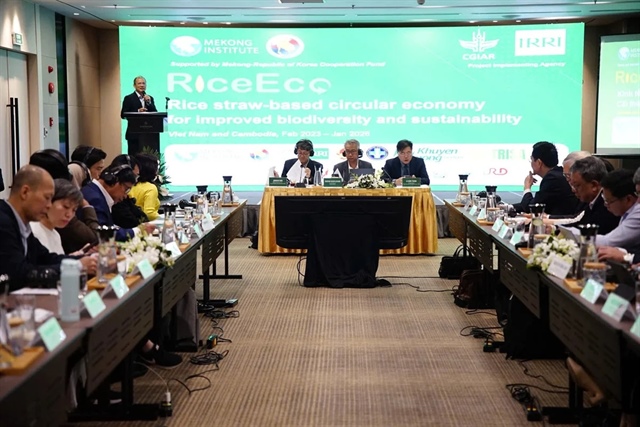
The RiceEco 4Is conference, organised by the National Agricultural Extension Centre (NAEC) under the Ministry of Agriculture and Environment and the International Rice Research Institute (IRRI), gathered more than 100 policymakers, scientists, businesses and farmer co-operatives from Việt Nam, Cambodia, Indonesia, the Philippines and other Mekong sub-region countries to discuss how rice straw-based circular economy models can support low-emissions agriculture.
Research shows that sustainable rice straw management could cut emissions by up to 36 per cent in the Mekong Delta, equivalent to more than two million tonnes of CO₂ annually.
NAEC director Lê Quốc Thanh said that as climate change intensifies and emissions reduction commitments tighten, shifting to circular, low-emissions agriculture is no longer a choice but a necessity. He noted that sustainable rice straw management is key to achieving Việt Nam’s net-zero goal while creating new income opportunities for millions of rice farmers.
The Mekong sub-region, one of the world's largest rice bowls, generates a substantial portion of the 500-600 million tonnes of rice straw produced globally each year. Yet across much of the region, the biomass is still predominantly burned or poorly managed, causing air pollution, soil nutrient depletion, biodiversity loss and increased greenhouse gas emissions.
Backed by the Mekong-Korea Cooperation Fund and running since 2023, the RiceEco project has provided scientific evidence that rice straw is not waste but a strategic biomass resource for low-emissions agriculture.
According to Associate Professor Dr Nguyễn Văn Hùng, who is an IRRI senior scientist and the RiceEco project leader, rice-straw value chain models have generated over 20 per cent added value while reducing greenhouse gas emissions by more than 30 per cent through the collection and reuse of straw for circular agriculture after three years of implementation.
"Rice straw management needs to be formally integrated into national and international programmes on sustainable and low-emissions agriculture, rather than just remaining as pilot models," he said.
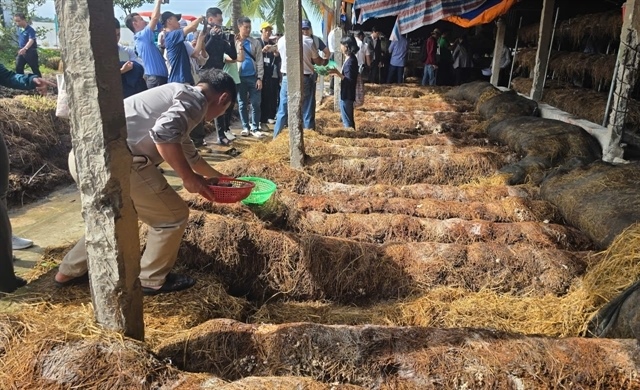
Rice straw is used as a growing medium for mushrooms at the Tiến Thuận Agricultural Co-operative in Cần Thơ City. — Photo baochinhphu.vn |
Proven economic benefits
Practical production results demonstrate clear economic viability.
At the Tiến Thuận Agricultural Co-operative in Cần Thơ City, income increased by more than 20 per cent – approximately US$640 per hectare annually – by integrating straw mushroom cultivation and organic fertiliser production from rice straw alongside three annual rice crops.
Co-operative director Nguyễn Cao Khải said that not burning straw after harvest has also protected community health and improved air quality in rural areas, an issue that has caused considerable social concern.
In Cambodia, participating co-operatives achieved average profits of $136 per tonne of compost, with stable income from straw mushroom cultivation on short production cycles suitable for smallholder conditions.
Former Minister of Agriculture and Rural Development Cao Đức Phát emphasised that the core issue is selecting and perfecting rice straw processing technologies that deliver genuinely high economic benefits for both farmers and businesses.
"These technologies need to be thoroughly researched to reduce risk, be easy to apply and ensure returns clearly exceed costs and effort," he said, highlighting the potential of using post-harvest straw for mushroom cultivation and high-quality organic fertiliser production.
IRRI senior scientist Dr Nurmi Pangesti outlined three key factors for scaling up the model based on lessons from Việt Nam and Cambodia: changing perceptions to view straw as a biomass resource rather than waste; organising synchronised value chains from collection and logistics to consumer markets; and establishing appropriate financial mechanisms and credit to support long-term investment.
Dr Suriyan Vichitlekarn, director of the Mekong Institute, stressed that the rice straw circular economy model has proven potential not only for Việt Nam, but for the entire Mekong sub-region, with regional cooperation key to scaling positive impacts.
- 07:34 22/01/2026