Vietnamese rice exporters pivot strategy for a challenging 2026
Vietnamese rice exporters pivot strategy for a challenging 2026
As the industry moves into 2026, fresh challenges are emerging, demanding more proactive and adaptive strategies from both policymakers and the business community.
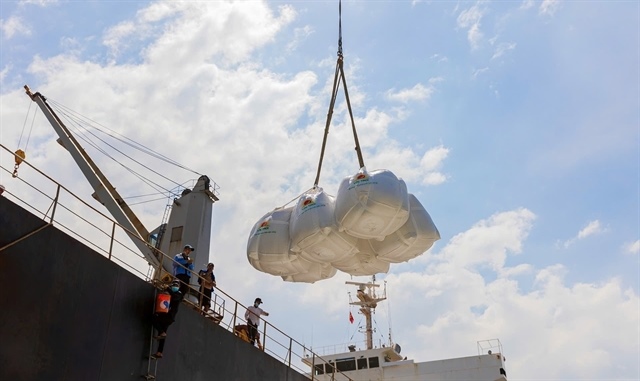
Bulk rice shipments are loaded onto a vessel for export as Việt Nam adjusts its rice trade strategy for 2026. VNA/VNS Photo |
Over the past year, Việt Nam’s rice exports have unfolded against a backdrop of heightened volatility in global markets, marked by intensifying competition and rapidly shifting import policies among key consuming countries.
Despite mounting headwinds, the sector has managed to maintain its strategic role in the global food supply chain.
As the industry moves into 2026, however, fresh challenges are emerging, demanding more proactive and adaptive strategies from both policymakers and the business community.
Holding ground
According to estimates from the Ministry of Agriculture and Environment, Việt Nam’s rice exports reached around 8 million tonnes, reaffirming the country’s position as one of the world’s leading rice exporters, second only to India and, at times, surpassing Thailand.
Yet while export volumes remained robust, export earnings and prices recorded a sharp decline.
During the first 11 months of 2025, Việt Nam shipped more than 7.5 million tonnes of rice, generating approximately US$3.8–3.85 billion in revenue, down nearly 28 per cent year-on-year from the record performance seen in 2024.
Average export prices fell by almost 20 per cent, significantly eroding revenues despite stable shipment volumes.
The downturn largely stemmed from rising global supply amid subdued demand.
More notably, several of the country’s traditional import markets simultaneously scaled back purchases.
The Philippines, Việt Nam’s largest rice consumer, abruptly suspended imports in an effort to protect domestic production, leading to a sharp contraction in shipments.
Meanwhile, Indonesia and Malaysia also significantly reduced import volumes.
Preliminary figures show exports to Indonesia plunging by nearly 96.4 per cent, while shipments to Malaysia declined by 32.5 per cent compared to the same period last year.
Phan Văn Có, marketing director of Vrice Rice Co Ltd, said that although export volumes broadly met targets in 2025, the steep fall in prices triggered widespread repercussions.
While the company achieved over 90 per cent of its planned export volume, export values dropped sharply compared to 2024.
In the second half of the year, particularly after news of the Philippines’ import suspension, rice prices declined by more than 30 per cent from early-year levels, leaving many firms that had procured stock early facing heavy losses.
According to Có, the absence of clear import plans for 2026 from traditional markets such as Indonesia, Malaysia and the Philippines has pushed rice trading into a holding pattern.
Export volumes to these destinations fell by around 15–20 per cent, forcing many businesses to scale back operations.
Beyond price and market pressures, enterprises also encountered procedural and cost-related hurdles.
Delays in issuing certificates of origin have recently caused significant disruption.
Some consignments arriving at European ports have been unable to clear customs due to missing documentation, compelling exporters to absorb high storage and port fees and further straining cash flow.
Sharing a similar view, Nguyễn Vĩnh Trọng, sales director of Viet Hung Rice Co, said 2025 was a year of intense adjustment as enterprises struggled to maintain operational stability.
Thanks to market diversification, the company largely met its volume and value targets.
However, reduced demand from major buyers such as the Philippines and Indonesia placed considerable pressure on exporters, forcing them to pivot to alternative markets.
Trọng noted that the 2025 context prompted businesses to abandon volume-driven strategies in favour of risk management.
With prices depressed and supply abundant, contracts were signed only when profitability could be assured. Caution, he said, became the defining principle of the year.

Bulk rice shipments are loaded onto a vessel for export as Việt Nam adjusts its rice trade strategy for 2026. VNA/VNS Photo |
Mounting pressure
Looking ahead, both experts and industry players expect Việt Nam’s rice exports in 2026 to face continued headwinds, particularly from persistent oversupply, fierce competition and limited prospects for price recovery.
Against this backdrop, diversifying markets, shifting towards higher-quality segments, developing low-emission rice and strengthening branding are widely regarded as critical pathways for sustaining competitiveness and long-term growth.
The outlook for 2026 has been further clouded by Indonesia’s announcement that it will not import rice next year, covering both consumption and industrial uses.
Phạm Thế Cường, Việt Nam’s trade counsellor in Indonesia, said the country’s rice output in 2025 was expected to reach nearly 34.8 million tonnes, with reserves potentially rising to 6 million tonnes after the early-2026 harvest — the highest stockpile level recorded in many years.
This development left little room for Vietnamese rice in the Indonesian market, pushing exporters to focus on premium segments such as fragrant, organic and specialty rice, supported by more systematic and long-term market-entry strategies.
Meanwhile, prospects for the Philippines reopening rice imports from January 2026 remain uncertain, particularly as local farmers face losses due to low prices and are calling for the reinstatement of a 35 per cent import tariff.
Có cautioned that even if the Philippines resumes imports, limited quotas would trigger intense competition.
Thailand currently enjoys ample supply and more flexible trading terms, exerting strong pressure on Vietnamese rice in both pricing and payment conditions, according to Có.
Strategic recalibration
In 2026, many exporters are expected to continue adopting cautious export strategies, prioritising profitability over volume.
The Middle East has emerged as a key destination with relatively stable demand, while Africa remains a promising but challenging market due to high logistics and input costs.
High-end markets such as Europe, Japan and the United Kingdom offer room for growth but impose stringent requirements on residue control, phytosanitary standards and traceability, posing significant compliance challenges for exporters.
Nguyễn Vĩnh Trọng forecast that exports to the Philippines and Indonesia would remain constrained in 2026, but saw encouraging signals from markets such as mainland China, Hong Kong, Malaysia and Africa, where demand is expected to stay steady.
Overall export volumes for the sector could still reach 7.5–8 million tonnes, broadly in line with 2025 levels.
In addition, the National Assembly’s recent approval of amendments to the Law on Value Added Tax, addressing bottlenecks in VAT refunds, is viewed as a positive development for businesses ahead of the new crop season.
“Restructuring export markets and product portfolios is essential to reduce reliance on a handful of traditional destinations,” Trọng said.
“In our 2026 plan, we will continue focusing on established markets such as mainland China, Africa, Hong Kong, Singapore and Malaysia. Alongside bulk shipments, we are gradually building our own brand, although persuading partners to distribute Vietnamese-branded rice requires a long-term vision, persistence and substantial investment.”
- 09:27 17/01/2026