Late-season shrimp prices hit record highs in Đồng Tháp
Late-season shrimp prices hit record highs in Đồng Tháp
Whiteleg shrimp prices in Đồng Tháp Province have surged to unprecedented levels toward the end of the farming season, boosting farmers’ incomes amid tightening supply and strong year-end domestic and export demand.
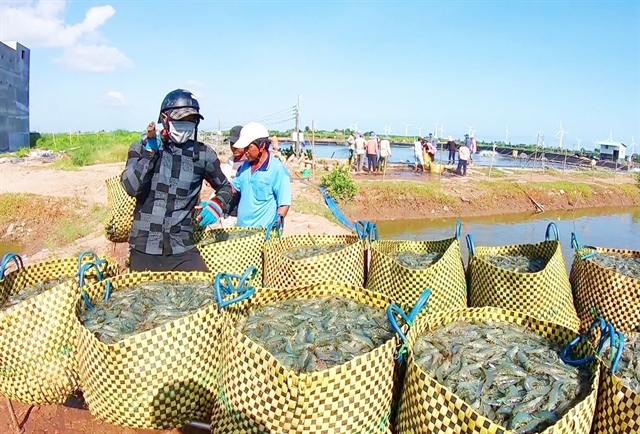
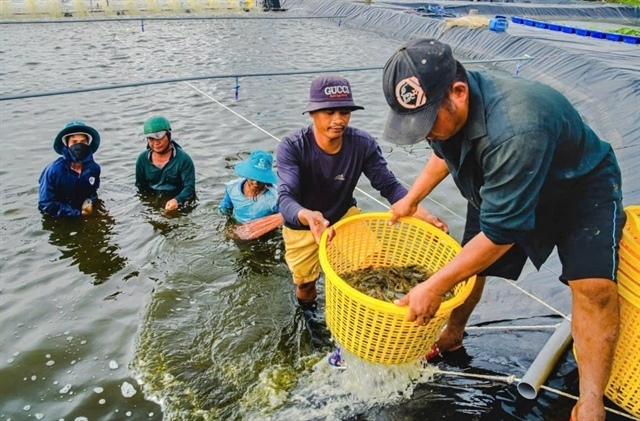
White-leg shrimp harvested from a high-tech farming pond in Đồng Tháp, where late-season prices have climbed to record levels. — VNA/VNS Photo |
White-leg shrimp prices in Đồng Tháp Province have surged to unprecedented levels toward the end of the farming season, boosting farmers’ incomes amid tightening supply and strong year-end domestic and export demand.
White-leg shrimp prices have climbed sharply in recent weeks, reaching record highs as the farming season draws to a close.
Farmers said the rally is being driven by limited supply, while domestic consumption and export demand strengthen toward the year’s end.
According to local producers, prices are expected to remain firm in the coming period as output continues to shrink.
Weather-related losses in central Việt Nam, where storms and flooding damaged aquaculture areas, have further constrained supply, adding upward pressure to prices.
Ngô Minh Tuấn, owner of a 40-hectare high-tech shrimp farm with 100 ponds in Tân Phú Đông Commune, said current prices are the highest seen in many years.
White-leg shrimp produced under high-tech systems at sizes of 20–25 pieces per kilogram are being purchased at VNĐ250,000–260,000 per kg (US$10–10.4).
Shrimp sized at around 30 pieces per kilogram are selling for more than VNĐ200,000 per kg ($8), while smaller sizes of roughly 100 pieces per kilogram fetch over VNĐ100,000 per kg ($4).
Meanwhile, average production costs are estimated at about VNĐ90,000 per kg.
Tuấn attributed the price surge to seasonal factors. “This is the end of the crop, so output is limited,” he said.
“At the same time, year-end demand is strong. Flood damage in the central region has reduced supply, while few farmers are still stocking ponds at this stage, as harvests will only come close to the Lunar New Year.”
Seafood processors share this assessment, noting that late-season price increases are largely supply-driven.
Many farming households have already completed harvests, leaving limited volumes on the market, while consumption at home and export orders remain stable.
To secure raw materials for final shipments of the year, processors have actively raised purchase prices.
Đồng Tháp is regarded as a province with strong potential in both freshwater and brackish-water aquaculture.
The current price rally is expected to encourage farmers to continue investing in production, particularly under high-tech, multi-phase farming models that deliver more uniform output and higher market value.
However, industry observers caution that long-term growth will depend on closer coordination among authorities, businesses and producers.
The provincial Department of Agriculture and Environment said it is prioritising environmentally friendly, high-tech shrimp farming, alongside disease monitoring and early-warning systems.
Strengthening linkages from production to consumption is also seen as key to reducing market risks and price volatility.
Authorities have additionally advised farmers to diversify aquatic species, combining shrimp with fish or adopting rotational farming models to ease environmental pressure and stabilise incomes.
In 2025, Đồng Tháp recorded a total aquaculture area of 21,690 hectares, reaching 104.9 per cent of the plan, with combined farming and capture output exceeding one million tonnes, up 3.8 per cent year on year.
Looking ahead, the provincial administration plans to invest further in industrial-scale, high-tech aquaculture zones capable of producing large volumes of market-oriented seafood.
Efforts will focus on accelerating the adoption of advanced technologies, biosafety standards and disease-free production, alongside the issuance of farming area codes, traceability requirements, food safety compliance and good aquaculture practices (GAP).
Aquaculture development in the province continues to centre on key species such as pangasius, shrimp, red tilapia and molluscs.
By 2026, Đồng Tháp aims to expand aquaculture area to 22,790 hectares while maintaining total output above one million tonnes.
The province currently hosts 80 seafood processing plants for export, with a combined capacity of nearly one million tonnes per year.
As Đồng Tháp accelerates agricultural restructuring towards greener and more sustainable growth, authorities say strengthening high-tech aquaculture, improving biosecurity and deepening market linkages will be crucial to stabilising production and enhancing the long-term value of the local shrimp industry.
- 10:50 02/01/2026