Harsh tests forecast for livestock industry in 2026
Harsh tests forecast for livestock industry in 2026
The latest forecasts indicate that meat imports into Việt Nam will continue to rise this year, surpassing levels seen in 2025.
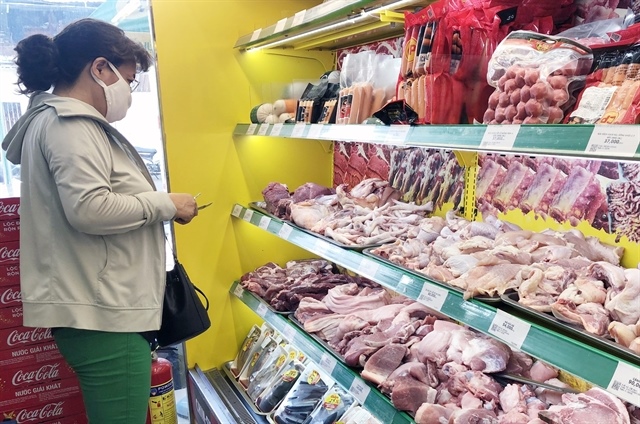
The market offers a wide variety of pork products, both in terms of type and quantity. —VNA/VNS Photo |
The domestic livestock industry is predicted to face significant challenges in the new year.
The latest forecasts indicate that meat imports into Việt Nam will continue to rise in 2026, surpassing levels seen last year.
This growth is primarily driven by the increasing price gap between domestically produced and imported meat.
Imported pork in 2025 is estimated to double compared to 2024. Analysts believe that the significant disparity between the price of domestic and imported pork, especially frozen pork, has led processing businesses to turn to foreign suppliers. This shift helps reduce production costs and maximise profits.
India remains the largest supplier of meat and meat products to Việt Nam. In addition, domestic businesses are also increasing imports of meat and meat products from Russia, the US, Brazil, Canada, Poland, Spain, and China.
Notably, imported frozen meat from some countries is priced at only VNĐ42,000 (US$1.6)- VNĐ45,000 per kilogramme, putting significant pressure on domestic pork prices, especially in the processing and industrial catering segments.
Given this situation, many are concerned that small-scale domestic pig farming will find it very difficult to compete in the future. Especially in countries with strong industrial-scale livestock farming, there is an advantage in optimising production costs and standardising quality, leading to lower prices even for imported products from distant markets compared to domestically produced livestock.
And even if small-scale farmers can utilise agricultural by-products, the costs of vaccines, housing, slaughtering and transportation remain too high, not to mention diseases or floods, making it difficult to avoid losing out in their home market.
Regarding the potential surge in imported frozen meat as mentioned above, in an interview with VnBusiness online magazine, Trần Kim Khánh, a market development specialist at San Hà Co., Ltd, a small and medium-sized enterprise in the livestock and meat processing sector, said that although this would put considerable pressure on the domestic livestock industry, he still believed that domestic fresh meat products would remain competitive against imported frozen meat.
He explained that consumers were now considering more than just the price, but were also questioning whether or not to buy frozen products.
In addition, regarding the prospects of the domestic livestock industry for the coming time, the analysis department of SSI Securities Corporation, a major securities firm, stated in their latest assessment that structural barriers including increasingly stringent farm licensing regulations, land scarcity, long biological cycles, and disease risks would continue to limit the ability to expand capacity quickly.
As a result, this would accelerate the process of business selection, reduce the proportion of small-scale livestock farmers and strengthen the role of large-scale livestock enterprises.
Regarding the operations of small-scale livestock farmers, according to the analysis department of Vietcombank Securities (VCBS), the market share of household-based livestock farming is shrinking. The structure of the livestock industry is witnessing a strong and continuous shift towards the corporate model.
The market share of livestock enterprises reached 47 per cent of total production by the end of 2025, a significant growth of three percentage points compared to the level recorded in 2024.
Future for those who stay
As predicted by VCBS, this trend will continue to accelerate. It is estimated that the structure of livestock farming by farmers will shrink significantly by 2030, accounting for only about 25 per cent of the total market share.
This shrinkage mainly stems from two key reasons. The first is stricter legal regulations and standardisation. The official implementation of the Livestock Law in 2025 has established stricter standards regarding biosecurity, environmental protection, and animal welfare.
This has made it difficult for most small-scale livestock farmers to meet the legal requirements to maintain operations.
At the same time, large enterprises are gradually reducing the scale and number of farms linked with smallholder farmers to optimise quality control and disease safety.
Secondly, there is a risk of disease outbreaks and higher costs. The disease situation remains unresolved, especially African Swine Fever (ASF), which continues to threaten small-scale livestock farming.
The risk of disease outbreaks leads to escalating costs for animal culling and biosecurity compliance, making the small-scale farming model less efficient and unsustainable economically.
With the rapid process of filtering out small-scale livestock farmers, the future playing field will belong to those who remain, large-scale enterprises and farms that have passed the 'harsh tests'.
For the new year 2026, analysts pointed out that the key to improving the competitiveness of the domestic livestock industry lied in the efficiency of sustainable farming models implemented by domestic enterprises.
They also needed to build a competitive advantage through superior livestock productivity and low production costs, supported by high-quality breeding stock and modern farm management systems, said experts.
- 08:36 05/01/2026