Pharmaceutical exports reach $312 million, Việt Nam ranks fourth in Southeast Asia
Pharmaceutical exports reach $312 million, Việt Nam ranks fourth in Southeast Asia
The total market value is expected to grow from around US$2.7 billion in 2015 to approximately $8 billion by 2026, making Việt Nam one of the fastest-growing pharmaceutical markets in Asia.
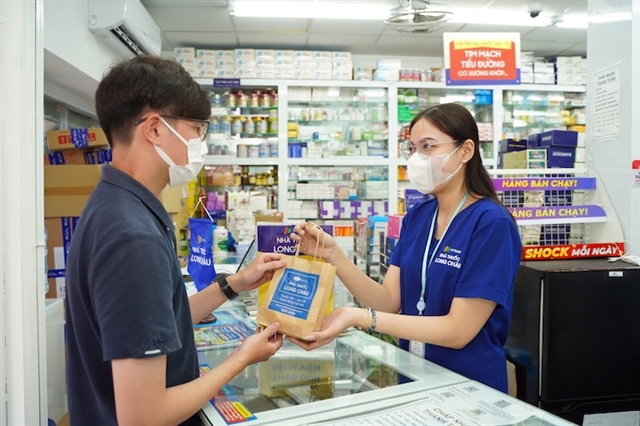
A customer buys medicine at a pharmacy. — Photo doanhnhansaigon.vn |
The Vietnamese pharmaceutical market has maintained a stable growth rate of 6 to 8 per cent per year, according to the Drug Administration of Vietnam (DAV) under the Ministry of Health (MoH).
Total market value is expected to grow from around US$2.7 billion in 2015 to approximately $8 billion by 2026, making Việt Nam one of the fastest-growing pharmaceutical markets in Asia.
Currently, 245 enterprises are engaged in the import and export of medicines and pharmaceutical materials nationwide, as well as related services.
There are nearly 8,000 wholesale drug establishments and over 95,600 retail outlets, including more than 40,500 pharmacies, 54,000 drug stalls and nearly 800 medicine cabinets in commune health stations.
The pharmaceutical distribution network is evenly distributed across regions, ensuring an adequate supply of medicines throughout the country.
Việt Nam now has 67 pharmaceutical and pharmaceutical ingredient exporters, with a total export value of $312 million last year, ranking fourth in Southeast Asia.
Foreign-invested enterprises account for about 75 per cent or $230 million of this export value, while domestic enterprises contribute $82 million. The main export markets are Asia, followed by Europe and Japan.
The capacity for domestic pharmaceutical production has continued to improve. There are currently 243 pharmaceutical factories nationwide that meet GMP-WHO standards, a significant increase from 158 factories in 2015.
Of these, 29 factories meet high standards like GMP-EU and PIC/S-GMP. Domestic production now meets about 60 per cent of the quantity and 46 per cent of the value of drug demand.
Domestic enterprises have successfully produced all 13 essential drug groups classified by the World Health Organization (WHO), supplied 11 out of 12 vaccines in the Expanded Programme on Immunisation and have gradually mastered the production of some biological materials, pharmaceutical raw materials and excipients.
Along with market growth, State management in the pharmaceutical and cosmetics sectors continues to be strengthened through administrative reforms and digital transformation.
The online newspaper Đầu tư (Investment) quoted DAV Director Vũ Tuấn Cường as saying that the MoH reduced the total number of administrative procedures in the pharmaceutical and cosmetics sectors from 124 to 75 last year, a nearly 40 per cent decrease.
This reduction has helped reduce compliance costs and facilitated processes for businesses and citizens.
Along with administrative reforms, digital transformation in the pharmaceutical and cosmetics sectors continues to be promoted.
The MoH currently offers 47 online public services, 37 of which are fully processed public services. Additionally, 24 full-process public services have been integrated into the National Public Service Portal, enhancing transparency and the efficiency of document processing.
Within the past year, the DAV has worked to apply information technology and digital transformation to administrative procedures.
The legal framework for pharmaceuticals has been fully completed, with 100 per cent of the planned legal documents finalised, creating favourable conditions for individuals and organisations participating in pharmaceutical activities.
In 2025, the pharmaceutical industry processed over 40,000 documents related to drug imports, exports and registration for circulation.
Nearly 95 per cent of new drug registration applications were processed on time, with an average processing time reduced to 114.5 days.
As for pharmaceutical industry development, the MoH is implementing two specialised industrial zones.
A 300-hectare pharmaceutical and biotechnology industrial park in Hưng Yên Province is expected to break ground in Q2 this year, and another specialised pharmaceutical industrial park in HCM City is in the process of completing procedures.
Moving into 2026, the pharmaceutical and cosmetics sectors will continue focusing on completing the legal framework and administrative reform linked to increased decentralisation and effective supervision, as well as further advancing the digital transformation.
The ministry will also continue developing the pharmaceutical industry towards self-sufficiency, ensuring a reliable supply of drugs, especially for rare and limited-supply medicines, to better meet the health care needs of the population.
- 09:15 02/01/2026