Việt Nam’s semiconductor surge underscores mounting demand for skilled workers
Việt Nam’s semiconductor surge underscores mounting demand for skilled workers
Việt Nam currently has some 15,000 semiconductor specialists, well below the target of 50,000 by 2030, underscoring an increasingly acute shortage of qualified workers in the sector.
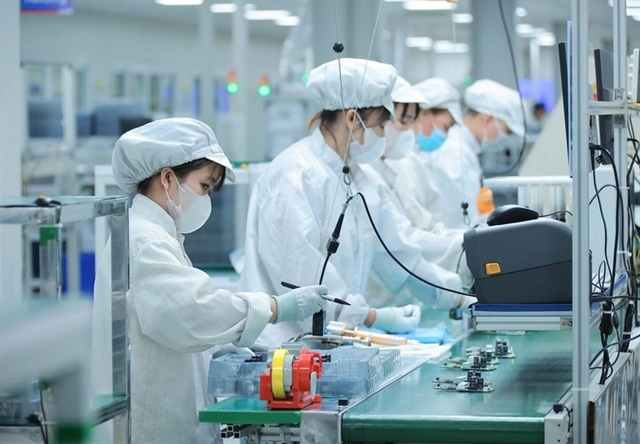
Technicians work in a laboratory as Việt Nam advances a strategy to build a high-quality workforce for its fast-growing semiconductor industry. VNA/VNS Photo |
Việt Nam’s fast-expanding semiconductor industry is running up against a growing talent bottleneck, with a workforce of only about 15,000 specialists nationwide – far short of the 50,000 needed by 2030 – raising concerns that labour shortages could slow the sector’s momentum.
A strong talent pool remains one of the decisive factors drawing global semiconductor giants to Việt Nam. Investors point to political stability, favourable investment policies and, notably, a large cohort of technically capable and fast-learning engineers.
This assessment was echoed by Lê Quang Đạm, PhD, general director of Marvell Vietnam, who highlighted Việt Nam’s advantage in its young engineering workforce with a solid grounding in mathematics and logic.
However, experts caution that this edge could diminish unless training quality improves significantly. Warning signs of a widening manpower deficit have already begun to surface.
According to the national steering committee on semiconductor industry development, Việt Nam is home to roughly 170 foreign direct investment (FDI) projects in semiconductors and high technology, with total registered capital nearing US$11.6 billion. Major investors include Intel ($4.1 billion), Amkor ($1.6 billion) and Hana Micron ($673 million).
Current estimates show around 7,000 engineers working in integrated circuit (IC) design, another 7,000–8,000 in packaging, testing, materials and semiconductor equipment, and about 10,000 technicians across packaging, testing and materials manufacturing. Together with more than 100 overseas Vietnamese experts engaged through the National Innovation Network, Việt Nam’s semiconductor workforce totals around 15,000.
Wan Azmi Bin Wan Hussin, chief operating officer of CT Semiconductor (a member of CT Group), noted that while Việt Nam is positioning itself as an emerging semiconductor hub amid expanding domestic and foreign investment, the country must build a substantial pool of high-quality talent to support this ambition.
A recent World Bank report, Forging Việt Nam’s Semiconductor Future: Talent and Innovation Leading the Way, emphasises that strengthening human capital will give Việt Nam greater flexibility and self-reliance across the semiconductor value chain.
"Investing in tech talent can pay economy-wide dividends, creating tens of thousands of high-paying jobs and boosting other high-tech sectors," the report said.
"A larger, more skilled workforce also enables local firms to move up the value chain and attracts higher-quality foreign direct investment (FDI), creating a virtuous cycle."
A diversified strategy
By 2035, Việt Nam should aim to be recognised as a global semiconductor talent hub, with a self-sustaining pipeline, vibrant domestic chip design houses and the credibility to attract the next wave of investment, the World Bank said.
This vision aligns with the Government’s human resource development programme for the semiconductor industry to 2030, with a long-term outlook to 2050, issued in September 2024. The plan targets training at least 50,000 university-level or higher-qualified workers, alongside establishing four national semiconductor laboratories and 18 institutional labs.
According to Võ Xuân Hoài, PhD, deputy director of the National Innovation Centre (NIC), the proposed shared-use laboratories will be located at Việt Nam National University HCM City, Việt Nam National University Hà Nội, Đà Nẵng and the NIC. The Ministry of Finance has consolidated funding demands and expects implementation to begin in 2026.
However, achieving at least 35,000 skilled workers within the next five years will require closer collaboration among government agencies, universities and enterprises. Effective cooperation mechanisms are needed to ensure training programmes align with industry requirements and enable institutions to adjust strategies in line with global developments.
Kenneth Tse, Intel Vietnam site general manager, stressed the need for STEM programmes that provide students with both fundamental and advanced knowledge, supported by hands-on learning to enable rapid application in real-world scenarios.
From a different angle, Assoc Prof Dr Phạm Tấn Thi of HCM City University of Technology said Việt Nam must prioritise postgraduate training, aiming for at least 100 outstanding engineers and 25 exceptional master’s and doctoral candidates annually. Investments in specialised laboratories for advanced training, research and technology transfer would be equally important, as these high-calibre professionals would drive major projects and national programmes.
One of the sector’s most pressing challenges is the limited number of full-stack semiconductor engineers capable of completing end-to-end chip design, from front-end processes to commercialisation, according to Thi.
Currently, most Vietnamese engineers specialise in a single stage of the design process, mainly back-end work. Expanding training and enabling deeper participation in global supply chains will be essential to upgrade skills.
Prof Konrad Young, former R&D director at TSMC, said that Việt Nam’s talent strategy must consider the breadth of the semiconductor ecosystem rather than concentrating solely on IC design. The industry encompasses dozens of roles ranging from design, manufacturing and process integration to packaging, testing, marketing, operations, legal services, and human resources.
Việt Nam, therefore, would need a workforce with broad and diverse expertise, he stressed. Addressing the semiconductor talent shortfall would require an applied engineering mindset that equips workers to fill every position across the value chain.
- 10:35 03/01/2026