Fertiliser makers seen benefiting from stable urea prices, lower oil costs in 2026
Fertiliser makers seen benefiting from stable urea prices, lower oil costs in 2026
Analysts expect prices to stabilise throughout 2026, keeping the average selling price in line with 2025 levels.
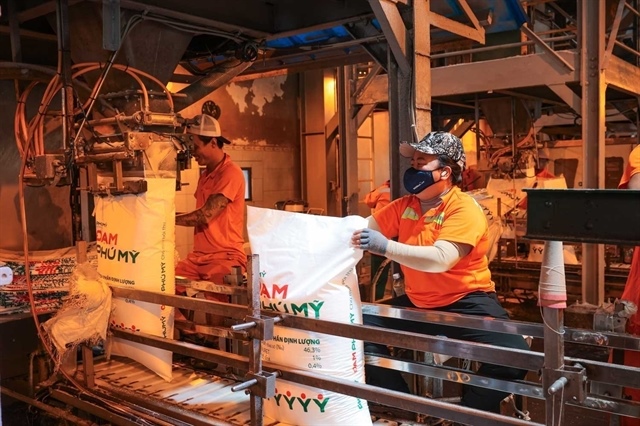
Fertiliser being packed at a DPM factory. — VNA/VNS Photo Hoàng Hiếu |
Việt Nam’s fertiliser producers are expected to post stronger profits in 2026 as stable urea prices, lower oil costs and tax changes allowing input value-added tax deductions support margins, according to an industry outlook from SSI.
In its fertiliser sector report released recently, SSI said urea prices are projected to remain broadly unchanged in 2026 compared with 2025, while lower production costs are likely to support margins.
Urea prices rose 17 per cent year-on-year in 2025, driven by higher natural gas prices in Europe, temporary supply disruptions in the Middle East and export restrictions from China during the first half of the year, SSI said. Prices came under pressure from the third quarter as European gas prices retreated.
Analysts expect prices to stabilise throughout 2026, keeping the average selling price in line with 2025 levels, the report said.
On the cost side, Brent crude oil prices are forecast to fluctuate between US$55 and $65 per barrel in 2026, representing a 6 per cent to 20 per cent decline from a year earlier, according to SSI estimates.
In addition, changes to Việt Nam’s tax policy are expected to further lift profits. From July 2025, fertiliser products were moved from a tax-exempt category to a 5 per cent value-added tax bracket, enabling manufacturers to deduct input VAT.
SSI estimates that PetroVietnam Fertilizer and Chemicals Corporation-JSC (HoSE: DPM) and PetroVietnam Ca Mau Fertilizer Joint Stock Company (HoSE: DCM) could save about VNĐ400 billion (over $15.2 million) and VNĐ200 billion (over $7.6 million) respectively, through VAT deductions. The savings are equivalent to around 60 per cent and 13 per cent of the companies’ pre-tax profits in 2024.
The ability to deduct VAT for the full year in 2026, compared with only half of 2025, combined with lower input gas costs, is expected to drive profit growth for both companies, SSI said.
Diversified fertiliser firms face steadier profits
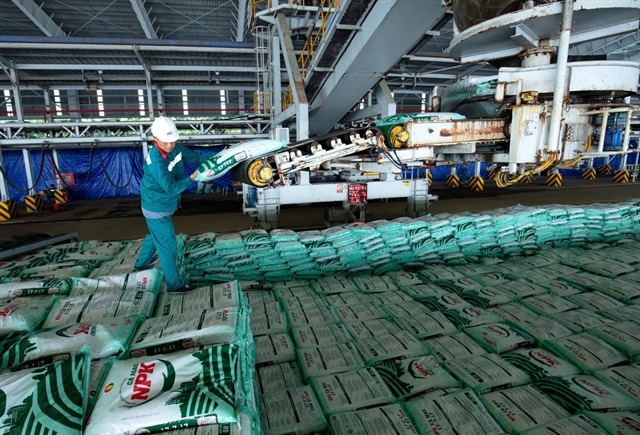
Fertiliser being packed at a DPM factory. — VNA/VNS Photo Hoàng Hiếu |
Meanwhile, MB Securities JSC (MBS) said that fertiliser companies with diversified product portfolios are expected to have more stable profit prospects in 2026.
It said urea prices are likely to trade in a similar range to 2025, with a base-case estimate of $400-$450 per tonne, supported by ample global supply from the Middle East, Latin America and Russia, alongside a modest recovery in demand from South and Southeast Asia and South America.
Domestic urea prices generally track global benchmarks, particularly Middle Eastern and Chinese prices, though adjustments tend to lag due to inventory levels and seasonal factors, MBS said. Việt Nam’s winter-spring crop cycle also differs from that of other major markets.
MBS forecasts domestic fertiliser consumption will rise 2 per cent in 2026 to about 10.7 million tonnes. Exports are expected to remain strong, supported by steady global prices and demand from India and Brazil, with volumes estimated at 1.8 million tonnes, or 14.3 per cent of domestic production.
In the first half of 2026, major urea producers including DPM and Habac Nitrogenous Fertilizer & Chemicals JSC (UPCoM: DHB) are expected to maintain stable revenue amid steady demand, although higher input gas costs could weigh on net profit.
By contrast, NPK producers such as Lam Thao Fertilizers and Chemicals JSC (HNX: LAS) and Binh Dien Fertilizer JSC (HoSE: BFC) are expected to see more stable earnings due to lower sensitivity to gas price fluctuations.
Overall, MBS expects modest profit growth across the sector in 2026, supported by favourable market conditions, but warned that sharp swings in gas prices would most significantly affect the earnings of DPM and DHB. DCM would also be impacted, though diversification into organic fertilisers is expected to help limit the downside, the brokerage said.
- 08:34 22/01/2026