Transparency and product quality help protect consumer rights
Transparency and product quality help protect consumer rights
Growing demand for transparency and higher product quality is reshaping the domestic market, making product traceability a fundamental safeguard for consumer rights, according to Government representatives.
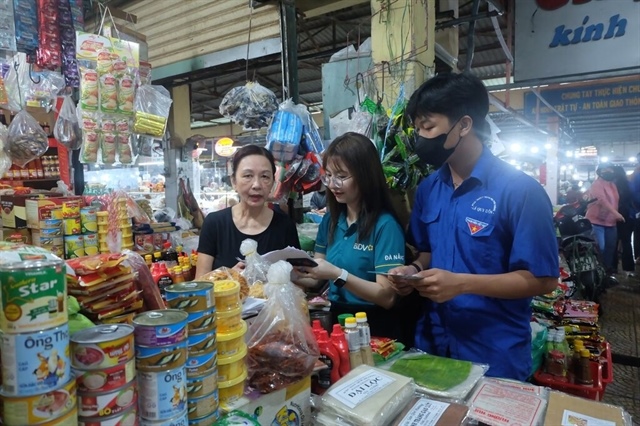
Two members of the Ho Chi Minh Communist Youth Union help shopkeepers at a local market set up QR code tracing electronic systems at a local market in Đà Nẵng City. —VNA/VNS Photo Văn Dũng |
Growing demand for transparency and higher product quality is reshaping the domestic market, making product traceability a fundamental safeguard for consumer rights.
Government representatives said that this shift aligns with the Politburo's Resolution 57-NQ/TW on accelerating scientific and technological breakthroughs, innovation and digital transformation.
According to Nguyễn Đức Lê of the Domestic Market Management and Development Agency, effective consumer protection begins with verifying the true origin of goods and determining whether products are counterfeit or infringe intellectual property rights.
He noted that new technologies, such as AI, big data and IoT, now allow authorities to detect violations at a much earlier stage, even at the point where businesses register or begin production. This proactive model reduces dependence on consumer complaints once products are already circulating and supports the transition from pre-market inspections to post-market supervision, a shift that grants businesses greater autonomy while decreasing potential risks for buyers.
Associate Professor Dr Chu Hoàng Hà of the Vietnam Academy of Science and Technology highlighted that strategic technologies — including semiconductor chips, IoT, blockchain, big data and AI — can form the backbone of a modern, secure and interconnected national traceability ecosystem.
However, he emphasised that technological capacity alone is insufficient. A legal framework, strong coordination between ministries and local governments and clear compatibility standards are essential for an effective system.
From the perspective of industry implementation, Chairman of the Vietnam Blockchain and Digital Assets Association Phan Đức Trung underscored the importance of developing a trusted national infrastructure, citing the Electronic Authentication Stamp Database and Việt Nam’s Multi-Chain Blockchain Service Network.
He said that these platforms will support authentication, standardisation and pilot applications that move the country toward a unified traceability model.
Checkee Technology CEO Phạm Văn Quân agreed, arguing that genuine traceability goes far beyond the simple use of QR codes or chips. A credible system requires standardised data and product identifiers, transparent databases linked to IoT devices, robust verification mechanisms and full adherence to legal and technical standards.
Both regulators and consumers must be able to access and independently verify all relevant product information, he said.
The Ministry of Agriculture and Environment plans to prioritise the development of technical regulations and sector-specific databases, which will be linked with the National Barcode Centre. Technology firms will provide digital platforms and tools, while producers and farmers will take responsibility for regularly updating product data.
Nguyễn Bảo Trung from the Ministry of Agriculture and Environment added that traceability is essential not only for export goods, but also for domestic consumption and for protecting legitimate producers from counterfeit products.
Technologies like AI and blockchain offer significant advantages in transparency and data integrity. Yet he also acknowledged the practical challenges Việt Nam faces, particularly the fragmented nature of small-scale production and the substantial cost of maintaining accurate databases for individual farmers, co-operatives and small enterprises.
Experts argue that a comprehensive national traceability system would allow authorities to verify product origins, ensure regulatory compliance and offer consumers reliable information before purchase.
Despite ongoing efforts, Việt Nam still lacks unified standards and an integrated national database, leaving current systems fragmented and significantly limiting their effectiveness.
Nevertheless, Trung noted that sectoral databases maintained by Government agencies are gradually being completed. This progress will enable officials to verify business-submitted data, which he said is crucial.
Only when information is validated by State authorities can traceability truly add value and contribute to improving product quality, he noted.
A draft Decree on identification, authentication and product traceability is under development to formalise this framework and support Việt Nam’s transition to a more transparent, technology-driven market environment.
- 07:38 02/12/2025