Ministry of Industry and Trade reviews fuel supply plan with Petrolimex
Ministry of Industry and Trade reviews fuel supply plan with Petrolimex
As one of the sector’s largest enterprises, Petrolimex was assigned a higher quota than other companies, with a total allocation of 11.939 million cubic metres/tonnes. After adjustments, the group is expected to supply about 11.2 million tonnes in 2025, equivalent to 105 per cent of its assigned minimum quota.
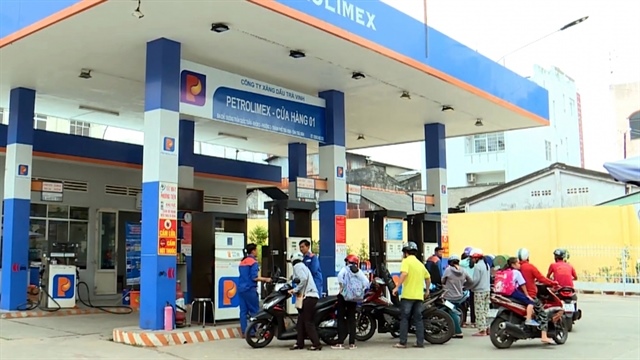
Residents top up their motorbikes at a fuel station in Hà Nội. — VGP Photo |
The Ministry of Industry and Trade (MoIT), led by Deputy Minister Nguyễn Sinh Nhật Tân, on Friday held a working session with the Việt Nam National Petroleum Group (Petrolimex) to review 2025 fuel supply and plans for 2026.
Nguyễn Thuý Hiền, Deputy Director of the Domestic Market Management and Development Department, told the meeting that in 2025 the ministry allocated a national fuel supply of 28.6 million cubic metres/tonnes, an increase of 2.13 per cent compared with 2024.
As one of the sector’s largest enterprises, Petrolimex was assigned a higher quota than other companies, with a total allocation of 11.939 million cubic metres/tonnes. After adjustments, the group is expected to supply about 11.2 million tonnes in 2025, equivalent to 105 per cent of its assigned quota.
For 2026, Petrolimex has registered a total supply of 10.997 million cubic metres/tonnes. The ministry said allocations would be based on overall national demand and enterprises’ performance in the previous year, with quotas broken down by product.
Providing further details on early supply preparations, Deputy General Director Nguyễn Xuân Hùng said Petrolimex began negotiating long-term supply contracts for 2026 with domestic and international suppliers from late 2025.
Under these contracts, the group has secured about 8.6 million cubic metres/tonnes, including 7.3 million cubic metres/tonnes from the Dung Quất and Nghi Sơn refineries and about 1.4 million cubic metres/tonnes through imports.
Fuel demand during the Tết (Lunar New Year) period in January 2026 is projected at more than 1.1 million cubic metres/tonnes. Since December 2025, Petrolimex has prepared supply plans and negotiated January contracts totalling around 784,000 cubic metres/tonnes. To date, nearly 1 million cubic metres/tonnes has been secured, meeting about 90 per cent of expected demand.
Demand in February 2026 is forecast at more than 700,000 cubic metres/tonnes. With supplies from long-term domestic and import contracts, the group said it would fully meet demand for the month.
Biofuel roadmap
On the biofuel roadmap, Deputy General Director Nguyễn Văn Sự said Petrolimex currently operates eight biofuel blending depots in key regions nationwide.
In preparation for the Government’s plan from June 1, 2026, the group has reviewed and upgraded infrastructure to serve the blending and trading of E5 and E10 gasoline, with projected capacity of about 455,000 cubic metres per month.
Petrolimex operates more than 2,800 fuel stations nationwide. To deploy E5 and E10 gasoline uniformly, the group will clean storage tanks, complete technical upgrades at stations, and update quality management systems to ensure products meet current technical standards.
From August 1, 2025, Petrolimex became the first enterprise to sell E10 gasoline at 36 stations operated by Petrolimex Saigon in HCM City, with monthly sales of 1,500–1,600 cubic metres. From September 1, 2025, pilot E10 sales were launched at three stations in Quảng Ngãi Province, with volumes of 300–400 cubic metres per month. Sales have since increased, reflecting growing consumer acceptance of biofuels.
The group also asked for support on fuel transport permits during Tết, guidance on allocating quotas for mineral gasoline and biofuels, revisions to technical standards for E10 gasoline, and tax incentives for biofuel products.
Tân said the ministry would remain flexible in allocating and adjusting supply quotas to balance business plans with national requirements. On pricing and cost declarations, he added that enterprises may calculate costs based on their own conditions, provided they comply fully with pricing regulations, and that the ministry would not impose rigid formulas. He also stressed the need to strengthen digital transformation in fuel management, measurement and quality control.
- 15:51 26/12/2025