Hanoi symposium highlights gender equality research and policy
Hanoi symposium highlights gender equality research and policy
An international scientific conference on gender equality and female empowerment was held in Hanoi, bringing together Vietnamese and international experts.
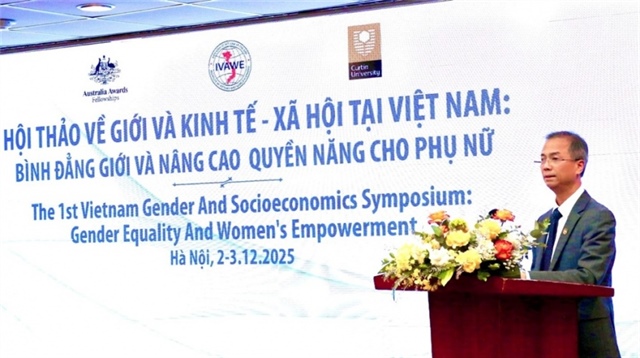
Dang Xuan Thanh, vice president of VASS |
Taking place on December 2–3, the event was organised by the Vietnam Institute of Economics and the World under the Vietnam Academy of Social Sciences (VASS), in collaboration with Australia’s Curtin University. It attracted more than 100 experts, researchers, university lecturers and policymakers from Vietnam and abroad, marking a significant step forward for gender-focused research and international cooperation in the country.
Delivering the opening remarks, Dang Xuan Thanh, vice president of VASS, noted that gender is not merely one aspect of development but a prerequisite for achieving the United Nations Sustainable Development Goals. Vietnam has made significant progress in narrowing gender gaps across fields such as education and healthcare. However, new challenges posed by globalisation and digital transformation require fresh approaches.
Thanh suggested that digital transformation could offer tremendous opportunities to empower women through improved access to information, online learning, and digital business platforms. “On the other hand, it may exacerbate the digital divide, especially for women in rural, remote, and disadvantaged areas. Likewise, the green energy transition is generating millions of new jobs, but opportunities remain uneven between men and women due to barriers in vocational training and persistent gender stereotypes,” he added.
Thanh raised a central question for the symposium, asking how women can move beyond being mere observers to become active participants, leaders and equal beneficiaries in ongoing transformation processes. This question became the central thread throughout the discussions and policy dialogues during the two-day symposium. He also called on stakeholders to share fundamental issues that could lay the groundwork for long-term cooperation in gender research.
The discussions in Plenary Session 1, 'Gender issues and family policy', presented by Assoc. Prof. Dr. Christine Ho from Singapore Management University, and plenary session 2, 'Climate Finance and Gender Equality', presented by Assoc. Prof. Dr. Pham Thu Phuong from Australia’s Curtin University clarified the role of climate finance in promoting women’s economic empowerment. The speakers also analysed the relationship between family policies, caregiving responsibilities, and gender equality, highlighting emerging family models and their direct impact on women’s career opportunities.
With 28 in-person presentations and five scientific posters, divided into two parallel sessions covering eight diverse thematic groups, the symposium reflected the multidimensional nature of gender issues. Experts and scholars contributed insights on key themes such as gender equality and women’s empowerment; women in digital transformation and the digital economy; sustainable development and gender equality; social protection and support programmes; gender-based violence; and gender-responsive policies.
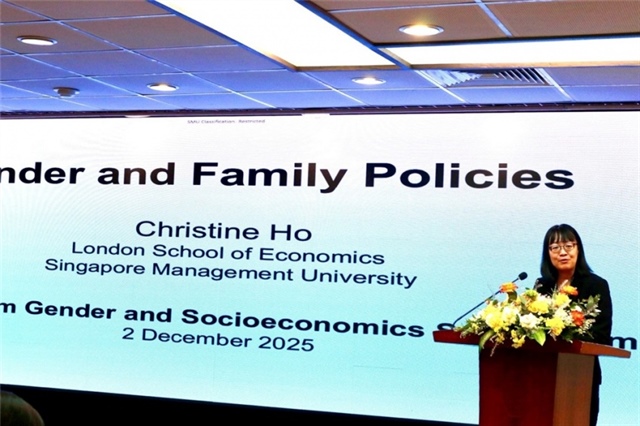
Prof. Dr. Christine Ho, Singapore Management University |
On December 3, two policy dialogues took place, marking a transition from academic exchange to practical policy application. These sessions provided a platform for researchers, policymakers, and development organisations to discuss ways to translate research findings into actionable policies.
In policy dialogue 1, on measuring and evaluating gender equality, participants discussed three main priorities: developing a comprehensive indicator system adapted to Vietnam’s context, sharing lessons from international evaluation models, and addressing the urgent need for sex-disaggregated data across all sectors to support policymaking. Experts agreed that without reliable data, policymakers cannot accurately assess conditions or measure the effectiveness of gender-related programmes.
In policy dialogue 2, on fostering gender equality policies and inclusive development in Vietnam, presentations centred on five key areas. These included mainstreaming gender equality in socioeconomic strategies from the design stage through strong political commitment and inter-sectoral coordination; improving access to high-quality, affordable childcare, eldercare and disability services to reduce women’s unpaid care burden; upskilling women workers, particularly in digital and green sectors as automation expands; supporting women entrepreneurs through better access to finance, technology and markets via preferential credit, mentoring and administrative reforms; and strengthening protection for vulnerable groups through targeted interventions.
The symposium created a multidimensional platform linking academic research, practical experience and political commitment. Through plenary sessions with international experts, thematic parallel discussions and policy dialogues, it moved beyond knowledge sharing towards turning research into practical action.
It provided updated, evidence-based insights to inform improvements in Vietnam’s gender equality policies at a time of both challenges and opportunities. Research findings clarified emerging gender issues while proposing feasible responses to pressures such as digital transformation, the energy transition, climate change and unequal access to resources.
The event also strengthened national, regional and international research networks, laying a solid foundation for long-term academic cooperation.
Policy recommendations from the symposium will be consolidated and submitted to relevant state agencies, supporting the development and refinement of national gender policies. The outcomes highlight the commitment of VASS and its international partners to advancing gender research and evidence-based policymaking, contributing to a more inclusive and sustainable society where women and men have equal opportunities to reach their full potential.
- 12:00 03/12/2025