Sustainability efforts on right track through policy and tech
Sustainability efforts on right track through policy and tech
Vietnam’s sustainable development landscape is evolving faster than ever as the government is accelerating the push to green growth through a range of policies, while companies are incorporating technology into strategies to fast-track their progress.
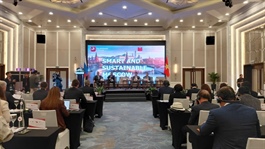
At VIR’s Sustainable Development 2025 Conference in Hanoi last week, policymakers and business leaders committed to strengthening partnerships, initiatives, and dialogue to advance a shared vision for a green, sustainable, and resilient Vietnam.
|
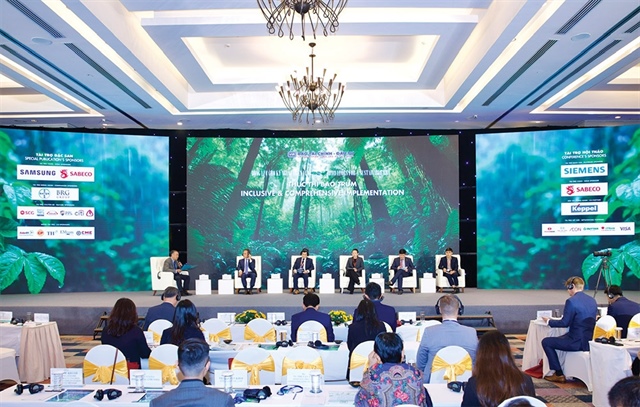
Addressing the event, Deputy Minister of Finance Nguyen Duc Tam said Vietnam has undertaken sweeping strategic changes to adapt to reality.
“The government is stepping up efforts to promote new growth models, with a focus on the private sector, innovation, science, and technology,” Tam said. “This is coupled with driving profound transformative shifts through landmark resolutions to stimulate economic development and achieve double-digit growth in the years ahead.”
The Ministry of Finance and relevant ministries are refining the financial legal framework to create stronger momentum for the private sector, Tam added.
“We are implementing tax incentives, priority credit, and an innovation support fund, while also researching the public-private partnership scheme for digital infrastructure and renewable energy ventures. The measures will foster investment, spur innovation, and strengthen business participation in the twin digital and green transformation,” he said.
In addition, the ministry continues to advance the development of green finance market, carbon market, and related financial instruments. By 2030, Vietnam plans to develop an efficient domestic carbon market connected with regional and global markets. This will pave the way for Vietnamese enterprises to penetrate the global green supply chains and access domestic and international financial resources.
Bridging the gap
In the same vein, Ta Duc Binh, a specialist at the Institute of Strategy and Policy on Agriculture and Environmentunder the Ministry of Agriculture and Environment, said Vietnam’s current vision for technology, the private sector, human resources, and finance are now more clearly defined in the country’s long-term strategy.
“Meanwhile, a clear trend is emerging – institutions guiding the direction, businesses accompanying the process, and technology leading the way,” Binh said.
He further noted that good policies alone are not enough, as inter-sectoral coordination is essential to drive the development of a green economy.
“Key economic sectors do not operate independently but are connected through capital, investment, technology, and policy.” Binh added. “For example, scaling electric vehicles without greening power ecosystems increases emissions and retains reliance on imported fossil fuels while straining load management of the grid. Technology is an important link to bridge the gap between policy formulation and implementation.”
Vu Thai Truong, head of the Climate Change, Energy, and Environment Unit at the United Nations Development Programme in Vietnam, commented that the country’s policies are gradually approaching international standards.
“Vietnam is on the right track by issuing policies on environmental protection, the circular economy, and green classification. The country has taken progressive steps in line with global trends,” Truong said.
However, the gap between policy and reality remains a challenge in achieving sustainability. Companies, especially small and medium-sized ones, face limitations in applying technologies and techniques to meet environmental standards, Truong said. They also lack access to relevant data and applications for implementing circular economy practices. This is compounded with a limited financial resource to invest in green technologies and human capital.
“Vietnam should have proper supporting tools such as training guidelines, green finance mechanisms, and data standardisation to enable transparent and open data sharing. We are collaborating with the regulatory bodies to conduct research and assessments that provide inputs for improving policies. The most important thing is not about speed, but it’s about managing the transition,” Truong explained.
Taking action now
As policies are in place to catalyse the green transition, the private sector has a vital role to play in supporting the government in achieving enduring growth. The opportunity for private companies to accelerate the trajectory is ample. By putting sustainability at the cornerstone of businesses, companies are leading the changes in this critical arena, underscoring the importance of collaborative action to unlock Vietnam’s green growth agenda.
DUYTAN Recycling is operating Vietnam’s first plastics recycling factory with the mission of creating a new lifecycle for plastics in line with the circular economy principles. The company has achieved steady growth amid rising demand for recycled plastics and government policies promoting environmentally friendly products among businesses.
Le Anh, sustainability director at DUYTAN Recycling, has seen the clear shift in businesses’ approach.
“Five years ago, sustainability initiatives were mostly voluntary, primarily undertaken by multinational corporations following their corporate policies. Recently, supportive policies have encouraged domestic businesses to participate more actively and responsibly for the sake of environmental protection,” Anh said.
Indeed, the company has overcome its own challenges to develop a plastic recycling business in Vietnam.
“In the early years, we mainly exported our products to the EU and the US, as recycled plastics were 1–3 times more expensive than conventional ones. Over time, we have reduced the export share to 70 per cent as the local market began to take off. Our domestic output has risen eightfold, from 2,000 tonnes in 2021 to 16,000 tonnes in 2025, reflecting growing local demand,” Anh noted.
Likewise, CME Solar Investment is funding renewable energy with a focus on rooftop solar power. The company has partnered with multiple companies to develop rooftop solar power systems on factories, warehouses, shopping malls, logistics centres, and other facilities in operation.
Bui Trung Kien, vice chairman of the Board at CME Solar, said the company has installed nearly 160MW of rooftop solar power in the country. CME’s model features a 100 per cent investment alongside collaboration with partners to carry out design, installation, operation, and maintenance. Thus, companies can use energy at a lower cost, resulting in lower overall energy expenses.
“Many businesses have proactively invested in rooftop solar power to use clean energy and protect the environment,” Kien said. “Regulations have been issued to resolve difficulties for businesses in the industry. Meanwhile, digital transformation, streamlined administrative procedures, and a clearer, more consistent legal framework have created strong momentum for businesses to move forward.”
Meanwhile, Japan’s largest retailer AEON is unlocking Vietnam’s potential as a regional hub for the production and distribution of sustainable goods. Between now and 2030, the retailer aims to aggressively expand its shopping mall network, improve retail capacity, and increase sales by 3-5 times. To facilitate the goal, the company is building a domestic supply chain with the growing participation of local suppliers.
“We view sustainability as a core value of the modern retail model. From operating energy-efficient smart buildings and optimising customer data to building resilient supply chains, every strategy is aimed at a single goal: providing high-quality products at reasonable prices while minimising environmental impact,” said Nguyen Thi Ngoc Hue, senior general manager of People and Brand Strategy as well as Corporate and Supplier Quality Management at AEON Vietnam.
AEON pays attention to fostering sustainable consumption habits among customers, from eco-friendly products to community activities. “This is how AEON turns green standards, which were once seen as international pressures, into a source of innovation for Vietnamese manufacturers,” Hue added.
- 12:05 03/12/2025