Foreign fruits flood Vietnamese market
Foreign fruits flood Vietnamese market
Benefiting from tariff advantages under various free trade agreements, imported fruits from the United States, Australia, and New Zealand are pouring into Vietnam, making the market more vibrant but also increasing competitive pressure on domestic fruit products.
|
China remains the largest supplier, with a turnover of $772.76 million, accounting for 35.8 per cent of total market share. The United States ranks second, with import value rising 37.5 per cent to $460.64 million, while Australia and New Zealand both recorded steady growth with a market share of 5-6 per cent.
Dang Phuc Nguyen, general secretary of the Vietnam Fruit and Vegetable Association, said free trade agreements are allowing many imported fruits to enter Vietnam with low or zero tariffs if they meet origin rules. Under the ASEAN-Australia-New Zealand free trade agreement (FTA), most fruits from Australia and New Zealand are completely duty-free, giving them a clear advantage over local produce.
“Since the end of March, US apples, grapes, and cherries have enjoyed tariff cuts to around 3 per cent, driving strong sales, especially cherries,” Nguyen said.
He predicted that if commitments in the Vietnam-US joint statement take effect in 2026, bilateral fruit and vegetable trade could reach $2 billion.
At the forefront
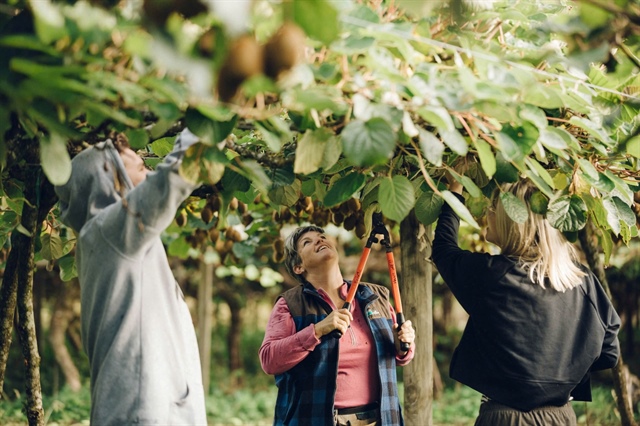
New Zealand’s agricultural exporters are accelerating their expansion in Vietnam, supported by the strong performance of apples, kiwifruit, and cherries. In 2024, New Zealand’s agricultural exports to Vietnam reached $172 million, with apples contributing $126 million, kiwifruit $30 million, and cherries $10 million, making Vietnam its second-largest apple market after China.
The two countries strengthened cooperation in February with 16 business agreements worth $130 million, aimed at lifting bilateral trade to $3 billion by 2026, paving the way for more high-quality New Zealand produce to enter Vietnam.
According to Liz Bell, CEO of the ASEAN-New Zealand Business Council, “Vietnam is the fastest-growing market for New Zealand exporters. The uncertainties from global tariff policies, particularly following new US tariff measures, have further opened up significant opportunities for New Zealand businesses to expand their presence in Vietnam.”
Beyond apples, kiwifruit, and cherries, New Zealand is also promoting pears, avocados, and summer fruits. Under current bilateral trade agreements, several items, including passion fruit, persimmons, apricots, and blueberries, enter Vietnam at zero per cent tariffs, giving them a notable advantage.
Australian fruit is also performing strongly with imports from Australia exceeded $140 million in the first 10 months of 2025, up 27 per cent on-year, according to Vietnam’s Customs Department. Australia ships a wide range of fruits to Vietnam, including peaches, nectarines, plums, cherries, oranges, mandarins, and table grapes.
Over the past five years, Australian fruit exports to Vietnam have held steady and are now rising following new market access granted in 2022 for peaches and nectarines and in 2024 for plums. Between 2020-2021 and 2024-2025, Australia’s total export value grew from $47.32 million to $57.59 million, with grapes and mandarins remaining top sellers.
|

Emma McDonald, senior trade and investment commissioner to Vietnam, noted that Australia's geographic proximity, short shipping times, and counter-seasonal supply offer clear advantages, particularly for fresh fruit.
“As income levels and digital access rise across both rural and urban areas, more consumers are willing to pay for natural, organic, and premium Australian products,” she said.
McDonald forecast that by 2035, more than half of Vietnam's population will be part of the global middle class. This rising purchasing power, coupled with growing awareness of health, nutrition, and food safety, positions Vietnam as an important growth market for Australian produce.
Grapes, peaches, nectarines, plums, oranges, and cherries are already performing well, while upcoming market access for Australian blueberries is expected to further strengthen Australia's presence, especially given the ability to deliver berries within 24 hours of harvest.
“Despite strong competition from major suppliers such as China, Thailand, and the US, Australia retains a solid position thanks to premium quality, strict food safety standards, and counter-seasonal supply. Vietnam's fast-rising demand continues to create opportunities, enabling Australia to compete effectively while fostering a more balanced, long-term agricultural partnership,” she added.
According to data from the Department of Customs, in October, imports of oranges, tangerines, strawberries, cherries, kiwis, and blueberries into Vietnam rose 10-100 per cent on-year, highlighting the continued strong demand for imported fruits. For the full year 2025, imported fruits and vegetables are projected to exceed $2.5 billion in value, with a total volume of over 1 million tonnes.
- 13:22 09/12/2025