Experts discuss measures to escape processing trap
Experts discuss measures to escape processing trap
According to economists and industry insiders, the majority of domestic enterprises remain positioned at the bottom of the value curve.
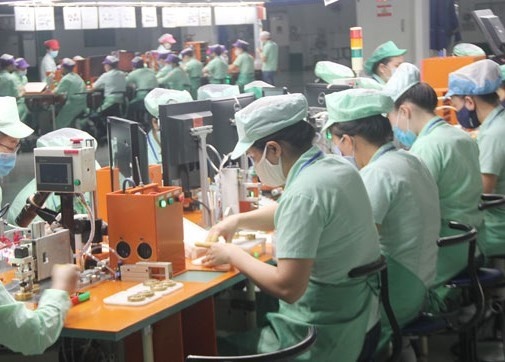
Workers at a factory in Đà Nẵng City. — VNA/VNS Photo |
Localisation rates in many key industries remain low, with textiles and footwear at around 45–50 per cent, mechanical engineering at 15–20 per cent, and automobile assembly at just 5–20 per cent, well below the 40 per cent localisation target, recent statistics from the Ministry of Industry and Trade showed.
This poses an urgent requirement to find solutions to upgrade the position of Vietnamese enterprises, enabling them to escape the “processing trap” and participate more deeply in stages that generate higher value added, said economists and industry insiders.
Explaining why Vietnamese enterprises remain seemingly stuck in low localisation, Dr Lê Duy Bình, Director of Economica Việt Nam, said the core cause lies in internal constraints, particularly limited scale and financial capacity. Most enterprises are small- and medium-sized, with thin capital bases, while investment in technological innovation, research and development (R&D), or brand building requires substantial resources and long-term horizons.
Slow changes in production thinking and development models also pose a significant barrier. Many enterprises remain accustomed to order-based production, heavily dependent on foreign partners for designs, technical standards and even markets. A short-term mindset that prioritises immediate revenue over long-term strategy has limited investment in creativity, product design and brand development, which are essential to moving beyond the role of a processor.
According to Dr Võ Trí Thành, Director of the Institute for Brand and Competitiveness Strategy Research, another important factor is the weakness and lack of synchronisation in Việt Nam’s supporting industries. Domestic enterprises struggle to secure stable sources of raw materials and components, particularly those with high technological content. Heavy reliance on imports not only reduces localisation rates but also makes it difficult to upgrade positions in the value chain, as core stages are effectively “locked in” by external suppliers.
Although policies and the institutional environment have improved, bottlenecks persist. Mechanisms to encourage innovation, support supporting industries and protect intellectual property rights remain insufficient to incentivise long-term investment. Meanwhile, for many years, policies to attract foreign direct investment (FDI) have focused more on quantity, cost advantages and labour incentives, while requirements for technology transfer and substantive linkages with domestic enterprises have been limited.
Processing trap
According to experts, the dominance of processing activities has produced negative consequences at both micro and macro levels. Prolonged reliance on processing leads to low value added and weak accumulation capacity. When enterprises mainly undertake assembly and finishing based on orders, they capture only a small share of profits in the global value chain.
As labour costs continue to rise and environmental and labour standards become stricter, Việt Nam’s cost-based competitive advantage is gradually eroding. Enterprises that remain stuck in processing face the risk of being excluded from global supply chains as multinational corporations shift orders to markets with lower costs or higher technological capabilities.
At the macro level, the processing trap raises the risk of growth that is rapid but not sustainable. Export volumes and values increase, yet the value retained domestically remains limited. The economy continues to rely heavily on cheap labour and resource exploitation, while growth driven by innovation and productivity gains has yet to take firm shape. Dependence on the FDI sector is also reinforced, as foreign-invested enterprises continue to dominate major export industries, limiting economic autonomy and the spillover of technology and know-how to domestic firms.
Overall, the processing trap is not merely a challenge for individual enterprises but a major obstacle to rapid and sustainable economic development. If left unresolved, it will continue to undermine the long-term competitiveness of both Vietnamese enterprises and the broader economy.
To escape this trap, experts stress that enterprises must change their mindset and development strategies. Processing should not be viewed as a long-term destination but as a stepping stone in participating in the global value chain. Enterprises need clear upgrading strategies to move gradually from assembly and processing to higher value-added stages such as design, product development and brand building.
Alongside enterprise-level efforts, the State’s role is crucial. Stronger policies are needed to support technological innovation, develop supporting industries, and form industry clusters linked to R&D centres.
Developing high-quality human resources is also a prerequisite for escaping the processing trap. Training engineers, designers and management specialists must be closely aligned with enterprise needs, while deeper capital markets and financial instruments for innovation, including venture capital funds and long-term preferential credit, will help enterprises invest in R&D and product development.
- 08:56 29/12/2025